The short answer
In an aging tank, pH tends to slide as waste builds up and the buffer (KH) is used up. Filter bacteria release acid as they process waste, carbon dioxide from fish, plants or a CO2 system lowers pH, and tannins from wood or peat can push pH lower in soft water. Test pH, KH and source water side by side.
This guide covers freshwater tanks whose pH falls week by week. If your question is why the water is acidic, the causes below are the same ones; Aqueon, an aquarium equipment maker, describes the pH scale “with 0 to 7 considered acidic”. To raise a low reading now, see our guide to low aquarium pH and safe ways to raise it.
Why KH Decides How Far pH Falls
API, a maker of test kits and water treatments, says: “An aquarium with a low KH level will tend to be acidic. Aquariums with very low KH are subject to rapid pH shifts if not monitored carefully.” Aquarium Co-Op, an aquarium retailer, explains that “KH helps neutralize acids and prevents your pH from changing too rapidly”, and compares KH to a trash can: “If we overflow that trash can, then a pH crash occurs.”
Tetra, a maker of water treatments, adds that “the pH value is influenced by both KH and carbon dioxide (CO2) levels”. The 2Hr Aquarist, a planted-aquarium retailer, describes CO2 injection as a case “which acidifies the water and lowers the pH, but does not change the carbonate hardness (KH) of the water”.
So two kinds of things pull pH down: acids that use KH up, and carbon dioxide, which lowers pH without using KH up. A KH test helps tell them apart (our reading). Our guide to what KH is and how it buffers pH explains the chemistry.
What Keeps Pulling the pH Down
Acid from the filter’s bacteria
The bacteria that turn fish waste into nitrate make acid as they work. Practical Fishkeeping, a fishkeeping magazine, in an article by Nathan Hill, says: “Biological bacteria, as they work, produce quantities of hydrogen ions.” It adds that “with a busy filter churning the stuff out, pH levels can soon plummet”.
aquariumscience.org, a hobbyist reference site, sees the same during cycling: “Many hobbyists note a significant drop in pH, like 7.4 to 6.0, during cycling.” It calls the effect “often surprisingly rapid”, but adds: “And you must have a low pH, and low KH water to see the drop.” Our guide to cycling a fish tank covers the nitrogen cycle itself.
Waste and rotting leaves using up KH
Aqueon explains the slow version: “There is a natural tendency for pH to gradually drop in an aging aquarium as organic waste accumulates and mineral buffers are depleted.” Practical Fishkeeping points at the gravel, “All of the ‘hidden’ waste down amongst the substrate will gobble up carbonates”, and at plants kept poorly, whose old leaves “start to rot”, “meaning more carbonate depletion and more nitrates”.
Water changes put buffer back. Aqueon says partial changes “replenish minerals that naturally buffer pH”. The reverse also holds: Aquarium Co-Op’s gentle way to lower pH on purpose is “letting the tank acidify over time by managing minimal water changes”. A routine that slips can do the same by accident (our reading). Our guide to how often to change fish tank water covers the routine.
Old tank syndrome: when the buffer runs out
Practical Fishkeeping describes old tank syndrome as a problem of established tanks: “Tanks that have been running successfully for months or years may slowly turn bad, or they might suddenly crash altogether”. It says “Carbonates play a vital role in buffering aquarium pH”, and that without them “pH in the tank can drop or swing wildly”.
aquariumscience.org gives a stricter definition. Old tank syndrome “is defined as a high ammonia, high nitrate, low pH and low KH situation”. Its chain:
- The keeper “either does no water changes, does too few water changes, over feeds, and/or does too small of water changes.”
- “The ammonia oxidation cycle produces acid which forces the carbonate out of the water as carbon dioxide and the KH drops, often down to zero.”
- “If the water doesn’t have a high KH (buffering capacity) the pH can go down to 6.5 or lower”.
- Below 6.5, the site says, the ammonia-oxidizing bacteria cannot work effectively. “The ammonia then rapidly rises, often well over 8 ppm.” It adds that “in a long established aquarium there can be a type of organism called archaea which can oxidize ammonia at low pH’s”, so the 6.5 line is not a fixed rule for older tanks.
Practical Fishkeeping puts the stall point lower: the bacteria “struggle to function” in acidic water “and below 6.0pH they might stop working altogether”. aquariumscience.org adds that the syndrome “can also occur with a very new tank” cycled in low-KH water. It notes that the syndrome can also come “with a very low nitrate level”, and warns: “The vast majority of ammonia spikes do not occur with an accompanying drop in pH and are NOT old tank syndrome.” Our guides to what causes ammonia in fish tank water and high aquarium nitrate cover those readings.
Carbon dioxide from fish, plants and CO2 systems
Fish and plants release carbon dioxide as they respire. A fact sheet from the Southern Regional Aquaculture Center (SRAC), a USDA-funded extension program, written for fish ponds, says “The free CO2 released during respiration reacts with water, producing carbonic acid”, and that “In waters with low alkalinity, pH can reach dangerously low” levels. In aquariums, Aqueon says plants “give off carbon dioxide at night, which lowers pH”, and that the swings are “more pronounced in tanks that have low buffering capacity” or that use added CO2.
Injected CO2 lowers pH more. Buce Plant, an aquarium plant retailer, explains: “The more CO2 gets dissolved into the aquarium water, the more carbonic acid is formed, causing the pH to decrease.” It warns: “Make sure not to add too much CO2 though, as this can be fatal for livestock in the aquarium.” The 2Hr Aquarist says that in CO2-injected planted tanks run on a lights-on timer, “the CO2 would cause a pH drop of 1 to 1.5 points.” Our guide to adding CO2 to an aquarium covers the systems.
Driftwood, leaves, peat and aqua soil
Buce Plant says: “When driftwood is submerged, it will release tannins that lower the pH of the tank.” It adds: “Peat moss, catappa/Indian almond leaves, and alder cones are used by many in the hobby to lower the pH of aquariums.” Some aqua soils are designed to hold pH below 7, it says, and the 2Hr Aquarist says “all aquasoils contain peat which slightly acidifies the tank and lowers KH levels”.
How much tannins do, two views. Aqueon says “it takes a fair amount of driftwood to have the desired effect”, and “One or two small pieces will not do much, especially in a large aquarium or one with strong buffering capacity.” aquariumscience.org goes further. After its author’s leaf test in water of pH 8.2 and KH 22 dKH, it calls tannic acid “totally ineffective in reducing the pH of high KH water, contrary to popular myth.” Both point at the buffer: wood and leaves matter most in soft, low-KH water (our reading).
Match the Pattern to the Cause
Our summary of the sources above:
| What you see | Likely cause | Check |
|---|---|---|
| Tank pH and KH fall between water changes | Waste and filter acid using up KH | Tank KH vs source KH |
| Low pH and KH, high ammonia | Old tank syndrome (aquariumscience.org) | Ammonia and nitrate |
| Lower at night than by day | CO2 from fish and plants at night | Same-time readings |
| Falls while CO2 runs, KH unchanged | Injected CO2 | KH steady, pH down |
| Fell after new wood, leaves or soil | Tannins, peat or aqua soil | Tank KH; what went in |
| Source water reads as low as the tank | The water you add | Source pH and KH |
How to Track Down a Falling pH
Test the tank and your source water side by side
Practical Fishkeeping says: “Unless you are deliberately altering the water in the tank with acidic products like Catappa leaves, then a difference of 0.5pH between the aquarium and the water source is a huge cause for concern.” If the source reads as low as the tank, the water you add is the cause; our comparison of tap, RO, distilled and bottled water covers the options.
Test KH in both
Practical Fishkeeping says “GH and KH levels in the tank should be no more than a couple of degrees lower than source”, and “it’s likely that KH will deplete faster out of the two”.
Test ammonia and nitrate
Old tank syndrome as aquariumscience.org defines it pairs high ammonia and nitrate with low pH and KH (it also says nitrate can be low). Practical Fishkeeping says that “if the tank water tests at 40ppm greater than the water source, alarm bells should be ringing” for nitrate.
In a planted or CO2 tank, test at the same time of day
Aqueon’s day-and-night swing means a morning reading and an evening one are not comparable (our reading).
List what went in
New driftwood, leaves, peat or aqua soil can each lower pH, most of all in low-KH water (see above).
Keep testing on a schedule
Practical Fishkeeping says testing for old tank chemistry “needs to be performed weekly, or fortnightly at least”. API also suggests “Testing water parameters weekly”.
From our freshwater test kit roundup, which suggests API’s GH & KH kit for “master kit owners whose pH drifts”, added to API’s master kit for ammonia, nitrite, nitrate and pH:
| # | Preview | Product | Price | Link |
|---|---|---|---|---|
| 1 | 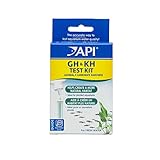 | API GH & KH TEST KIT Freshwater Aquarium Water Test Kit…Tests KH and GH | $11.98 Prime | Check on Amazon |
| 2 |  | API Freshwater Master Test Kit 800-Test Freshwater Aquarium…Tests pH, ammonia, nitrite, nitrate | Check on Amazon |
How Much KH Is Enough? Sources Disagree
| Source | KH figure (each as the source writes it) | Scope |
|---|---|---|
| Aquarium Co-Op | 4-8 dKH typical; avoid 2 dKH or below | Freshwater tanks; low-pH species excepted |
| Tetra | “should not generally drop below 3 °dH” | For pH stability |
| Practical Fishkeeping | Below 5°KH “a warning that cannot be ignored” | Unless keeping incredibly soft-water fish |
| The 2Hr Aquarist | 0.5-2 dKH “more than sufficient” | Most community tanks, in a passage on CO2 injection |
Co-Op’s full line: “In general, you don’t want KH to reach 2 dKH or below because then pH swings can easily happen and potentially kill your animals.” The four floors run from 0.5 to 5 dKH, and a reading of 1 to 2 dKH is called sufficient by one source and a risk by another, so no single number here is safe for every tank. A KH that keeps falling is worth testing against your source water (our reading).
How Sources Say to Stop the Slide
Warning
If your fish look unwell, test the water straight away and contact an aquatic veterinarian. This article covers water chemistry only; it does not diagnose or treat sick fish.
Keep up the routine. Practical Fishkeeping says: “The way these issues are avoided is simple: water changes, gravel cleaning and maintenance.” It explains that “Because the newer water will be richer in minerals, it will also help to boost hardness, increasing the GH and KH, and stabilising pH.” That holds when your source water carries KH; test it first (our reading).
Raise KH slowly, if your water needs it. Aquarium Co-Op says that “people with low KH in their tap water often use crushed coral to gradually raise the KH (or increase the size of their trash can) and prevent pH crashes”, and notes “The lower your pH is, the faster it dissolves”. Tetra caps its pH/KH Plus at a rate: “the maximum increase per day should not exceed 3 °dH”. Follow each product’s label; this guide gives no doses. Aqueon warns: “Sudden changes in pH can be harmful, or even fatal, if the change is too drastic or happens suddenly”. Our guides to raising KH and raising pH safely cover the methods and their cautions.
If the tank has already crashed, the sources disagree on water changes:
| Source | What it advises | Its reason or caution |
|---|---|---|
| Practical Fishkeeping | If the tank is “in a bad way”, 25% daily or every other day; 50-75% “to the point of a tank crash” | One change “won’t be enough”; 50-75% is “a drastic measure” |
| aquariumscience.org (one hobbyist’s reference site) | A >90% water change | For old tank syndrome as it defines it (high ammonia, high nitrate, low pH, low KH); it says most ammonia spikes are not that. Warns against small changes plus baking soda |
aquariumscience.org, a hobbyist reference site written by one author, cleans the mechanical filter “without cleaning the biological filter or the substrate” and refills with new water treated “with chlorine remover if necessary”; our water conditioner roundup compares products for removing chlorine from the new water. Its reason: in its illustrative example, “the old standard of adding baking soda and doing 25% water changes” lifted pH from 6.1 to 7.6, and “a high pH converts bad ammonium into very bad ammonia”. aquariumscience.org’s example puts numbers on it: “A level of 20 ppm “total ammonia” isn’t a problem at a pH of 6.1 but a level of 15 ppm “total ammonia” is a big problem at a pH of 7.6.” Aqueon’s advice for a cycling tank is to “test pH, ammonia and nitrite regularly to avoid stressing new fish”.
Ready to buy?
Our freshwater test kit roundup compares kits that read pH, KH, ammonia and nitrate, our Water Problems section gathers the guides to other water troubles, and our Water Lab section covers water chemistry.
Frequently Asked Questions
Q. What does it mean if my aquarium water is acidic?
Its pH is below 7. Whether that is a problem depends on the fish: Aqueon says “Most freshwater tropical fish do best between 6.8 and 7.8”.
Q. Is it normal for pH to drop while a tank cycles?
In soft, low-KH water it can be: aquariumscience.org reports drops “like 7.4 to 6.0, during cycling”, while its author saw no drop in his hard, high-KH well water.
Q. Why does my pH drop after a water change?
New water usually adds buffer, so a drop right after a change points at source water lower than the tank (our reading of Practical Fishkeeping).
Q. Does baking soda raise pH in a fish tank?
Buce Plant says some keepers use it, but “the pH will slowly revert back to its former level”. aquariumscience.org warns that in a crashed tank, raising pH with baking soda turns ammonium into more toxic ammonia; see our low pH guide before using it.
Sources (11)
- Aqueon (maker), What is pH
- Aqueon (maker), Aquarium pH
- API (maker), GH & KH Test Kit
- Tetra (maker), pH/KH Plus
- Practical Fishkeeping (magazine), How to avoid old tank syndrome
- SRAC (extension fact sheet), Publication 464, fish ponds
- Aquarium Co-Op (retailer blog), pH, GH, and KH
- The 2Hr Aquarist (retailer blog), pH explained
- Buce Plant (retailer blog), How to Adjust pH
- aquariumscience.org (hobbyist reference site), Old Tank Syndrome
- aquariumscience.org (hobbyist reference site), Dropping pH
Product prices and availability are accurate as of the date/time indicated and are subject to change. Any price and availability information displayed on Amazon.com at the time of purchase will apply to the purchase of this product.