The short answer
KH, or carbonate hardness, measures the carbonate and bicarbonate dissolved in water; API, a test-kit maker, says it is “also known as alkalinity”. It buffers pH: API says KH “helps stabilize pH” and that tanks with very low KH are subject to rapid pH shifts if not monitored carefully. GH measures calcium and magnesium instead.
Sources give different KH figures for fish, shrimp and plants, so this page shows each with its scope rather than one target.
Warning
If fish look unwell, test the water and contact an aquatic veterinarian. This page covers water chemistry only; it does not diagnose or treat sick fish.
KH, alkalinity and GH: three readings
| Reading | What it measures | Source |
|---|---|---|
| KH (carbonate hardness) | Carbonate and bicarbonate in the water | API |
| Alkalinity | “acid-neutralizing capacity” | UF/IFAS, EPA |
| GH (general hardness) | Calcium and magnesium in the water | API |
API treats KH and alkalinity as one reading. Seachem, a water-care maker, keeps them apart in its planted-aquarium chemistry guide. Its KH entry says KH “is typically the same as the alkalinity value, but it is not necessarily always so”. Its alkalinity entry says: “Alkalinity can be provided by any number of compounds (carbonate, bicarbonate, borate, phosphate, hydroxide).”
GH is a separate measure. API defines it as “the measure of calcium and magnesium ion concentrations dissolved in water”, and Seachem notes that GH “does not appreciably change in the short term.”
How KH holds pH steady
UF/IFAS Extension, the University of Florida’s extension service, says alkalinity “buffers the pH of water within the system” and: “Without this buffering capacity, small additions of acids or bases would result in significant changes of pH, which could be deleterious for aquatic life.”
In the aquarium, API says: “An aquarium with a low KH level will tend to be acidic.” It adds: “Water with a high KH level usually has a high pH.” Tetra, a water-care maker, says on its pH/KH Plus product page: “When CO2 levels remain constant, the pH can only be adjusted through changes in KH”.
KH also gets used up. UF/IFAS, writing about aquatic systems, says the bacteria that convert ammonia produce carbon dioxide and hydrogen ions, “reducing the pH of the water unless sufficient buffers (alkalinity) are present”, and: “Over time, alkalinity levels in water, particularly in recirculating tank systems, will decrease.” Seachem, writing about CO2-injected planted tanks, says they produce acids “that will react with the KH”, though a drastic loss of KH “is not something that commonly occurs because most people perform a water change well before that situation might arise.”
The bacteria need the buffer too. UF/IFAS: “At a total alkalinity less than 20 milligrams per liter (mg/L), common species of nitrifying bacteria do not function effectively.” That is about 1.1 dKH (our arithmetic, from ForAquarium, a fishkeeping guide site: “One dKH is equivalent to approximately 17.848 mg/L”, assuming both are as calcium carbonate and that alkalinity equals KH, which Seachem says is “not necessarily always so”). UF/IFAS adds that “once alkalinity is depleted, pH of the water can drop significantly and quickly”.
Units: dKH, ppm and mg/L
- Degrees (dKH). Tropica, an aquarium plant and fertilizer maker, says dKH “is expressed in German degrees of hardness”. Tetra writes KH as °dH and Dennerle as °d; we read both as the same German degree.
- ppm. API’s kit chart gives each drop as 1 °dKH and 17.9 ppm.
- mg/L as calcium carbonate. The EPA says total alkalinity is “reported as milligrams per liter of calcium carbonate (mg/L CaCO3)”.
| Drops (API kit) | °dKH and ppm (API’s chart) |
|---|---|
| 1 | 1 °dKH, 17.9 ppm |
| 3 | 3 °dKH, 53.7 ppm |
| 5 | 5 °dKH, 89.5 ppm |
| 10 | 10 °dKH, 179 ppm |
How KH is tested
Safety
API’s safety data sheet for its KH Test Solution carries the signal word “DANGER” and “Causes severe skin burns and eye damage.” It says: “Do not breathe dust/fume/gas/mist/vapours/spray.” and “Wear protective gloves/protective clothing/eye protection/face protection.” For eyes: “IF IN EYES: Rinse cautiously with water for several minutes. Remove contact lenses, if present and easy to do. Continue rinsing.” and “Immediately call a POISON CENTER or doctor/physician.” Its first-aid section differs on lenses: “Removal of contact lenses after an eye injury should only be undertaken by skilled personnel.” For skin: “IF ON SKIN (or hair): Remove/Take off immediately all contaminated clothing. Rinse skin with water/shower.” If swallowed: “IF SWALLOWED: Rinse mouth. Do NOT induce vomiting.” If inhaled: “IF INHALED: Remove victim to fresh air and keep at rest in a position comfortable for breathing.” It also says “Store locked up.” and “Limit all unnecessary personal contact.” In the US, the National Capital Poison Center, a nonprofit, says to “call a poison center at 1-800-222-1222”. These lines are for the KH bottle; API’s leaflet prints a separate DANGER label for its GH Test Solution, so read that before testing GH.
Our guide to liquid test kits vs test strips compares the two kinds of test.
- Drop kits. API’s directions: fill a clean tube “with 5 ml of water to be tested”, add KH Test Solution “1 drop at a time”, “Cap test tube & invert several times after each drop”, and stop when the water “turns from blue to yellow”; the number of drops gives the KH.
- Strips. API’s 5-in-1 directions say to “immediately read General Hardness (GH) and Carbonate Hardness (KH). Wait 30 seconds, then read pH, Nitrite, and Nitrate.” Tetra says its 7in1 strips are read “only one minute later”.
API’s KH kit page says: “Test weekly to accurately measure and monitor KH conditions in your aquarium.” Test your tap water too (our suggestion): API says the level in tap and bottled water “depends on the source of the water and the treatment processes it has undergone.”
Both kits below come from our freshwater test kit roundup.
| # | Preview | Product | Price | Link |
|---|---|---|---|---|
| 1 | 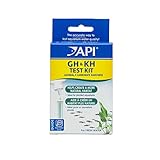 | API GH & KH TEST KIT Freshwater Aquarium Water Test Kit…Hardness add-on | $11.98 Prime | Check on Amazon |
| 2 |  | API 5-IN-1 TEST STRIPS Freshwater and Saltwater Aquarium…High-count dip strips | $24.98 Prime | Check on Amazon |
KH figures by source: fish, shrimp and plants
API says the GH and KH of aquarium water “should match their natural habitat”. Each figure below is the source’s own; they overlap but do not agree.
Freshwater fish
| Source | KH figure | For |
|---|---|---|
| API | 3-6º (50-100 ppm) | A community tank of tropical fish; most tropical fish incl. angelfish, cichlids, tetras |
| API | 0-3º (0-50 ppm) | Discus, arowana, elephantnose, neons, cardinals |
| API | 6-11º (100-200 ppm) | Most tropical fish incl. swordtails, guppies, mollies, goldfish |
| API | 11-22º (200-400 ppm) | Rift Lake cichlids, goldfish, brackish water fish |
| Tetra | Not generally below 3 °dH | pH stability, all aquarium inhabitants |
| Tetra | Approximately < 5 °dH | Soft water fish such as discus |
| Tetra | Approximately > 10 °dH | Hardwater fish such as Lake Tanganyika cichlids |
| The 2Hr Aquarist | 1 to 10 dKH | The majority of commercially bred common ornamental fish |
API’s leaflet gives one “GH & KH Range” per row, so each API row covers both readings, and it rounds ppm (50 for 3º; its chart gives 53.7). Tetra’s full line is: “With regard to pH stability, the KH should not generally drop below 3 °dH to ensure the well-being of all aquarium inhabitants”. API’s softest row (0-3º) and The 2Hr Aquarist’s low end (1 dKH) go below that line, and UF/IFAS’s alkalinity floor for nitrifying bacteria (about 1.1 dKH, above) falls inside API’s 0-3º row.
Shrimp
| Source | KH figure | For |
|---|---|---|
| Dennerle | Carbonate hardness 1 °d | Water set with its Shrimp Salt GH/KH+ (Neocaridina, tiger shrimp) |
| Dennerle | “without carbonate hardness” | Water set with its Bee Salt GH+ (bee and bumblebee shrimp) |
Dennerle, a German aquarium products maker, gives these for water made with its own salts from “osmosis water, rainwater and demineralized water”, so they are product targets, not general rules (our reading).
Planted tanks
| Source | KH figure | For |
|---|---|---|
| API | Two separate rows, 0-3º and 3-6º | Each lists live plants |
| The 2Hr Aquarist | 0-2 dKH | “sensitive soft water species” |
| The 2Hr Aquarist | 2-7 dKH | “97% of all commercially available aquatic plants in optimum condition” |
The 2Hr Aquarist, a planted-tank fertilizer maker, says aquasoil tanks in soft water countries “are often run at 1dKH or less” and, of planted tanks, that “low pH/KH environments are not a barrier to having a fully cycled tank”. That reads against UF/IFAS’s 20 mg/L line (about 1.1 dKH). Neither source addresses the other’s figure (our reading).
GH: the other hardness reading
USGS, the US Geological Survey, defines water hardness as “the amount of dissolved calcium and magnesium in the water”, the same minerals API names for GH. For tap water, agencies draw the “soft” line in different places: USGS says “0 to 60 mg/L (milligrams per liter) as calcium carbonate is classified as soft”, while the EPA scale that UF/IFAS reprints puts soft below 75 mg/L. Those classify waters; they are not fish targets. To lower GH, see our guide to softening aquarium water.
What to do with your reading
- KH higher than your fish need: our guide to lowering alkalinity (KH) covers it.
- KH low, or pH sliding down: see why aquarium pH runs low and our guide to raising pH.
- pH higher than you want: our guide to lowering aquarium pH.
Whatever you change, Aqueon, an aquarium equipment maker, says that with fish in the tank you should “never make sudden or drastic changes to pH or any other water parameters.”
Ready to buy?
Our freshwater test kit roundup compares kits that read KH and GH. For RO or bought water, our guide to water for a fish tank compares remineralizers, and our water conditioner roundup covers tap water. Our Water Lab gathers the guides to each reading.
Frequently Asked Questions
Q. What should the KH level be in a fish tank?
There is no single figure. API’s leaflet gives 3-6º for a community tank of tropical fish, and the tables above show where other sources differ by species and by tank.
Q. Is high KH harmful to fish?
It depends on the species: API says GH and KH “should match their natural habitat”, and API and Tetra both list hard-water fish, such as Rift Lake and Lake Tanganyika cichlids, at their high end. If fish look unwell, test the water and contact an aquatic veterinarian.
Q. Is a KH of 0 good for an aquarium?
It depends on the tank. Dennerle’s Bee Salt, for soft water shrimp such as bee and bumblebee shrimp, makes RO, rain or demineralized water “without carbonate hardness”; its Shrimp Salt for Neocaridina sets 1 °d. API says “Aquariums with very low KH are subject to rapid pH shifts if not monitored carefully.”
Q. How do I fix the KH in my fish tank?
Our guides to lowering alkalinity (KH) and raising pH and rebuilding buffer cover each direction.
Sources (19)
- API, GH & KH Test Kit (maker)
- API, KH Test Kit (maker)
- API, GH & KH Test Kit Instructions (maker)
- API, KH Test Solution Safety Data Sheet (maker)
- API, 5-in-1 Test Strips (maker)
- Tetra, pH/KH Plus (maker)
- Tetra, Test 7in1 (maker)
- Seachem, General Chemistry of the Planted Aquarium (maker)
- Dennerle, Shrimp King Shrimp Salt GH/KH+ (maker)
- Dennerle, Shrimp King Bee Salt GH+ (maker)
- Tropica, Fertiliser and CO2 (plant and fertilizer maker)
- Aqueon, Aquarium pH (maker)
- The 2Hr Aquarist, KH in a planted aquarium (fertilizer maker’s blog)
- UF/IFAS Extension, Alkalinity and Hardness (university extension)
- UF/IFAS Extension, Ammonia in Aquatic Systems (university extension)
- US EPA, Total Alkalinity (federal agency, archived page)
- USGS, Hardness of Water (federal agency)
- ForAquarium, Aquarium KH (fishkeeping guide site)
- National Capital Poison Center (nonprofit poison center)
Product prices and availability are accurate as of the date/time indicated and are subject to change. Any price and availability information displayed on Amazon.com at the time of purchase will apply to the purchase of this product.