The short answer
First check that your fish need it. Then test the tank, tap water and KH, remove anything that raises pH, and lower it with prepared RO water, driftwood or peat, or a freshwater pH product used as labeled. Go slowly: API says some fish may be sensitive to changes greater than 0.2 in 24 hours.
These steps are for freshwater tanks. To find what is pushing your pH up, see our guide to what causes high pH in an aquarium.
Warning
If fish look unwell, test the water and contact an aquatic veterinarian. This guide covers water chemistry only; it is not a diagnosis or treatment for sick fish.
What you need
- A pH test that covers your reading. API, a test-kit maker, says its High Range pH Test Kit reads from 7.4 to 8.8.
- A KH test, and a GH test if you will use RO water.
- A clean bucket or spare container to prepare and test water before it goes in.
- A tap water conditioner for any tap water you add; API’s directions say to use it “when adding or changing water”. Our water conditioner roundup compares them.
Both kits below are from our freshwater aquarium test kit roundup, which compares pH and KH kits.
| # | Preview | Product | Price | Link |
|---|---|---|---|---|
| 1 |  | API Freshwater Master Test Kit 800-Test Freshwater Aquarium…Liquid master kit | $35.98 Prime | Check on Amazon |
| 2 | 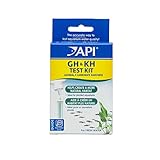 | API GH & KH TEST KIT Freshwater Aquarium Water Test Kit…Hardness add-on | $11.98 Prime | Check on Amazon |
Seven steps to lower aquarium pH
Decide whether your fish need a lower pH
Aqueon, an aquarium equipment maker, says that unless you are breeding “sensitive or wild caught fish from environments with extremely low or high pH, it is best not to try to change your aquarium pH”, and adds: “Most fish will adapt as long as water quality is good and pH is stable.” Check what your species needs. On a new setup, Aqueon says to make the change “BEFORE introducing fish or other livestock”.
Test the tank, the tap water and KH, and note the numbers
Swell UK, an aquarium retailer: “Test the tank water and the tapwater you filled the tank with, and see if they are the same.”
Set a slow pace
API warns that “some fish may be sensitive to pH adjustments greater than .2 in a 24 hour period”, changes it says should be “executed with extreme care”. The Spruce Pets, a pet-care publication, warns that “Shifting the pH too quickly, either up or down, can potentially kill your fish” and says “Changes should be no more than 0.3-0.5 pH units per day.” The two differ; 0.2 a day or less fits both (our reading). At that pace, 8.0 to 7.0 takes at least five days (our arithmetic).
Remove anything in the tank that raises pH
If the tap reads low or neutral and the tank high, Swell says “something in the tank is raising the pH”, such as “rocks which contain lime, like Limestone, Tufa rock, or Ocean Rock”. Swell’s fix for non-inert rocks and concrete-like ornaments is to remove them and “do several large water changes”. Each change moves the tank toward the tap’s reading, so test before and after each one and keep within the pace from step 3 (our reasoning, not Swell’s).
Prepare and test new water outside the tank
Aqueon: “Always prepare water and test pH before adding it to your aquarium.” Try leaves, peat or a product in a measured volume of water first too (our suggestion; see the leaf test from TFH Magazine, a fishkeeping magazine, and Spruce’s bench test).
Lower the pH with the method that fits your readings
Use the table below; add it in small amounts; stop for the day once the tank has moved as far as step 3 allows.
Retest before every dose or water change, and keep testing until the reading holds
API’s directions say: “Take another pH reading before adding another dose.”
Which method fits your readings
| Your readings | Method that fits | Why |
|---|---|---|
| Tap lower than tank | Remove the source (step 4) | Swell: something in the tank |
| Tap high, KH high | RO water, remineralized | Tannins fade in high KH (TFH) |
| Tap high, KH low | Driftwood, peat or leaves | TFH: best in soft water |
| Other methods not enough | A freshwater pH product | Makers urge extreme care |
The table is our summary of Swell and TFH.
RO water
The Spruce Pets describes RO water as “a pure water source with a neutral pH and limited kH/gH”, and Buce Plant, an aquarium plant retailer, says: “Since there are no minerals in RO/DI water, you will need to add them back in with remineralization products.” Remineralize it, then test pH, KH and GH before it goes in. A full swap to RO water can outpace API’s 0.2 a day, so mix it in through small water changes (our reading of API’s caution). Our guide to the best water for a fish tank covers RO water and remineralizers.
Driftwood, peat and leaves
TFH says “Tree leaves or peat will bring your pH down slightly and gradually, not drastically and quickly”, and that “in the presence of high alkalinity, the effect of any pH-lowering material will be quite fleeting”; it suggests softening hard water first, “by adding RO water for example”.
- Driftwood. Buce Plant says driftwood will “release tannins that lower the pH”, and: “Please make sure to use aquarium-safe wood, as not all wood is safe for fish and shrimp!” It adds: “To avoid the brown tinted water, you can boil it for 1-2 hours”.
- Peat. Aqueon says to put it in the filter: “Use a mesh media bag to keep it contained and use only peat products designed for aquariums. Replenish as needed to maintain the desired pH.” TFH adds: “Dosing should be as per the manufacturer’s instructions.” Interpet, a UK aquarium products maker, says peat can discolor the water, “so be sure to use it sparingly”.
- Catappa leaves. TFH suggests store-bought catappa (Indian almond) leaves. To test first, TFH suggests you “take a few liters of RO water, place a handful of leaves in it for a few days, and then measure the pH”.
TFH cautions that “it is possible to overdose tannins unintentionally in the aquarium by using too many leaves or too much peat”, and that leaves, peat and their extracts “should be dosed in moderation and with care”.
pH and KH products
Aqueon says pH products “should be avoided altogether or used with extreme care by experienced aquarists to avoid sudden drastic pH shifts”, and warns that “Some products, especially liquid pH adjusters, often have only temporary effects and pH soon shifts back to its original value”. Buce Plant, an aquarium plant retailer, says: “please proceed with extreme caution when using these products.” If you go ahead:
- Choose a freshwater product and read its label in full. API says its pH Down “lowers aquarium pH in freshwater aquariums”. Tetra, a water-care maker, says its pH/KH Minus is “Suitable for all freshwater aquariums” and that “By lowering the KH, the pH value also decreases automatically.”
- Bench-test it. The Spruce Pets says “it is critical that you do your own tests to determine dosage rather than rely on what the pH adjusting bottle prescribes, unless you are starting with RO water”, using “a known volume of water and a known weight, not volume, of your additive”. It adds: “Test your pH and kH prior to mixing and after.”
- Keep each maker’s own cautions. API warns that water high in carbonate and bicarbonate can “strongly buffer aquarium water and can resist a pH change” or cause “pH rebound”, and that “repeated dosing may be necessary to lower pH”. For that product, Tetra’s pH/KH Minus directions say to “ensure proper aeration”, to avoid adding CO2, and to “maintain KH levels between 2 – 4 °dH to prevent significant drops in pH”. Its FAQ adds that too much of the product can cause a rapid drop in pH that may stress or harm fish and other aquatic life. On handling, Tetra says: “Please handle Tetra pH/KH Minus with caution, as it can cause severe skin burns and eye damage. Keep out of reach of children, and if medical advice is needed, have the product container or label available. In case of contact with skin or eyes, rinse thoroughly with water.” It also advises against using several products that affect pH or KH at once, which it says can lead to unpredictable results.
- Treat every batch of new water. Swell says of pH products: “Just remember to use it every time you add new water, and test pH regularly.”
CO2 injection also lowers pH, but Buce Plant warns: “Make sure not to add too much CO2 though, as this can be fatal for livestock in the aquarium.” This guide does not cover it.
Troubleshooting
- pH drops, then climbs back. After a pH product in carbonate-buffered water, that is API’s “pH rebound”; for leaves and peat, TFH says high alkalinity makes the effect “quite fleeting”. Aqueon warns that “The resulting pH roller coaster this creates is very stressful to aquatic creatures”.
- pH fell too far. Retest pH and KH before adding more (our suggestion); API notes that tanks with very low KH “are subject to rapid pH shifts”. Our guide to why aquarium pH runs low covers raising it.
Our Water Lab has a guide to each reading.
Ready to buy?
Our freshwater aquarium test kit roundup compares kits for pH, KH and GH, and our RO/DI system roundup compares units.
Frequently Asked Questions
Q. What is the cheapest way to lower pH?
Often, leaving it alone, as Aqueon advises for most fish (step 1); otherwise start with step 4. No source here compares costs.
Q. Can I use vinegar to lower pH in a fish tank?
None of the makers’ pages we used covers vinegar; The Spruce Pets says DIY methods “should be used with caution”.
Q. Does baking soda lower pH in an aquarium?
No: Buce Plant lists baking soda under raising pH (“Some hobbyists also use baking soda”), and Interpet lists too much baking soda among the causes of high pH.
Q. How do I lower pH without tannins?
Remove what raises it (step 4), or use RO water, which Aqueon lists first among its ways to lower pH, remineralized as Buce advises.
Sources (11)
- Aqueon, Aquarium pH: How to Safely Adjust pH (maker)
- API, pH Down (maker)
- API, High Range pH Test Kit (maker)
- API, GH & KH Test Kit (maker)
- API, Tap Water Conditioner (maker)
- Tetra, pH/KH Minus (maker)
- Interpet, Understanding water pH in your aquarium (maker)
- The Spruce Pets, Causes and Solutions to High pH in Aquariums (publication)
- TFH Magazine, Leaf Litter & More: How to Naturally Lower Aquarium pH (publication)
- Swell UK, What causes high pH in a fish tank (retailer guide)
- Buce Plant, How to Adjust pH in the Freshwater Aquarium (retailer blog)
Product prices and availability are accurate as of the date/time indicated and are subject to change. Any price and availability information displayed on Amazon.com at the time of purchase will apply to the purchase of this product.