The short answer
Test KH, pH, ammonia and your tap water first. Sources describe four ways to raise KH: water changes with higher-KH water, crushed coral or limestone in the filter, premixed baking soda, and maker buffers. API says high-KH water “usually has a high pH”, and Seachem recommends altering pH slowly, so retest as you go.
API, a test-kit maker, treats alkalinity and KH as the same reading for aquarium test kits, calling carbonate hardness “also known as alkalinity”. These steps are for freshwater tanks. Our guide explains how to lower alkalinity (KH).
Warning
If fish look unwell, test the water and contact an aquatic veterinarian. This guide covers water chemistry only; it does not diagnose or treat sick fish.
What you need
- A KH test and a pH test. API’s KH kit page: “Test weekly to accurately measure and monitor KH conditions in your aquarium.” For pH, follow your pH kit’s directions.
- An ammonia test (step 2).
- A bucket and a tap water conditioner; API says to use its conditioner “when adding or changing water”. See our water change guide and our water conditioner roundup.
- A mesh media bag for crushed coral (step 4).
The kit below is from our freshwater test kit roundup, which notes it is two separate tests on top of any master kit, with the number of tests not published.
| # | Preview | Product | Price | Link |
|---|---|---|---|---|
| 1 | 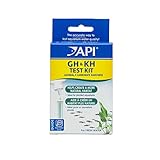 | API GH & KH TEST KIT Freshwater Aquarium Water Test Kit…Hardness add-on | $11.98 Prime | Check on Amazon |
Set a target first
API’s leaflet: “When keeping a community aquarium with a variety of tropical fish, adjust the GH and KH to 3 – 6º (50-100 ppm).” API says the GH and KH “should match their natural habitat”: its leaflet table lists discus, arowana, elephantnose, neons, cardinals and live plants in its 0º – 3º row, and Tetra says “fish like discus thrive in environments with a KH of less than 5 °dH”. For such soft-water species, raising KH may be the wrong move, and the makers differ: Tetra’s floor (below) is for “all aquarium inhabitants”, while API’s table puts these species in 0º – 3º (our reading); check your species’ range; our KH guide lists each source’s figures by species. Tetra, a water-care maker: “With regard to pH stability, the KH should not generally drop below 3 °dH to ensure the well-being of all aquarium inhabitants” (Tetra writes KH in °dH; we read it as the same German degree as dKH, as our KH guide does). UF/IFAS Extension, the University of Florida’s extension service, writing about aquatic systems: “At a total alkalinity less than 20 milligrams per liter (mg/L), common species of nitrifying bacteria do not function effectively.” That is about 1.1 dKH (our arithmetic, from ForAquarium, a fishkeeping guide site: “One dKH is equivalent to approximately 17.848 mg/L”, assuming both are as calcium carbonate and that alkalinity equals KH, which Seachem says is “not necessarily always so”). For a community tank, treat 3 dKH as the first floor (Tetra, API); UF/IFAS’s figure, about 1.1 dKH, is where nitrifying bacteria stop working well (our reading).
Raising KH step by step
Steps 3 to 8 are separate methods. ForAquarium says that if your tap water’s KH is very low, “maintain a rigorous weekly water change schedule and supplement with the additional methods listed below to raise your KH levels.” Seachem says “using multiple buffers and regulators when only one is needed could result in a pH that is different from the one you want”, and Tetra’s FAQ advises against using several products that affect pH or KH at once, warning of unpredictable results, so use one KH product at a time. For steps 6 to 8, follow the label for the amount, and stop once KH reaches your target: for a community tank, API’s 3 – 6º band, otherwise your species’ range (our reading). Step 9 ends every method.
Before any step that puts your hands in the water, unplug everything
Fluval’s AquaClear filter manual: “CAUTION – Always unplug or disconnect all appliances in the aquarium from electricity supply before placing hands in water, before putting on or taking off parts and while the equipment is being installed, maintained or handled.” With your hands out, restart the filter first: for an AquaClear, Fluval says to “Fill filter case completely with water.”, then “Plug power cord into electrical outlet. Allow 30-45 seconds for priming.”, and warns: “IMPORTANT – DO NOT OPERATE FILTER WITHOUT WATER”. Other filters follow their own manual. Hydor, a heater maker, says its heater “can ONLY then be turned back on when the Aquarium is full and the heater is completely submerged.” Then plug every other appliance you unplugged back in.
Test KH, pH and ammonia in the tank, and KH in your tap water
For the sample: unplug all appliances before your hand goes in; restart and plug every appliance back in after (step 1). API’s KH directions: fill a clean tube “with 5 ml of water to be tested”, add KH Test Solution “1 drop at a time”, “Cap test tube & invert several times after each drop”, and stop when the water “turns from blue to yellow”; the number of drops gives the KH. API’s safety data sheet for the KH Test Solution carries the signal word “DANGER” and “Causes severe skin burns and eye damage.” It says: “Wear protective gloves/protective clothing/eye protection/face protection.” For eyes: “IF IN EYES: Rinse cautiously with water for several minutes. Remove contact lenses, if present and easy to do. Continue rinsing.” and “Immediately call a POISON CENTER or doctor/physician.” Its first-aid section differs on lenses: “Removal of contact lenses after an eye injury should only be undertaken by skilled personnel.” For skin: “IF ON SKIN (or hair): Remove/Take off immediately all contaminated clothing. Rinse skin with water/shower.” If swallowed: “IF SWALLOWED: Rinse mouth. Do NOT induce vomiting.” It also says “Store locked up.” In the US, the National Capital Poison Center, a nonprofit, says to “call a poison center” at 1-800-222-1222. Test ammonia because raising KH usually raises pH (our reading of API), and Aqueon, an aquarium equipment maker, writing about cycling a new tank, says “as pH rises above 7.3, the balance swings toward toxic NH₃”. If ammonia reads above zero, deal with that first (our reasoning; see what causes ammonia in fish tank water). API’s leaflet: “Some tap water supplies have very low KH (below 3 ºdKH) which can contribute to wide pH swings in the aquarium.”
Change water with higher-KH water
ForAquarium: “If your tap or replacement water has a higher KH than your aquarium, regular water changes can help replenish depleted alkalinity and restore buffering capacity.” Our guide to the best water for a fish tank compares tap, RO, distilled and bottled water. Treat tap water with a conditioner, and as Aqueon says, “Be sure to match temperatures of the new water with the aquarium.” Switch off and unplug the heater first, as long ahead as its maker says (our sequencing). Hydor’s support page says “at least 30 minutes before any waterchange”; its Theo manual says “at least 5 minutes before taking it out of the water or before adding or changing the water”, and: “Always ensure the water level stays above the ‘Minimum water level’ mark shown on the heater”. With no manual, our reading is the longer wait. Unplug every other appliance before your hand goes in (step 1). Aqueon says: “Avoid water changes of more than 25% as larger water changes can stress your fish and upset the balance in your aquarium.” API says: “It is not recommended to do more than 30% because it may cause loss of bacteria and be stressful on the fish.” These are upper limits, not targets (our reading). Once refilled, restart and prime the filter, turn the heater on only when the tank is full and the heater is completely submerged, and plug every appliance you unplugged back in (step 1).
Add crushed coral, aragonite or limestone, starting small
Unplug all appliances first (step 1). Aqueon says: “Fill a mesh media bag with crushed coral or dolomite gravel and place it in your filter.” Shrimply Explained, a shrimp-keeping education site, recommends “starting with a mesh bag in the filter so it is easily removable if you notice the pH rising too quickly”, and: “For the sake of safety, it is also best to start with a small amount, monitor parameters closely for a few days, then add or remove some after seeing the effects.” Buce Plant, an aquarium plant retailer, says of calcium carbonate: “Please make sure to wash and sanitize these objects before placing them into the aquarium.” (It names no cleaner.) ForAquarium says crushed coral and oyster shells release calcium, magnesium and carbonates “when they dissolve in the presence of acidic water”, and: “While carbonates will raise KH, calcium and magnesium minerals will raise GH.” The 2Hr Aquarist, a planted-tank fertilizer maker, says of limestone: “Depending on the quality/type of limestone used, the KH in the tank can rise from 0 to 10 within a week.” (dKH, in a tank with limestone rock; our reading). Afterward, restart and plug every appliance back in (step 1). Test KH and pH over the next days, and take the bag out if they climb past your target (our suggestion). To remove it: unplug all appliances before your hand goes in; restart and plug every appliance back in after (step 1).
Baking soda: premix it in change water
ForAquarium: “Pure sodium bicarbonate (baking soda) can increase KH without directly increasing GH.” No maker or authority we read gives an aquarium amount for baking soda, so this guide gives none. ForAquarium says: “Baking soda can provide a quick, temporary increase when only a minor adjustment is needed.” and “Calculate the required amount based on the aquarium’s total water volume and the desired increase in KH”. ForAquarium: “Add baking soda while performing a small 10% water change.” It says to dissolve it “in a separate container of replacement water before slowly adding it to the aquarium”, and: “Do not add baking soda directly to the aquarium without premixing.” Shrimply Explained, a shrimp-keeping education site, suggests “ideally dripping it in over an hour or so to avoid sudden pH changes”. ForAquarium warns: “High sodium concentrations or large additions of sodium bicarbonate can become harmful, so KH should be raised gradually while monitoring KH and pH.” No source we read gives a per-day limit for baking soda (our reading), and Atlas Scientific, a pH sensor maker, advises against over-the-counter remedies such as baking soda to buffer a tank when pH dips. Unplug all appliances before your hand goes in; restart and plug every appliance back in after (step 1). For the heater, follow step 3 as well. Church & Dwight’s safety data sheet for Arm & Hammer Baking Soda lists it as “Not classified” (for people handling it; the SDS does not address fish) but says “Exposure may aggravate pre-existing eye, skin, or respiratory conditions.” For eye contact: “Rinse cautiously with water for at least 15 minutes. Remove contact lenses, if present and easy to do. Continue rinsing.” and “Obtain medical attention.”
Seachem Alkaline Buffer: follow the label, and expect pH to rise
Aqueon says pH products “should be avoided altogether or used with extreme care by experienced aquarists to avoid sudden drastic pH shifts”. Aqueon also says to adjust pH “BEFORE introducing fish or other livestock and test regularly to make sure it remains stable”. Seachem says Alkaline Buffer is “a sodium bicarbonate based buffer”, “is intended to raise pH and KH in the aquarium” and “will have no impact on GH”. Its dosing page says that its dose “raises alkalinity by about 1 meq/L (2.8 dKH)”. That is a per-dose effect, not a target: test before each dose and stop at your target (see above the steps). Seachem adds: “Dosing Alkaline Buffer alone will target a pH of above 7.6.” On which tanks it suits, Seachem answers “Possibly”: “Alkaline Buffer™ is exclusively intended for freshwater tanks and not every type of aquarium fish is suited to the range of pHs which Alkaline Buffer™ can be used to create. Research your fish to know what pH they would prefer.” It continues: “We recommend to alter pH slowly and keep water changes to 30% of the tank or less.” Its overdose FAQ: “An overdose of Alkaline Buffer™ can result in a sudden and stressful shift in pH and KH.” Its safety data sheet says, under OSHA and GHS criteria, “This material is not hazardous.”, but also “May cause eye irritation.”, “Wash thoroughly after handling this product.” and “Avoid generating and breathing dusts or particulates generated by this product.”; for eye protection it lists “Splash goggles or safety glasses.” and for hands: “Wear neoprene or butyl rubber gloves for routine industrial use.” For eyes, first aid: “Immediately flush eyes thoroughly with water for 15-20 minutes. Remove contact lenses after the initial 1-2 minutes and continue flushing for several additional minutes. If effects occur, consult a physician, preferably an ophthalmologist.” Unplug all appliances before your hand goes in; restart and plug every appliance back in after (step 1).
Tetra pH/KH Plus: follow the label and its daily cap
Aqueon’s caution on pH products (step 6) applies. Tetra’s FAQ says the product raises both pH and KH. Tetra’s EU product page says its dose is meant “to achieve an increase of around 1 °dH”, a per-dose effect, not a target. It adds: “Remember that the maximum increase per day should not exceed 3 °dH.” That cap is for this product (our reading). Test before each dose and stop at your target (see above the steps). Tetra’s FAQ says an overdose can raise pH and KH rapidly, and for handling says to avoid skin contact and contact with eyes and mucous membranes, keep it out of reach of children, and rinse thoroughly with water after contact. Unplug all appliances before your hand goes in; restart and plug every appliance back in after (step 1).
API Proper pH: API says it raises KH; check with a KH test
Aqueon’s caution on pH products (step 6) applies. API’s leaflet calls Proper pH 6.5, 7.0 and 7.5 “non-carbonate buffers that automatically adjust pH and increase KH”. API says Proper pH 7.0 “automatically sets and stabilizes the pH level in freshwater aquariums” to 7.0, so it can lower pH in a tank above 7.0 (our reading). API gives no KH effect per dose: follow the label, test before each dose and stop at your target (see above the steps). It is “Not for use in aquariums containing live plants.” Its safety data sheet carries the signal word “Warning” and “Causes serious eye irritation”. It says: “Wear protective gloves, eye protection, protective clothing.” and “Wash hands, forearms and face thoroughly after handling.” For eyes: “IF IN EYES: Rinse cautiously with water for several minutes. Remove contact lenses, if present and easy to do. Continue rinsing.” and “If eye irritation persists: Get medical advice or attention.” Its first-aid section for eyes says: “IF IN EYES: Immediately flush with plenty of water for at least 15 minutes.” Seachem differs: its own phosphate-based regulators “will not increase your KH”, it says, and kits sold as KH tests often measure total alkalinity. API does not say what its buffers contain, so whether that applies is unclear (our reading). Unplug all appliances before your hand goes in; restart and plug every appliance back in after (step 1).
Retest, and stop at your target
Unplug all appliances before your hand goes in; restart and plug every appliance back in after (step 1). Aqueon says that with fish in the tank, “never make sudden or drastic changes to pH or any other water parameters.” For pH, the only rate we found is in the directions for API’s pH Up, a pH-raising product: “Some fish may be sensitive to pH adjustments greater than 0.2 in a 24 hour period, so changes of this magnitude should be done with extreme care.” If pH ends up too high for your fish, see our guide to lowering aquarium pH; if KH overshoots, our lowering-KH guide covers dilution.
When KH will not stay up
- It keeps falling. UF/IFAS: “Over time, alkalinity levels in water, particularly in recirculating tank systems, will decrease.” Our CO2 guide covers pH and KH in CO2-injected tanks.
- It will not rise despite repeated doses. Seachem: “If pH or KH of the water is still incorrect despite repeated additions of a buffer like Alkaline Buffer™, it is likely that there is a high concentration of acids or buffers in the aquarium that are resisting the change in pH.” Stop dosing and retest (our suggestion).
- GH rose too. Crushed coral and limestone raise GH as well (step 4); our guide to softening aquarium water covers lowering it. Steps 5 and 6 raise KH without directly raising GH (ForAquarium, Seachem).
Ready to buy?
Our freshwater test kit roundup compares kits that read KH and pH, and our Water Lab gathers our guides to each reading.
Frequently Asked Questions
Q. How do I raise KH without raising pH?
No source we read gives a way to raise KH with no effect on pH. Seachem says Alkaline Buffer alone targets a pH above 7.6 and recommends its Acid Buffer with it for a lower pH; its multiple-buffer caution is about buffers used “when only one is needed”. API says its Proper pH buffers set pH and increase KH (step 8). Our raise-pH guide covers the pH side.
Q. What causes low KH in an aquarium?
API names low-KH tap water. UF/IFAS says “Alkalinity (primarily bicarbonate and carbonate) is also used by the nitrifying bacteria.” and that it falls over time, “particularly in recirculating tank systems”.
Q. What is a good KH level for a fish tank?
For a community tank of tropical fish, API gives 3 – 6º, and Tetra says KH “should not generally drop below 3 °dH to ensure the well-being of all aquarium inhabitants”. API’s table has a 0º – 3º row for soft-water species, so the makers differ; see “Set a target first”.
Q. Is low alkalinity bad for fish?
API says: “Aquariums with very low KH are subject to rapid pH shifts if not monitored carefully.” If fish look unwell, test the water and contact an aquatic veterinarian.
Sources (34)
- API, GH & KH kit (maker)
- API, KH kit (maker)
- API, kit leaflet (maker)
- API, KH reagent SDS (maker)
- API, Proper pH 7.0 (maker)
- API, Proper pH 7.0 SDS (maker)
- API, pH Up (maker)
- API, Tap Water Conditioner (maker)
- API, routine care (maker)
- Seachem, dosing (maker)
- Seachem, sodium bicarbonate FAQ (maker)
- Seachem, GH FAQ (maker)
- Seachem, tanks FAQ (maker)
- Seachem, overdose FAQ (maker)
- Seachem, products FAQ (maker)
- Seachem, regulators FAQ (maker)
- Seachem, SDS (maker)
- Seachem, planted chemistry (maker)
- Tetra, pH/KH Plus (EU page) (maker)
- Aqueon, Aquarium pH (maker)
- Aqueon, What is pH (maker)
- Aqueon, Do’s and Don’ts (maker)
- Aqueon, Cleaning Checklist (maker)
- Fluval, AquaClear manual (maker)
- Hydor, support page (maker)
- Hydor, Theo manual (maker; linked from hydor.com/products/theo)
- Church & Dwight, baking soda SDS (distributor copy) (maker)
- UF/IFAS, FA031 (university extension)
- The 2Hr Aquarist, KH (fertilizer maker’s blog)
- Atlas Scientific, raising pH (sensor maker’s blog)
- National Capital Poison Center (nonprofit)
- ForAquarium, KH (fishkeeping guide site)
- Shrimply Explained, SB 103 (shrimp-keeping education site)
- Buce Plant, adjusting pH (retailer blog)
Product prices and availability are accurate as of the date/time indicated and are subject to change. Any price and availability information displayed on Amazon.com at the time of purchase will apply to the purchase of this product.