The short answer
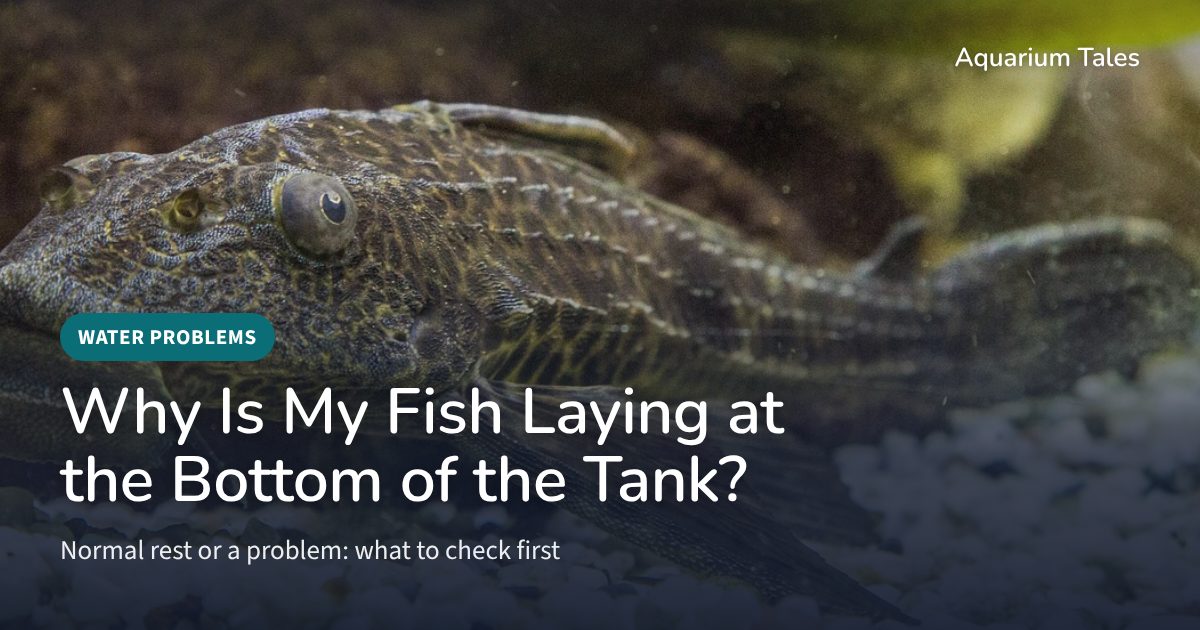
Sometimes it is normal: Aqueon says many aquarium species lie on the bottom when they sleep, and corydoras and loaches forage there. Sources link a still or sluggish fish to poor water quality, the wrong temperature, low oxygen, stress and illness, including swim bladder problems. Test the water, check the thermometer, and call an aquatic veterinarian if it looks unwell.
Warning
A fish on its side, struggling to swim or looking unwell? Test the water now and contact an aquatic veterinarian. This page covers freshwater tanks and gives no treatment or medication advice.
Fish at the surface instead? See why fish stay at the top of the tank.
Possible reasons at a glance
| Reason | Sources | Next |
|---|---|---|
| Sleep, a bottom species, old age | Aqueon, Chewy, AQQA, PFK | Watch; step 5 |
| Ammonia, nitrite, nitrate | Chewy, Aqueon (limits) | Steps 1, 3 |
| Too cold or too warm | Aqueon | Step 2 |
| Low oxygen | Complete Koi, AQQA | Step 4 |
| New fish and a moved tank | Aqueon (limits) | Steps 1, 5 |
| Illness, swim bladder | Chewy, UF/IFAS | Steps 1, 6 |
Resting, sleeping or a bottom-living species
Aqueon, an aquarium equipment maker, says seeing a fish lying on the bottom “is enough to panic any aquarium-keeper, but many aquarium species do this when they’re sleeping.” Its signs of a sleeping fish:
- “They remain motionless for periods of time.”
- “They lay on the bottom or an object in the aquarium.”
- “They don’t react to things going on around them.”
- “They exhibit this behavior at about the same time each day, usually when the aquarium light is turned off.”
Aqueon’s list describes sleep; its page does not say how to tell a sleeping fish from a sick one. Chewy, a pet retailer, adds: “Sick fish might sit still like this all day long, which is a sign that something is wrong.” If yours does, or you are not sure, test the water (step 1). Our guide to how fish sleep covers resting postures.
Aqueon names “Certain species of catfish and plecostomus, some knife fish, loaches and others” as nocturnal, “spending daylight hours sleeping in a cave or crevice”. It names corydoras and loaches among “species that like to forage on the bottom”, and says corys and their relatives “tend to be out and about during the daytime”. It says a betta might like “a betta hammock that attaches to the side of your tank, giving your fish a place to rest.” Chewy’s betta page lists, among signs of a happy betta, “swimming around their tank instead of lolling at the bottom of the tank or hiding all day.”
AQQA, an aquarium equipment brand, lists among normal reasons: “Older fish rest more often as they naturally slow down with age.” Practical Fishkeeping (PFK), a fishkeeping magazine, summarizing fish health expert Dr Peter Burgess: “It seems that old fish are at greater risk of certain diseases and are also less able to withstand unsuitable water conditions or bullying.”
Ammonia, nitrite and nitrate
Aqueon: “The only safe ammonia level is zero.” and “The only safe nitrite level is zero.” Long exposure to high nitrate, it says, “can stress them, stunt growth, damage organs and make them more susceptible to disease.” In a new aquarium, Aqueon says, existing fish “may not show signs of distress until it’s too late” as ammonia and nitrite rise slowly. Chewy’s vet-reviewed swim bladder page, which lists “Sinking to the bottom” among buoyancy signs, calls poor water quality “The most overlooked contributor to swim bladder disorders”. Aqueon’s pages on ammonia, nitrite and nitrate do not say fish go to the bottom. See what causes high ammonia and why nitrite gets high.
Water too cold or too warm
Aqueon: “When it’s too cold, they’re less active, their appetite is reduced and their immune systems are compromised, making them more susceptible to disease.” Bettas in cooler water “will be inactive and more susceptible to disease”. When it’s too warm, fish “use more oxygen” while the water “holds less oxygen”. Aqueon does not say these fish go to the bottom.
Low dissolved oxygen
Complete Koi, a UK aquarium and pond retailer, says low oxygen “can lead to sluggishness, increased disease risk, and in severe cases, death.” AQQA, an aquarium equipment brand, lists oxygen deprivation among causes of a fish on the bottom: crowding, a still surface, a broken filter or power cut, and hot water. See our oxygen guide.
New fish and a moved tank
Aqueon lists “huddling on the bottom (except for catfish)” among signs of stress or disease to look for in fish for sale. It says a moved tank, even an established one, will “most likely” go through New Tank Syndrome “because the biological balance has been disrupted”, and adds: “You may experience temporary cloudiness, as well as ammonia and/or nitrite spikes.” It says to “Test for ammonia and nitrite 3 to 5 days after the move and take appropriate action if levels are elevated.” It does not say fish go to the bottom after a move. See our guides to adding new fish and quarantining new fish.
Illness and swim bladder problems
Chewy’s swim bladder page calls swim bladder disease “a sign of other underlying issues”. One sign: the fish “spends most of their time lying on the bottom of the tank and struggles to swim to the surface, if they can do so at all.” UF/IFAS Extension, the University of Florida’s extension service, on monogeneans (parasitic flatworms): “Fishes infested with monogeneans may become lethargic, swim near the surface, have clamped fins, seek the corners of aquaria or the sides of the pond, and have diminished appetite.” UF/IFAS does not say these fish lie on the bottom. Our rule: illness is for an aquatic veterinarian (step 6).
What to do, in order
Test the water
With an aquarium test kit, test ammonia, nitrite, nitrate and pH; Chewy’s swim bladder page says to start with these four for a fish with a buoyancy problem. Ammonia or nitrite above zero? See how to lower ammonia or how to lower nitrites. If a hand goes in the water, unplug first. Fluval, a filter maker, in its AquaClear manual: “Always unplug or disconnect all appliances in the aquarium from electricity supply before placing hands in water, before putting on or taking off parts and while the equipment is being installed, maintained or handled. Never yank cord to pull plug from outlet. Grasp the plug and pull to disconnect.” Afterwards, plug every appliance you unplugged back in; for the heater, follow its manual (our reading).
Check the temperature
with a thermometer against both ends of your fish’s range in our tank temperature guide. Aqueon: “always remember to make any fish temperature changes in your aquarium gradual”; Aqueon’s summer-heat page gives a figure only for cooling: not “more than 2 or 3 degrees F in a 4-hour period”. If a hand goes in the water, unplug first (step 1), then plug every appliance you unplugged back in (step 1).
Change some water, treated and temperature-matched
Unplug first (step 1). Aqueon: “Replacement water should be the same temperature as the aquarium water.” and “Always treat tap water with a water conditioner to neutralize chlorine and ammonia before adding it to the aquarium.” Sizes differ, even between Aqueon’s own pages. Its do’s and don’ts, as a general rule: “Avoid water changes of more than 25% as larger water changes can stress your fish and upset the balance in your aquarium.” Its ammonia guide, for an ammonia reading: “Change between 25 to 50% of the tank’s water to remove some of the ammonia from the water quickly.” Our water change guide gives the steps. Then plug every appliance you unplugged back in (step 1).
Add aeration
if the surface is still, the tank is crowded, the filter has stopped or the water is hot (AQQA’s list). Aqueon: “While an air pump is not a necessity, aeration does help maintain the dissolved oxygen level in your aquarium and also aids in biological filtration.” Unplug first (step 1). For an air pump, Tetra, an aquarium equipment maker, says in its Whisper pump manual: “To prevent possible electrical shock resulting from water back-siphoning, pump should be used with a check-valve or positioned higher than the water level.” Aqueon, on what a check valve does: “A check valve should always be installed to prevent backflow when the air pump is unplugged or in the event of a power outage.” Tetra: “If pump falls into the water, or otherwise becomes wet, do not reach for it until you have first unplugged it.” Before plugging in: “Carefully examine appliance after installation. It should not be plugged in if there is water on parts not intended to get wet.” and “Do not operate appliance if it has a damaged cord or plug, or if it is malfunctioning, or if it is dropped or damaged in any manner.” For its own pumps, in those cases, Tetra says “do not attempt repairs yourself; return the appliance to Tetra® for service or discard the appliance.” It says to “position the aquarium to the side of a wall-mounted outlet” and “Arrange a “drip loop” for each cord connecting an aquarium appliance to an outlet.” “The “drip loop” is the part of the cord below the level of the outlet that prevents water from traveling along the cord and coming in contact with the outlet.” And: “If the plug or receptacle gets wet, don’t unplug the cord. Disconnect the fuse or circuit breaker that supplies power to the appliance. Then unplug the appliance and examine the outlet for the presence of water.” Then plug every appliance you unplugged back in (step 1). For bettas, Seriously Fish, a species database, says “strong water movement should be avoided”.
Watch for other signs
Besides sinking, Chewy’s swim bladder signs are a distended belly, floating at the surface, listing or leaning to one side, and a head tilted up or down. Keep testing until ammonia and nitrite read zero.
Call an aquatic veterinarian
if the fish looks unwell, stays down through the day, or shows those signs. Search the Find a Fish Vet map of the American Association of Fish Veterinarians (AAFV), a professional association, by city or state; it “only supports fish vets located in North America”. “If there are no fish vet locations shown in your area”, it suggests a local vet, AAFV itself, or “an aquarium shop or local/regional aquarium society near you for a vet recommendation.”
Picks by step. Test kit (step 1), from our freshwater test kit roundup: freshwater only; “There is no GH, KH, chlorine or phosphate test”. Seachem Prime (step 3), from our water conditioner roundup: Seachem says Prime “removes chlorine, chloramine and detoxifies ammonia, nitrite, and nitrate”; its FAQ says Prime “does not remove ammonia, nitrite, or nitrate from the system” but binds them “for up to 48 hours”, and the roundup “found no independent test” of that. “A binder can change your ammonia reading”: Seachem says “a Nessler based kit will not read ammonia properly if you are using Prime”, and with a salicylate kit, the roundup says, “read right away”. Penn-Plax pump (step 4), from our air pump roundup: “Tank Sizing = Up to 65 Gallons” (55 on another listing); “Output: not stated on the listing”; “tubing and accessories are sold separately”; “No independent test or owner report of this model was found.” Its listing: “Always have a drip loop or safety check valve, and never place air pump into water.”
| # | Preview | Product | Price | Link |
|---|---|---|---|---|
| 1 |  | API Freshwater Master Test Kit 800-Test Freshwater Aquarium…Liquid master kit | $35.98 Prime | Check on Amazon |
| 2 |  | PENN-PLAX Air-Tech Aquarium Air Pump – Ultra Quiet and…Two fixed outlets, 65 gal | Check on Amazon | |
| 3 |  | Seachem Prime -500 ml/ 17 fl. oz. | Chemical Remover and…Concentrated ammonia binder | $16.62 Prime | Check on Amazon |
Ready to buy?
Compare kits in our freshwater test kit roundup; see also Water Care & Testing and Water Problems.
Frequently Asked Questions
Q. Why is my fish lying on its side at the bottom?
Chewy lists “Listing, leaning, or swimming on one side” as a swim bladder sign, and says a fish “could be swimming sideways from a swim bladder issue, illness, neurologic issue, poor water quality, or even injury” and should be evaluated by a fish veterinarian “right away”. No source here describes a fish lying flat on its side: test the water and contact an aquatic veterinarian now (step 6).
Q. Why is my fish at the bottom after a water change?
Check step 3, then test; our guide to why fish die in an aquarium covers water-change causes.
Q. Is my fish dead or asleep?
Chewy, a pet retailer: “A fish that isn’t moving or breathing is deceased; dead fish also tend to become buoyant and float toward the top of the tank, unlike sleeping fish that settle toward the bottom.” If you cannot tell, test the water and contact an aquatic veterinarian (step 6).
Q. How do you fix a fish with a swim bladder problem?
We give no treatment advice. Chewy puts water quality first, so test (step 1), then ask an aquatic veterinarian.
Sources (10)
- Aqueon (maker): Sleep, Temperature, Water Quality, Common Problems, Keep Fish Alive, Disease Prevention, Moving, Corydoras, Betta, Betta Setup, Summer Heat, Do’s and Don’ts, Ammonia, Setup
- Chewy (pet retailer): Sleep, Swim Bladder, Betta Care
- UF/IFAS (extension), Monogeneans
- Complete Koi (retailer blog), Oxygen
- AQQA (brand blog), Bottom
- Practical Fishkeeping (magazine), Fish Ages
- Seriously Fish (database), Betta
- Fluval (maker), AquaClear manual
- Tetra (maker), Whisper manual
- AAFV (vet association), Find a Fish Vet
Product prices and availability are accurate as of the date/time indicated and are subject to change. Any price and availability information displayed on Amazon.com at the time of purchase will apply to the purchase of this product.