The short answer
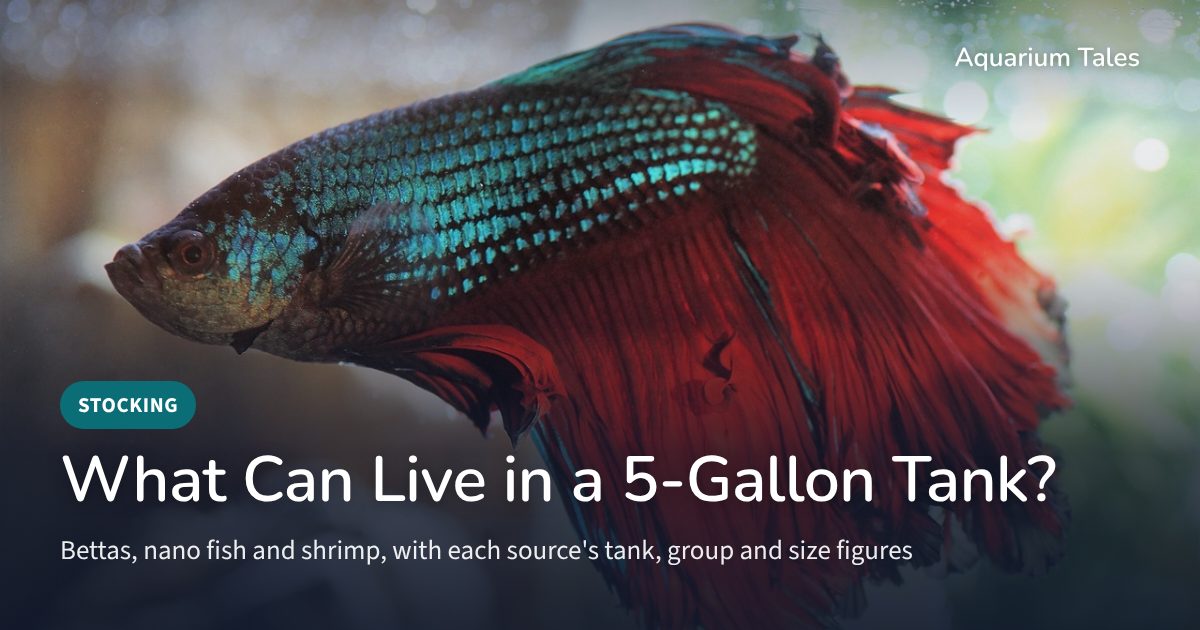
Sources describe four ways to fill 5 gallons: one betta alone; a betta with snails or shrimp (AQQA; Illinois’s vet college says the tank and filter must then grow); shrimp and snails only; or a few nano fish, or one pea puffer alone. LiveAquaria lists 10 gallons for embers, Endler’s and pea puffers; Aquarium Co-Op gives 5 (Endler’s 5-10).
Aqueon is an aquarium-products maker; LiveAquaria (LA) and Aquarium Co-Op (Co-Op) are retailers; AQQA and hygger are aquarium-equipment brands; FishBase is a scientific fish database, and figures after “≈” are our conversions from its metric units. All of it is for freshwater. For bigger tanks, see our guides to fish for a 10-gallon tank and fish for a 20-gallon tank.
Four Ways Sources Fill 5 Gallons
| Source | What it puts in 5 gallons |
|---|---|
| Tree of Life, a veterinary clinic | “Minimum 5 gallons for a single betta”; “Male bettas are territorial and should be kept alone to prevent fighting” |
| University of Illinois veterinary college | A betta “ideally” in “a 5-gallon glass or plastic tank or larger”; to add tank mates, “the size of the tank and filtration system must increase to keep everyone healthy and clean” |
| LA | Betta “at least 4 gallons” kept singly; blue velvet shrimp 5 gallons; 10 gallons on each nano-fish listing used below |
| AQQA | “5 gallons: ideal for one betta or a nano community tank”; for 4-5 gallons, “three to five micro fish or a betta with shrimp/snails” |
| hygger | “1 to 4 fish”; “one male or one female betta, the least killifish, or just invertebrates”; its list adds guppies, mollies, neon tetras, white clouds, honey gouramis and celestial pearl danios |
| Co-Op | Five “favorite” nano fish: one pea puffer, rosy loaches, green neon tetras, white clouds, one scarlet badis |
| Aqueon | For 5-10 gallon tanks: fish “should be small”, generally ½ to 2 inches at most, and “these size tanks do not lend themselves to schools of fish”; it also lists small groups (see below) |
The Nano Fish at a Glance
FishBase’s “Max length” is the largest length it lists, not a typical adult size. SL ends at “the midlateral posterior edge of the hypural plate (in fish with a hypural plate)”, the “base of the caudal fin”; TL is “the greatest length of the whole body”. LA and Co-Op do not say which length they give.
| Species | Size | Tank size, per source |
|---|---|---|
| Betta (Betta splendens) | 6.5 cm TL ≈2.6 in (FishBase); 3 in (LA) | 4 gal kept singly (LA); 5 gal for one (Tree of Life); 2.5-5 gal (AQQA) |
| Chili rasbora (Boraras brigittae) | 3.5 cm TL ≈1.4 in (FishBase); “about ¾ inch” (Co-Op) | 3 gal, planted (Co-Op); 3-10 gal for Boraras (Aqueon); 3-5 gal (AQQA) |
| Ember tetra (Hyphessobrycon amandae) | 2.0 cm SL ≈0.8 in (FishBase); 1.25 in (LA); 0.8 in (Co-Op) | 5 gal “with a smaller school” (Co-Op care guide); 10 gal (LA); 10-20 gal, most tetras (Aqueon) |
| Endler’s livebearer (Poecilia wingei) | 2.0 cm SL ≈0.8 in, female (FishBase); males 1 in, females 1.8 in (Co-Op) | 5-10 gal (Co-Op); 5 gal (AQQA); 10 gal (LA) |
| Green neon tetra (Paracheirodon simulans) | 2.0 cm SL ≈0.8 in (FishBase); “around 1 inch” (Co-Op) | 5 gal (Co-Op’s list); 10-20 gal, most tetras (Aqueon) |
| White cloud minnow (Tanichthys albonubes) | 4.0 cm TL ≈1.6 in (FishBase); 1.5 in (Co-Op; LA, golden) | 5 gal (Co-Op’s list); 10 gal (Co-Op care guide; LA, golden) |
| Pea puffer (Carinotetraodon travancoricus) | 3.5 cm TL ≈1.4 in (FishBase); 1 in (Co-Op) | One in 5 gal (Co-Op); 10 gal in LA’s stats |
| Scarlet badis (Dario dario) | 1.5 cm SL ≈0.6 in, male (FishBase) | One in 5 gal (Co-Op) |
| Rosy loach | 1.25 in (Co-Op) | 5 gal, “Get a school of six or more” (Co-Op’s list) |
Water Ranges by Source
| Species | FishBase: pH; temperature | Maker and retailers: pH; temperature |
|---|---|---|
| Betta | 6.0-8.0; 24-30°C ≈75-86°F | Aqueon: 6.8-7.5; 76-85°F. LA: 6.0-8.0; 75-86°F |
| Chili rasbora | 6.5-7.0; 25-28°C ≈77-82°F | Aqueon (commercially raised rasboras): 6.8-7.8; 75-80°F. Co-Op reports 6.0-8.0; 72-82°F |
| Ember tetra | pH not given; 24-28°C ≈75-82°F | Aqueon (most tetras): 6.8-7.8; 75-80°F. LA: 5.5-7.0; 72-77°F. Co-Op: 5.5-7.5; 72-82°F |
| Endler’s livebearer | not given | Aqueon (most livebearers): 7.0-8.4; 74-78°F. LA: 5.5-8.0; 64-82°F. Co-Op: 6.5-8.5 |
| Green neon tetra | 5.5-6.0; 23-27°C ≈73-81°F | Aqueon (most tetras): 6.8-7.8; 75-80°F |
| White cloud minnow | 6.0-8.0; 18-22°C ≈64-72°F | Aqueon (danio group, which includes white clouds): 7.0-7.8; 70-78°F. LA (golden): 6.5-7.5; 64-72°F. Co-Op: 6.5-8.5; 65-77°F |
| Pea puffer | 7.5-8.3; 22-28°C ≈72-82°F | LA: 7.0-8.0; 72-82°F. Co-Op: kept at 6.5-8.4, 7.2-7.5 “ideal”; 74-82°F |
The Species, One by One
Betta
LA says “only one male betta should be kept in an aquarium”, and that a betta “should be kept singularly in aquariums of at least 4 gallons in size or with suitable, peaceful tank mates.” LA lists “Care Level: Easy”, “Temperament: Peaceful” and “Diet: Carnivore”. Our betta tank size guide gives each vet source’s figure.
Chili Rasbora
Co-Op likes “a school of at least 8-12 together”; AQQA says they are “best in small shoals” of 5-6. Aqueon says some rasboras, “especially members of the genus Boraras, are collected in the wild where the water is very soft and slightly acidic”, and that Boraras “are best kept in a species tank, but due to their small size, they are one of the few fish species that can also be housed with dwarf freshwater shrimp.” Its rasbora guide also says “Rasboras are best purchased in groups of 7 or more”.
Ember Tetra
Co-Op’s care guide says “we like to get at least 6-10 of them”. Its betta tank-mates page, for embers kept with a betta, gives “any aquarium that is 10 gallons or larger in size” and says “Make sure to get at least five to six of them”. Aqueon’s tetra guide, for most tetras: “They do best in schools of 6 or more”. LA: “Temperament: Peaceful”, “Diet: Omnivore”.
Endler’s Livebearer
Co-Op: “The minimum tank size for Endlers is 5-10 gallons, but we recommend going bigger because of all the fry they will produce.” It says they “prefer not to be kept alone”. AQQA advises “males only for less bioload”. For mixed groups, Co-Op recommends “keeping one male for every 2-3 females so that the girls get a little break from being bothered by the boys”, and Aqueon’s livebearer guide says “a ratio of 2 to 3 females per male is advised to prevent excessive harassment of the females”. Aqueon warns: “if you have male and female livebearers, you will eventually have fry – plan accordingly!”
Green Neon Tetra
Co-Op says it “looks like a regular neon tetra but is actually an entirely different species” and advises: “get a school of six and provide lots of shelter”. Aqueon’s guide for most tetras: “They do best in schools of 6 or more”.
White Cloud Minnow
Co-Op’s 5-gallon list says white clouds “don’t even need an aquarium heater”. Its care guide says they “may get stressed if the water gets too warm” and advises “a group of at least six” in “a 10-gallon tank or larger”. FishBase’s aquarium-keeping line says “in groups of 5 or more individuals”; Aqueon’s danio guide says “Danios are best kept in schools of at least 6 or more.”
Pea Puffer
- Tank and group: Co-Op’s 5-gallon list: “we generally recommend only one pea puffer in a 5-gallon fish tank because they can get a bit nippy if you try to cram in more tank mates.” Its care guide gives “five gallons of water for the first puffer and three gallons of water for each additional puffer”, with no other tank mates. LA’s text calls the ideal “a planted aquarium of at least 30 gallons” and says “only one per aquarium is suggested unless it is a large system.”
- Size and diet: FishBase says it “reaches less than 2.5 cm TL” (≈1.0 in). LA: “Care Level: Moderate”, “Temperament: Aggressive”, “Diet: Carnivore”. Co-Op: it “will go after your live snails and dwarf shrimp if given the chance.”
Scarlet Badis
Co-Op: “it’s best to only keep one dario dario in a 5-gallon aquarium”, with tank mates from its list “all except for the pea puffer”. It adds: “They normally only like to eat live and frozen foods at first, so keep them away from your dwarf shrimp.”
Shrimp and Snails
| Animal | Size | Tank and water, per source |
|---|---|---|
| Cherry shrimp (LA lists the blue velvet variety) | 1.5 in (LA) | LA, blue velvet: 5 gal, pH 6.6-7.0, 60-80°F; AQQA: 1+ gal |
| Amano shrimp | 2 in (LA) | LA: 10 gal; AQQA: 2-5 gal |
| Nerite snail | 0.5-1.5 in (Co-Op) | Co-Op: “as small as 2-3 gallons”; they “prefer freshwater setups with higher pH above 7.0 and lots of minerals”; AQQA: 1+ gal |
| Mystery snail | About 2 in across (Co-Op); 1.5 in (LA) | Co-Op: one or two in 5 gal; “ideal” 70-78°F, pH “at least 7.2”; LA: 10 gal; AQQA: 2-5 gal |
LA calls its blue velvet shrimp “a color variety of red cherry shrimp” and says: “Do not house blue velvet shrimp in aquariums with loaches, puffers, and other larger carnivores that will feed on invertebrates.” Co-Op keeps mystery snails only “with a tight-fitting lid that prevents them from crawling out”;
Fish Some Sources Name for 5 Gallons and Others Put Higher
| Fish | Named for 5 gallons | Larger figure |
|---|---|---|
| Neon tetra | hygger’s list | LA: 10 gal. Aqueon (5-10 gal): “avoid the more torpedo shaped tetras like neons and cardinals” (or 12+, below) |
| Guppy | Co-Op: 5 gal “for a trio”; Aqueon: most livebearers, 5-20 gal (larger tanks “are easier to take care of”); hygger’s list | LA: 10 gal; Co-Op: 10-20 gal “in the long run” |
| Celestial pearl danio | hygger’s list | Co-Op: “at least 10 gallons”, and “go for a 20-gallon aquarium or larger” for a school of 10-15; LA: 10 gal |
| Honey gourami | Co-Op: one, “in a 5- or 10-gallon tank”; hygger’s list | Co-Op: “a group of three gouramis would do better in a 20-gallon aquarium”; Aqueon, for four gourami kinds including honey: “as small as 10 gallons”; LA: 10 gal |
| Pygmy cory | Co-Op: a small group “could technically fit in a 5-gallon nano tank” | Co-Op: “a 10-gallon or larger aquarium” for “at least 8-12 pygmies” |
Aqueon’s reason for the neon line: “When only a few neons or cardinals mixed in with other species are kept in the tank, they do not display their best.”
How Many Fish Fit in 5 Gallons?
- hygger: “the answer is 1 to 4 fish”. Its size limits: “you can keep about 2-4 fish in a tank this size, as long as each fish is not larger than 1 inch”, and “1-4 fish can be kept in a 5-gallon fish tank provided they cannot grow over 2 inches in size and the filtration system is working properly”.
- AQQA: for a nano community, “keep groups small, around 5-6 nano fish total”; its table gives 5 gallons a “recommended max fish length” of “4-5 inches”. It adds: “In the case of uncertainty, do not stock more fish, but fewer.”
- Co-Op: “In the past, it was often recommended to beginners that you can keep 1 inch of fish for every 1 gallon of water. This rule of thumb mainly applies to small community fish that are approximately 1-3 inches (2-7 cm) in size.” For a cycled tank, its “easiest way” is “measuring the nitrate level and making sure it stays below 40 ppm”.
- Aqueon gives no total for 5 gallons: “The bigger they are, the fewer you want to keep.” For its 5-10 gallon band it lists small groups: a small group of 4-6 diamond-shaped tetras such as serpae or black phantoms; at least 3 livebearers, “preferably 1 male and 2-3 females”; “A group of 4-6 Corydoras” of the smaller species (panda, salt and pepper); a small group of danios; and for neons “a minimum of 12 fish” with no other fish but Corydoras or a bristlenose pleco. It advises avoiding swordtails and sailfin mollies “if your aquarium is under 10 gallons”. On nitrate: “Nitrate toxicity to fish varies depending on species, age and overall health, but levels above 50 ppm are undesirable in freshwater aquaria.”
Before the First Fish
Must-haves
A cycling plan
Among the cons of 5-gallon tanks, AQQA says “both temperature and ammonia may vary rapidly.” API, a test-kit maker, describes a “fishless cycle” that “would require daily dosing of ammonia and bacteria”, and a “fish in cycle” where “it is recommended to add small amounts of fish at a time”. See our guide to cycling a fish tank.
A gentle filter
Aqueon says a filter “should have a flow rate at least four times the volume of the tank per hour”, which is 20 gallons per hour for 5 gallons (our arithmetic). For chili rasboras Co-Op advises “a filter with low current like a sponge filter”, or a prefilter sponge over a hang-on-back or canister intake “so the nano fish won’t accidentally get sucked up”. Tree of Life says “Gentle filtration is recommended” and “bettas dislike strong currents”.
A heater and thermometer
Aqueon advises a heater when the room is below 76° for bettas, 75° for tetras and rasboras, 74° for livebearers and 70° for danios and white clouds. See our tank temperature guide. For the Hydor Theo in the box below, Hydor, the heater’s maker, gives two different waits before a water change. Its manual says to disconnect it “at least 5 minutes before taking it out of the water or before adding or changing the water”; its support page says to turn it off and unplug it “at least 30 minutes before any waterchange”, that its heaters “MUST NOT be used out of water” and “The Heater can ONLY then be turned back on when the Aquarium is full and the heater is completely submerged.” Without the manual to hand, our reading is the longer wait.
A test kit and water conditioner
Aqueon: “Test the aquarium water for pH, ammonia and nitrite before adding new fish” and “Always treat tap water with a water conditioner to neutralize chlorine and ammonia before adding it to the aquarium.” It says “The only safe ammonia level is zero” and “The only safe nitrite level is zero”.
A secure lid
Aqueon: “bettas are jumpers, so keep a secure lid on the tank!”
A slow start
Aqueon: “only buy a few fish at a time. Wait at least a week between new fish additions.” Co-Op measures nitrate “each week for 2 to 3 weeks in a row” before adding the next species. See our guide to adding new fish.
| # | Preview | Product | Price | Link |
|---|---|---|---|---|
| 1 |  | Marineland Portrait 5 Gallon Fish Tank Kit | Aquarium Kit…Tall 5-gallon glass kit | Check on Amazon | |
| 2 |  | Aqueon LED MiniBow Small Aquarium Fish Tank Kit with…5-gallon acrylic kit | $72.95 Prime | Check on Amazon |
| 3 |  | Hydor Theo Shatterproof Aquarium Heater, 25-Watt & Ideal…Adjustable heater, 2.6-6.6 gal | $26.88 Prime | Check on Amazon |
Both kits come without a heater and are compared in our betta fish tank roundup. It lists the Portrait’s tall, narrow shape among its cons and notes that one owner found its flow strong at the lowest setting; for the MiniBow 5 it notes that owners in one thread differ on the filter’s flow. The Hydor Theo 25 W is in our heater roundup: Hydor rates it for 2.6 to 6.6 gallons when the tank is up to 14°F warmer than the room, or up to 4 gallons for a 22°F lift.
What changes the list
- Shrimp or snails in the plan: see Co-Op’s pea puffer and scarlet badis lines and Aqueon’s Boraras line above.
- A cool room: Co-Op says you can keep Endler’s “at room temperature in an aquarium without a heater” and that white clouds “don’t even need an aquarium heater”; Aqueon advises a heater when the room is below 74° for livebearers and 70° for danios and white clouds.
- Your tap water: the ranges above differ, from FishBase’s pH 5.5-6.0 for green neons to 7.5-8.3 for pea puffers.
Ready to buy?
Our tropical fish food roundup compares flakes, granules and sinking pellets.
Frequently Asked Questions
Q. Can a goldfish live in a 5-gallon tank?
hygger says “the goldfish cannot be kept in a 5 gallon.” Aqueon: “Goldfish should never be kept in bowls, small aquariums or any unfiltered container!” It gives adult common goldfish, comets and shubunkins “at least 20 gallons of water per fish, while adult fancy goldfish should have at least 10 gallons per adult fish.”
Q. Can a betta share a 5-gallon tank?
AQQA says “you can add snails or shrimp as companions if space allows.” A University of Illinois veterinarian lists “snails, ghost shrimp, certain species of fish, and African dwarf frogs” as tank mates, but the column says the tank and filter “must increase”. For fish tank mates Co-Op asks for “at least 10 to 20 gallons with lots of cover and live plants”, and Aqueon for “a peaceful community aquarium of 15 gallons or larger.”
Q. Is a 5-gallon tank good for a beginner?
Aqueon calls 5 to 10 gallons “the aquarium size range that can cause the most problems by adding too many fish or fish that get too large.” hygger says 5 gallons “could be very tricky if you don’t have a filtration system that is working properly.” See our beginner fish guide.
Q. What should I do if a fish looks sick?
Test ammonia and nitrite first, and ask an aquatic veterinarian about the fish; disease and medication are outside what this site covers.
Sources (55)
- FishBase (database), betta
- FishBase, chili rasbora
- FishBase, ember tetra
- FishBase, Endler’s livebearer
- FishBase, green neon tetra
- FishBase, white cloud minnow
- FishBase, pea puffer
- FishBase, scarlet badis
- FishBase, standard length
- FishBase, total length
- Aqueon (maker), fish by tank size
- Aqueon, bettas
- Aqueon, rasboras
- Aqueon, tetras
- Aqueon, livebearers
- Aqueon, danios
- Aqueon, gouramis
- Aqueon, goldfish
- Aqueon, filters
- Aqueon, do’s and don’ts
- Aqueon, water quality
- Aqueon, first 60 days
- API (test-kit maker), cycling
- Hydor (maker), Theo manual
- Hydor, Theo water-change answer
- Tree of Life (veterinary clinic), betta care
- University of Illinois (veterinary college), bettas
- AQQA (equipment brand), tanks under 5 gallons
- hygger (equipment brand), 5-gallon tank
- Co-Op (retailer), 5-gallon nano fish
- Co-Op, how many fish
- Co-Op, chili rasboras
- Co-Op, ember tetras
- Co-Op, Endler’s livebearers
- Co-Op, white clouds
- Co-Op, pea puffers
- Co-Op, nerite snails
- Co-Op, mystery snails
- Co-Op, guppies
- Co-Op, celestial pearl danios
- Co-Op, honey gouramis
- Co-Op, pygmy corys
- Co-Op, betta tank mates
- LA (retailer), veiltail betta
- LA, ember tetra
- LA, Endler’s livebearer
- LA, golden white cloud
- LA, Indian dwarf puffer
- LA, blue velvet shrimp
- LA, amano shrimp
- LA, gold mystery snail
- LA, neon tetra
- LA, guppies
- LA, celestial pearl danios
- LA, honey gourami
Product prices and availability are accurate as of the date/time indicated and are subject to change. Any price and availability information displayed on Amazon.com at the time of purchase will apply to the purchase of this product.
