The short answer
Tree of Life, a vet clinic, gives a 5-gallon minimum for one betta, and a University of Illinois vet says “ideally” 5 gallons or larger. The lowest vet-written figure is PetMD’s “at least 2.5 gallons”, with 5–10 or 10+ gallons ideal. Two vets quoted here warn against bowls.
This guide covers one betta kept alone in a freshwater tank. Each figure below is one source’s own; we do not average them or set our own.
Betta tank size by source
| Source (type) | Size it gives | Its wording |
|---|---|---|
| University of Illinois vet college column | 5 gal or more | “ideally be in a 5-gallon glass or plastic tank or larger” |
| Tree of Life (exotic-pet vet clinic) | 5 gal | “Minimum 5 gallons for a single betta” |
| The Spruce Pets (byline: an aquatic vet) | 5 gal | “ideal for most” (intro); “a minimum” (FAQ) |
| LiveAquaria (fish retailer) | 4 gal | “at least”, kept “singularly” |
| PetMD (vet-written sheet; its shop links go to Chewy) | 2.5 gal | “At least 2.5 gallons” |
| Chewy (pet retailer; AI-assisted, human-edited) | 2.5 gal | “Many experienced aquarists consider 2.5 gallons the minimum” |
| AAGB (UK fishkeeping association, 2016) | 5 litres (about 1.3 gal) | “absolute minimum”, “for long-term maintenance” |
| Aqueon (aquarium maker) | No figure | “they don’t require a lot of space. However, larger habitats are more stable and easier to maintain.” |
The Illinois column quotes Dr. Krista Keller, a board-certified zoological medicine specialist. The Spruce Pets, a pet-care publisher, bylines its betta tank list to aquatic veterinarian Jessie Sanders, DVM; it adds: “In some cases, you can use a smaller tank”, but says smaller tanks need more maintenance and are “more susceptible to temperature swings throughout the day.” PetMD’s sheet, by Maria Zayas, DVM, gives three “ideal” sizes: “5–10 gallons” in its summary, “10 gallons or larger” in its text and “A 2.5+ gallon aquarium with a lid” in its FAQ. The Anabantoid Association of Great Britain (AAGB) wrote its guidelines with Dr Peter Burgess; Practical Fishkeeping, a UK fishkeeping magazine, printed them, and its writer added: “I’d personally aim for tanks of 20 litres capacity or so for a single male.” (about 5 gallons; our conversion). He also said the 5 litres “will still be way too small for some”.
Why the sources lean bigger
Our reading: a minimum here is a floor, not a target. Besides The Spruce Pets and Aqueon above, three sources say more water helps:
- Tree of Life: “Larger tanks provide more stable water conditions and allow for enrichment”.
- PetMD: “bigger fish tanks are often easier to keep stable (temperature and water chemistry swing less)”.
- The AAGB: “Smaller volumes present a significant challenge in maintaining good, stable water conditions.”
Bowls and vases
- University of Illinois: Dr. Keller says “Betta fish are often seen living in bowls that are too small to allow for normal swimming and hiding behavior,” and “They should not live in bowls.”
- The Spruce Pets quotes aquatic veterinarian Dr. Jessica Fox, DVM: “We have seen too many betta fish kept in inappropriate environments (e.g., bowls or vases) that can severely impact their health.”
- AAGB: “Bare tanks or bowls may cause stress as the Betta will have nowhere to escape from perceived threats.”
- Tree of Life: “While often marketed as low-maintenance pets that can live in small bowls, bettas thrive when provided with proper tank size, warm water, filtration, and enrichment.”
- Aqueon’s two pages differ. Its setup article says keeping a betta “in tiny bowls or narrow vases” isn’t “the best choice for your betta”, and that “in a pinch, they can survive in a less hospitable, shallow environment. But they don’t prefer tiny spaces.” Its care guide says the labyrinth organ makes “it possible for them to live in small aquariums without circulation”.
Betta tank checklist
Our split, starting from PetMD’s supply checklist and its “optional” labels; the rest is our call.
Must-haves
- A tank. Sizes differ (table above): Tree of Life, “Minimum 5 gallons for a single betta”; the Illinois column, “ideally” 5 gallons “or larger”; PetMD’s checklist, “Aquarium (2.5 gallons or larger)”.
- A lid. PetMD: “Lid/cover (bettas can jump)”. The AAGB: “The aquarium should have a close-fitting cover.”
- A heater and thermometer. The Illinois column: “Because most homes are kept at a lower temperature, an in-tank water heater will be needed to maintain the temperature.” Betta temperature ranges and safe heater setup are in our guide to what temperature a fish tank should be.
- A gentle filter. PetMD: “Air-driven sponge filters or box filters or very low flow rate filters are ideal for bettas.” Aqueon’s care guide says “bettas do not necessarily need a filter” but that one “provides them with optimum water quality”; for “small unfiltered containers” it says to “change 1/3 of your betta’s water every 3 to 4 days”; our betta tank cleaning guide covers the steps. Our filter-current guide covers turning one down.
- Water conditioner and a test kit. PetMD lists both and says to “Test tank water weekly”; our cycling guide covers readying a new tank.
- Hides and resting spots, and food. PetMD lists “Decorations for hiding and resting (live or artificial plants, caves, logs—smooth edges only)” and “Betta fish food”. Dr. Keller: “Decorations for a tank should never take up too much of the tank, pushing the fish to the periphery”. Our betta food roundup compares foods.
Nice-to-haves
- Our call: more water than the figure you pick, since the sources above say bigger is more stable.
- Substrate and a lidded bucket for conditioned water (both “optional”), and an LED light (“helpful”), per PetMD.
Per our betta tank roundup, Aqueon’s MiniBow 5 is a 5-gallon acrylic kit with no heater. For the MiniBow, our aquarium heater roundup reports that Hydor rates the adjustable Theo 25 W for 2.6 to 6.6 US gallons when the tank is up to 14°F warmer than the room, or up to 4 gallons for a 22°F lift. A 5-gallon tank falls in the 14°F row only, so for a 78°F tank in a room below about 64°F it is outside Hydor’s figures (our arithmetic). Hydor’s manual says “the heater should be disconnected from the power supply at least 5 minutes before taking it out of the water or before adding or changing the water.” PetMD: “Select a heater that provides about 3–5 watts per gallon”; 25 W on 5 gallons is 5 watts per gallon (our arithmetic).
| # | Preview | Product | Price | Link |
|---|---|---|---|---|
| 1 | 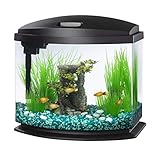 | Aqueon LED MiniBow Small Aquarium Fish Tank Kit with…5-gallon acrylic kit, no heater | $72.95 Prime | Check on Amazon |
| 2 |  | Hydor Theo Shatterproof Aquarium Heater, 25-Watt & Ideal…Adjustable heater, 2.6-6.6 gal | $26.88 Prime | Check on Amazon |
What changes the list
- Another betta. The CDC, a US federal health agency: “Some types of fish, like male betta fish, can’t be in the same aquarium together because they will fight.” The Illinois column: bettas “should not be housed with any other betta fish because they will fight and injure each other, often resulting in death.” The AAGB: “Never keep two or more adult male Bettas together as they will fight, often to the death.” The Spruce Pets: “they should never share their tank with another betta fish.” The AAGB adds: “Male and female Bettas should not be housed together except for breeding purposes”. Female groups are outside this guide and sources differ: PetMD says females “may be kept in groups called a sorority, but the tank should be at least 10 gallons, and the setup needs lots of hiding places”; Tree of Life, “Females can sometimes be housed in sororities(groups) in larger, heavily planted tanks under careful monitoring”; The Spruce Pets, “not all female betta fish get along with other betta fish”.
- Tank mates. Aqueon, the only source here that gives a size, says bettas “can be kept with other fish in a peaceful community aquarium of 15 gallons or larger” and adds: “Avoid putting them with male gouramis, fin-nippers such as tiger barbs or active fish like giant danios.” Dr. Keller names tank mates “such as snails, ghost shrimp, certain species of fish, and African dwarf frogs”; the Illinois column adds that “the size of the tank and filtration system must increase to keep everyone healthy and clean.”
- Shape and long fins. The Spruce Pets lists “narrow, tall tank limits swimming patterns” against a tall 5-gallon kit. PNW Bettas, a betta breeder and shop in Oregon, says “in general I recommend a 5+ gallon tank” and “having longer, more shallow tanks is preferred”. It says “every fish is different” and that a long-finned “dumbo” “that just needs to rest more often” “may do best in a shallow 3 gallon long”; it finds a 3 gallon long “better suited” than “a tall 5 gallon”, not better than 5 gallons in general. That is one breeder’s view.
Betta at a glance
| Field | Figure | Source |
|---|---|---|
| Scientific name | Betta splendens | PetMD; Tree of Life |
| Care level | “Beginner-friendly”, with “a properly equipped, fully cycled tank” | PetMD |
| Minimum tank | Sources differ (table above) | |
| Temperament | Males “territorial”, “kept alone to prevent fighting” | Tree of Life |
| Adult size | 2.5–3 in body length | PetMD |
| Temperature range | 76–81°F; 78–80°F; 76–85°F | PetMD and Illinois; Tree of Life; Aqueon |
| pH range | 6.5–7.8 tolerated, target around 7; 6.8–7.5 | PetMD; Aqueon and Tree of Life |
| Diet | Carnivores | Illinois; PetMD |
See also how long betta fish can go without food and our beginner fish guide, which lists the betta among ten starter species. If your betta looks unwell, test the water and contact an aquatic veterinarian; we do not diagnose or treat fish.
Ready to buy?
Our betta tank roundup compares eight kits from 2.5 to 20 gallons; more species guides are in our Stocking section.
Frequently Asked Questions
Q. Is a 1 or 2 gallon tank enough for a betta?
Two gallons is below PetMD’s 2.5, LiveAquaria’s 4 and the 5-gallon figures. It is above only the AAGB’s 5 litres (about 1.3 gallons), a figure Practical Fishkeeping’s writer said “will still be way too small for some”. One gallon (about 3.8 litres) is below every figure in the table.
Q. Can one betta live in a 3 gallon tank?
It is below the 5-gallon minimums of Tree of Life and The Spruce Pets, and below the Illinois vet’s “ideally” 5 or larger.
Q. Can I keep two bettas in one tank?
Not in one open tank, on the sources here (see “Another betta”). Aqueon says males “must be kept separately or in a partitioned container” and gives no size for each side. This guide’s sizes are for one betta, so a divided tank is not covered; the vet sources do not discuss dividers, and the Practical Fishkeeping writer criticised retailers “selling tiny ‘Betta racks’ to be inserted into tanks, holding multiples of the fish side by side”.
Q. What size is a betta tank in litres or inches?
5 gallons is about 19 litres, 2.5 gallons about 9.5 and 10 gallons about 38. A 4 x 6 x 8 inch container holds about 0.8 gallons filled to the brim (192 cubic inches ÷ 231 per US gallon), below every figure in the table, the AAGB’s 5 litres included. All are our conversions.
Sources (12)
- University of Illinois, Bettas Need More Than Bowls (vet college column)
- Tree of Life, Betta Fish Care (vet clinic)
- PetMD, Betta Fish Care Sheet (vet-written)
- The Spruce Pets, tanks for betta fish (publisher; vet-written)
- Practical Fishkeeping, AAGB guidelines (magazine)
- Aqueon, Betta Care Guide (maker)
- Aqueon, Betta Fish Tank Setup (maker)
- CDC, Fish (agency)
- LiveAquaria, Veiltail Betta (retailer)
- Chewy, betta tank size (retailer)
- Hydor, Theo heater manual (maker)
- PNW Bettas, betta tank size (breeder and shop)
Product prices and availability are accurate as of the date/time indicated and are subject to change. Any price and availability information displayed on Amazon.com at the time of purchase will apply to the purchase of this product.
