The short answer
Sources give minimum tanks of 30 gallons or less for tiger and rosy barbs, rummy-nose tetras, peppered and bronze corys, bristlenose plecos, swordtails, sailfin mollies, a single pearl gourami, cockatoo dwarf cichlids and neon dwarf rainbowfish. Angelfish, kribensis, rainbow sharks and goldfish are disputed at this size.
Aqueon, an aquarium-products maker, says tanks of 20 to 50 gallons can hold “all of the small fish that do well in the smaller tanks (even more of them)” and some fish of 3 to 4 inches. Aquarium Co-Op (Co-Op) and LiveAquaria (LA) are retailers; FishBase is a scientific fish database, and figures after “≈” are our conversions from its metric units. All figures are for freshwater.
See also our guides to fish for a 10-gallon tank, fish for a 20-gallon tank and our beginner fish guide.
The 11 Species at a Glance
FishBase’s “Max length” is the largest length it lists, not a typical adult size. It gives some as SL, which ends at “the midlateral posterior edge of the hypural plate” (or the end of the vertebral column in fish without one), the “base of the caudal fin”, and some as TL, “the greatest length of the whole body”.
| Species | Size, per source | Tank size, per source |
|---|---|---|
| Tiger barb | 7.0 cm TL ≈2.8 in (FishBase); 3 in (LA); 2.5-3 in (Co-Op) | 30 gal (LA; Aqueon barb guide); 29 gal “or larger” (Co-Op) |
| Rosy barb | 14.0 cm TL ≈5.5 in (FishBase); 6 in “in the wild” (LA); 3-4 in (Co-Op) | 30 gal (LA; Aqueon barb guide); 29 gal, unheated (Co-Op) |
| Rummy-nose tetra | 5.0 cm TL ≈2.0 in (FishBase); 2 in (Co-Op) | 20 gal “or bigger” (Co-Op); 10-20 gal for most tetras (Aqueon) |
| Pearl gourami | 12.0 cm TL ≈4.7 in (FishBase); 4.5 in (LA); 5 in (Co-Op) | 30 gal (LA; Aqueon gourami guide); one in 29 gal (Co-Op) |
| Peppered cory | 6.6 cm SL male, 7.1 cm SL female ≈2.6-2.8 in (FishBase); 2.5 in (LA); 3 in (Co-Op) | 30 gal (LA); 30 gal “best for most species” (Aqueon) |
| Bronze cory | 7.5 cm SL ≈3.0 in (FishBase); 2.5 in (LA); 2.5-2.75 in, albino form (Co-Op) | As for the peppered cory |
| Bristlenose pleco | 6 in (LA); 4-6 in (Co-Op) | 30 gal (LA); 20-29 gal “or more” (Co-Op); named for 20-50 gal (Aqueon) |
| Swordtail | 14.0 cm TL male, 16.0 cm TL female ≈5.5-6.3 in (FishBase); 4 in (LA); 4-6 in (Co-Op) | 20 gal (LA); named for 20-50 gal (Aqueon) |
| Sailfin molly | 15.0 cm TL male ≈5.9 in, 10.0 cm TL female ≈3.9 in (FishBase); 5 in (LA); 4-5 in for mollies (Co-Op) | At least 20 gal; 29-55 gal “more suitable for larger species” (Co-Op); 30 gal (LA) |
| Cockatoo dwarf cichlid | 5.0 cm SL male ≈2.0 in (FishBase); 2.5 in (LA) | 30 gal (LA); 20 gal for one or a pair of apistos (Co-Op); 10-20 gal for a mated pair (Aqueon) |
| Neon dwarf rainbowfish | 5.0 cm SL ≈2.0 in (FishBase); 3 in (LA, Co-Op) | 30 gal (Aqueon); 20 gal (LA); 20 long or 29 gal (Co-Op) |
FishBase’s aquarium notes say “in groups of 5 or more individuals” for both barbs, the rummy-nose, both corys and the rainbowfish. Of the ten LA listings behind the table, all but the cockatoo cichlid say “Diet: Omnivore”, and all but the molly and the cockatoo “Care Level: Easy”.
Water Ranges by Source
Aqueon says to “choose fish whose preferred temperature ranges match the temperature of your tank”, and warns that a middle ground between two species “may stress both fish because one is always a little cold, and the other is a little warm.”
| Species | FishBase: pH; temperature | Maker and retailers: pH; temperature |
|---|---|---|
| Tiger barb | 6.0-8.0; 20-26°C ≈68-79°F | Aqueon (barbs): 6.8-7.8; 75-80°F. LA: 6.0-7.0; 74-79°F. Co-Op: 6.0-8.0; 72-82°F |
| Rosy barb | 6.0-8.0; 18-22°C ≈64-72°F | Aqueon (barbs): 6.8-7.8; 75-80°F. LA: 6.0-7.0; 74-79°F. Co-Op: “without a heater” |
| Rummy-nose tetra | not given | Aqueon (most tetras): 6.8-7.8; 75-80°F. Co-Op: 5.5-7.5; 74-84°F |
| Pearl gourami | 6.0-8.0; 24-28°C ≈75-82°F | Aqueon (gouramis): 6.8-7.8; 75-80°F. LA: 6.0-8.0; 61-79°F |
| Peppered cory | 6.0-8.0; 18-23°C ≈64-73°F | Aqueon (captive-bred corys): 7.0-8.0; 74-80°F. LA: 5.8-7.0; 72-79°F. Co-Op: down to 68°F |
| Bronze cory | 6.0-8.0; 25-28°C ≈77-82°F | Aqueon (captive-bred corys): 7.0-8.0; 74-80°F. LA: 6.0-7.2; 72-79°F |
| Bristlenose pleco | no single record (sold as Ancistrus sp.) | Aqueon (captive-bred plecos): 7.0-8.0; 74-80°F. LA: 6.5-7.4; 72-82°F |
| Swordtail | 7.0-8.0; 22-28°C ≈72-82°F | Aqueon (most livebearers): 7.0-8.4; 74-78°F. LA: 7.0-8.3; 64-82°F |
| Sailfin molly | pH not given; 20-28°C ≈68-82°F | Aqueon (most livebearers): 7.0-8.4; 74-78°F. LA: 7.0-7.8; 68-82°F. Co-Op: 75-80°F |
| Cockatoo dwarf cichlid | 6.0-8.0; 24-25°C ≈75-77°F | Aqueon (captive-bred dwarf South American cichlids): 7.0-7.5; 78-84°F. LA: 6.5-7.5; 72-86°F. Co-Op (apistos): 80-82°F |
| Neon dwarf rainbowfish | pH not given; 22-28°C ≈72-82°F | Aqueon (Melanotaeniids): 7.0-8.0; 74-78°F. LA: 6.8-7.5; 72-77°F. Co-Op: 74-80°F |
The Species, One by One
Tiger Barb (Puntigrus tetrazona)
Aqueon’s tank-size guide says tiger and rosy barbs “will do well in tanks of this size in groups of 6 or more”, its barb guide “schools of at least 6 to 10 fish”, and Co-Op’s store recommends “a minimum of seven and prefer more than 12 if possible”, because “Having a big group of tiger barbs spreads out the aggression among themselves and towards other fish.” LA says it “may pester or even nip the fins of larger, slower moving fish.”
Rosy Barb (Pethia conchonius)
Co-Op’s barb list says “A school of 6–10 rosy barbs can live without a heater in a coldwater aquarium of 29 gallons or more”; its 29-gallon ideas page says “Get a school of four to six fish”. LA’s listing says: “If in a large enough school, they typically will not bother any other fish in the aquarium.” Aqueon says barbs are “sometimes unfairly characterized as being fin-nippers, largely due to the behavior of a few types like tiger barbs, rosy barbs and black ruby barbs.”
Rummy-Nose Tetra (Petitella rhodostoma)
FishBase’s Hemigrammus-rhodostomus page now carries this name. Co-Op says “While six is the typical number suggested for a school of fish, rummy-nose tetras need a bigger group to see their special swimming behavior. Get at least 8–12 tetras and you won’t regret it.” On tank mates: “do not put them with cooler water fish because of the mismatched temperature requirements.”
Pearl Gourami (Trichopodus leerii)
Sources differ on numbers. Co-Op: “you can keep one in a 29-gallon tank or a group of them in a 55- or 75-gallon aquarium.” Aqueon’s tank-size guide says of pearl and three spot gouramis: “It is generally a good idea to keep at least a pair of these fish, but you may want to add more females to reduce male aggression.” Aqueon’s gourami guide is about males: “Male gouramis have a tendency to be aggressive towards each other, so they should typically be kept individually. Female gouramis usually tolerate each other well.”
Peppered Cory (Corydoras paleatus) and Bronze Cory (Corydoras aeneus)
- FishBase now files these as Hoplisoma paleatum and Osteogaster aenea. Aqueon says corys “should be purchased in groups of 5 or more”; LA says six or more; Co-Op, for the albino bronze, “at least five to six same-species companions”. Co-Op says the peppered cory “can go in cooler waters at 68°F (20°C)”.
- Caution: Aqueon’s Corydoras guide: “Pristine water quality is essential to good health in these catfish. They should never be added to new aquariums or those that have been neglected.”
Bristlenose Pleco (Ancistrus sp.)
Aqueon calls it “A much better choice” than the common pleco, which “will get too large for tanks of this size and should not be kept,” and adds: “Like all bottom feeders, it should be fed specifically and not just dependent on algae and scraps.” Co-Op warns that some plecos “(especially the males) can be territorial towards their own kind or other bottom dwellers”, and says bristlenoses “can be kept in multiples as long as you aim for more females than males and provide plenty of caves and hides”.
Swordtail (Xiphophorus hellerii) and Sailfin Molly (Poecilia latipinna)
Aqueon names “the larger livebearers such as swordtails and sailfin mollies” for 20 to 50 gallons: “When given more room to swim and move around, these fish will get up to their true size.” It says swordtail females “can get well over 3” long” and male sailfin mollies are “typically larger, getting up to about 3””. Its livebearer guide advises “a ratio of 2 to 3 females per male”, and its tank-size guide warns: “if you have male and female livebearers, you will eventually have fry – plan accordingly!” LA: “male swordtails can get territorial and exhibit some aggression towards one another”. FishBase: “the males aggressive towards each other”.
Cockatoo Dwarf Cichlid (Apistogramma cacatuoides)
Aqueon says a 10- to 20-gallon tank “will suffice for a mated pair, however, larger aquariums allow for larger groups and/or additional tank mates,” and that “males may quarrel over territory”. LA: it “should not be housed with large, aggressive fish.”
Neon Dwarf Rainbowfish (Melanotaenia praecox)
Aqueon says it “will thrive in a 30-gallon aquarium” and that rainbowfish “should be kept in groups of 6 or more for best effect.” Co-Op says they “require at least 6 or more of the same species”, advises “at least 1–2 females for every male to minimize their squabbling” and says “they prefer harder, alkaline water.”
Where Sources Differ on 30 Gallons
- Angelfish (Pterophyllum scalare). For: Co-Op’s angelfish guide says “For a 29-gallon community tank, keep no more than four adult angelfish with other tank mates.” Its centerpiece page says that “if you have upwards of 20 or 25 gallons (especially a vertically tall tank), they’ll fit right in”, and “if you only have one – and we do encourage just one”. LA: 30 gal, 6 in. hygger’s 30-gallon table: 1-2. Against: Aqueon’s angelfish guide says they need “an aquarium of 55 gallons or larger when full grown”, and Bubble-Magus lists “2–3 Angelfish (in a 75 gallon or larger tank)”. FishBase: “in groups of 5 or more individuals; keep pairs in small tanks for breeding”.
- Kribensis (Pelvicachromis pulcher). For: Co-Op’s “Top 10 Cichlids We Love to Keep in 29-Gallon Aquariums” lists it. Against: LA says it is “ideally kept in a 50-gallon or larger aquarium” and lists 4 in. Aqueon gives no tank size; its 55-120 gallon section says kribensis “would do well as a pair in a smaller aquarium”. FishBase: 11.0 cm TL ≈4.3 in, “in pairs”.
- Rainbow shark (Epalzeorhynchos frenatum). For: Co-Op’s GloFish setup of tiger barbs or black skirt tetras says to “start with a group of six to 10 fish of the same species”, and “For a 30-gallon aquarium with a longer, 3-foot (91 cm) footprint, you may be able to add one GloFish shark (rainbow shark) as well.” Against: LA: 50 gal, 6 in. Aqueon gives no gallon figure: “Red tail and rainbow sharks become territorial as they grow and should be provided with plenty of space as well as caves and other structures to call ‘home’.” Toward one another, they “are best kept individually when they get older”. FishBase: 15.0 cm TL ≈5.9 in.
Goldfish in 30 Gallons: What Each Source Says
Aqueon: “Goldfish should never be kept in bowls, small aquariums or any unfiltered container!” Sources differ:
- Aqueon’s goldfish guide: adult common goldfish, comets and shubunkins “should have at least 20 gallons of water per fish, while adult fancy goldfish should have at least 10 gallons per adult fish.” Its tank-size guide says “A 29-gallon aquarium would be a good home for 3-4 of the fancy Ryukin or Oranda varieties.”
- Co-Op’s fancy goldfish guide: “in general, we recommend 20 gallons of water volume per goldfish, with at least 10 gallons added for every other goldfish”, which comes to 30 gallons for two (our arithmetic). Its 29-gallon ideas page says “we recommend choosing only one fancy goldfish for this setup”, and “do not add too many tank mates unless you plan to upgrade to a 40- to 55-gallon tank.”
- LA lists 30 gallons and 10 in for its ryukin listing.
Temperatures differ too: Co-Op keeps fancy goldfish at “50–70°F (10–21°C)”; Aqueon says “The optimum temperature for fancy goldfish is 68° to 74° F” and “Considered cold water fish, goldfish can also be kept in heated aquariums.”
Which Fish Go Together
| Keep apart | Why | Source |
|---|---|---|
| Barbs and timid, slow or long-finned fish | “Some barbs communicate by nipping at each other, so avoid mixing these fish with timid, slow moving or long-finned fish such as neon tetras, angelfish, guppies or bettas.” | Aqueon barb guide; FishBase (tiger barb): “not to be kept with long-finned fishes” |
| Gouramis and fin nippers | “Gouramis are slow moving and are best kept with similar sized fish that are not fin nippers or too active.” | Aqueon gourami guide |
| Angelfish and small fish | “they will not hesitate to eat smaller fish” | Aqueon angelfish guide |
See our checklist for choosing fish for a tank.
How Many Fish Fit in 30 Gallons?
- Co-Op: “In the past, it was often recommended to beginners that you can keep 1 inch of fish for every 1 gallon of water. This rule of thumb mainly applies to small community fish that are approximately 1-3 inches (2-7 cm) in size.” For a cycled tank, its “easiest way” is “measuring the nitrate level and making sure it stays below 40 ppm”.
- Bubble-Magus, an aquarium-equipment brand, says “A 30 gallon tank can support 20–25 small to medium fish”; for 30- to 75-gallon tanks it lists “A large school of Corydoras Catfish (6–8 fish)” and “A small group of peaceful gouramis (3–4 fish)”.
- hygger, an aquarium-equipment brand, gives in its 30-gallon table 9-11 cory catfish, 4-6 mollies, 3-5 bristlenose plecos and 3-5 rainbowfish; the rainbowfish figure is under Aqueon’s and Co-Op’s six.
- Aqueon gives no count, but says: “With these larger fish, sometimes their natural territoriality and aggression can be a concern, so care must still be made to not overcrowd them.” Its nitrate line differs from Co-Op’s: “levels above 50 ppm are undesirable in freshwater aquaria.”
Before the First Fish
Must-haves
A cycled tank
API, a test-kit maker, describes a “fishless cycle” that “would require daily dosing of ammonia and bacteria”, and a “fish in cycle” where “it is recommended to add small amounts of fish at a time”. See how to cycle a fish tank and our tank set-up guide.
A filter
Aqueon: “Ideally, the flow rate of your filter should be between four and six times the size of your tank.” For 30 gallons that is 120 to 180 gallons per hour (our arithmetic).
A heater and thermometer
Set them for the species you keep; see our tank temperature guide. Co-Op’s unheated-tank idea (rosy barbs, peppered corys) is for “a chilly office building, basement, or living room tank with no aquarium heater”.
A test kit and water conditioner
Aqueon says to “Test the aquarium water for pH, ammonia and nitrite before adding new fish” and “Always treat tap water with a water conditioner to neutralize chlorine and ammonia before adding it to the aquarium.” It says “The only safe ammonia level is zero” and “The only safe nitrite level is zero”. See our freshwater test kit roundup.
A slow start
Aqueon: “only buy a few fish at a time. Wait at least a week between new fish additions.” Co-Op checks nitrate “each week for 2 to 3 weeks in a row” before the next species. See our guide to adding new fish.
A secure lid
Aqueon’s barb and gourami guides: “Keep a secure lid on the aquarium to prevent them from jumping out.” Its livebearer guide says the same.
| # | Preview | Product | Price | Link |
|---|---|---|---|---|
| 1 | 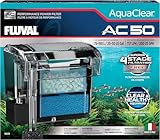 | Fluval AquaClear Fish Tank Power Filter for 20- to…Hang-on-back, 20-50 gal (Fluval) | $61.99 | Check on Amazon |
| 2 |  | Aqueon Pro 100 Submersible Aquarium Fish Tank Heater, 100…Adjustable heater | $62.95 | Check on Amazon |
The AquaClear 50, which Fluval rates for 20 to 50 gallons at a maximum 200 GPH with adjustable flow, is compared in our filter roundup. Our heater roundup lists the Aqueon Pro 100 for keepers of 15-30 gallon tanks: its listing’s title says up to 30 gallons, its bullet 40 and Aqueon’s manual 15 to 40. The manual says to keep it submerged “for a minimum of 30 minutes prior to powering” and to “ALWAYS disconnect all immersed electrical equipment from power source before placing hands in water.”
What changes the list
- Soft or hard tap water: Co-Op’s 29-gallon Apistogramma setup asks for “softer water with low GH”; Aqueon says livebearers “are native to hard, alkaline water”.
Ready to buy?
Our tropical fish food roundup compares flakes, granules and sinking pellets.
Frequently Asked Questions
Q. What is a good centerpiece fish for 30 gallons?
Co-Op’s centerpiece list names an angelfish, a honey gourami or “The female powder blue gourami” (“Only get one to prevent aggression”), an Apistogramma, a Bolivian ram and a betta, which it says “will all live happily in a 29-gallon tank or smaller”. For the angelfish it adds “we do encourage just one”.
Q. How many tetras can go in a 30-gallon tank?
hygger’s table gives 10-12 tetras for 30 gallons; Bubble-Magus suggests “A school of 12–15 tetras” for 30- to 75-gallon tanks; Co-Op says of rummy-nose tetras, “Get at least 8–12 tetras”. Aqueon says most tetras “do best in schools of 6 or more”.
Q. How many liters is 30 gallons?
About 114 liters (30 × 3.785, our arithmetic); Co-Op gives “110–114 liters” for 29- and 30-gallon tanks.
Q. What should I do if a fish looks sick?
Test ammonia and nitrite first, and ask an aquatic veterinarian about the fish; disease and medication are outside what this site covers.
Sources (65)
- FishBase (database), tiger barb
- FishBase, rosy barb
- FishBase, rummy-nose tetra
- FishBase, pearl gourami
- FishBase, peppered cory
- FishBase, bronze cory
- FishBase, swordtail
- FishBase, sailfin molly
- FishBase, cockatoo cichlid
- FishBase, dwarf rainbowfish
- FishBase, angelfish
- FishBase, kribensis
- FishBase, rainbow shark
- FishBase, standard length
- FishBase, total length
- Aqueon (maker), fish by tank size
- Aqueon, barbs
- Aqueon, tetras
- Aqueon, gouramis
- Aqueon, Corydoras
- Aqueon, plecostomus
- Aqueon, livebearers
- Aqueon, dwarf South American cichlids
- Aqueon, rainbowfish
- Aqueon, angelfish
- Aqueon, freshwater sharks
- Aqueon, goldfish
- Aqueon, water temperature
- Aqueon, filters
- Aqueon, do’s and don’ts
- Aqueon, water quality
- Aqueon, first 60 days
- API (test-kit maker), cycling
- Bubble-Magus (equipment brand), stocking by tank size
- hygger (equipment brand), 30-gallon stocking
- Co-Op (retailer), 29-gallon ideas
- Co-Op, how many fish
- Co-Op, tiger barbs
- Co-Op, top 10 barbs
- Co-Op, rummy-nose tetras
- Co-Op, gouramis
- Co-Op, top 10 corys
- Co-Op, plecos
- Co-Op, livebearers
- Co-Op, mollies
- Co-Op, Apistogramma
- Co-Op, neon dwarf rainbowfish
- Co-Op, angelfish
- Co-Op, cichlids for 29 gallons
- Co-Op, fancy goldfish
- Co-Op, centerpiece fish
- LA (retailer), tiger barb
- LA, rosy barb
- LA, pearl gourami
- LA, peppered cory
- LA, bronze cory
- LA, bristlenose pleco
- LA, red swordtail
- LA, sailfin molly (silver)
- LA, cockatoo dwarf cichlid
- LA, neon dwarf rainbowfish
- LA, angelfish
- LA, kribensis
- LA, rainbow shark
- LA, ryukin goldfish
Product prices and availability are accurate as of the date/time indicated and are subject to change. Any price and availability information displayed on Amazon.com at the time of purchase will apply to the purchase of this product.