The short answer
Choose a level spot near an outlet, away from sun and vents, on a stand made for the tank. Rinse gravel and decor without soap, fit the equipment unplugged and fill with conditioned water. Start the filter, then any heater once submerged. Cycle the tank (sources describe fishless and fish-in ways), then stock slowly.
The steps follow the freshwater guides of Aqueon, an aquarium-products maker, with Tetra’s differences in a table. They cover how to start a fish tank, not saltwater setups.
What you need
- A tank sized for your fish and room. Aqueon says the choice depends on “the amount of space you have, the kind fish you want to keep and your budget”; none of the sources here gives a setup cost. Our guide to fish for a 10-gallon tank covers one common size.
- A stand made for that tank, a cover and a light.
- A filter. Our filter roundup compares hang-on-back, canister and sponge types.
- A thermometer, and a heater if your fish need water warmer than your room. Aqueon’s steps set the heater to “75° – 80° F for tropical fish”. Of goldfish, its care guide says: “If housed without a heater, they should be kept with other fish that are tolerant of cooler water temperatures.”
- Substrate, decor and any plants.
- Tools: a clean bucket, a colander or strainer, a plate or saucer, and wood shims if the stand needs leveling.
- A test kit and a water conditioner. Aqueon says most municipal tap water “contains chlorine or chloramine”, which it calls harmful to fish. Our water conditioner roundup covers the three below and five more.
| # | Preview | Product | Price | Link |
|---|---|---|---|---|
| 1 |  | Aqueon Fish Tank Water Conditioner Bottle, 16 Oz | Water…Aqueon's own conditioner | $11.49 Prime | Check on Amazon |
| 2 |  | Tetra AquaSafe Plus Water Conditioner & Dechlorinator For…Tetra's own conditioner | $22.29 Prime | Check on Amazon |
| 3 |  | Seachem Prime -500 ml/ 17 fl. oz. | Chemical Remover and…Concentrated ammonia binder | $16.62 Prime | Check on Amazon |
Safety
Fluval, a filter maker, says in its AquaClear manual: “Always unplug or disconnect all appliances in the aquarium from electricity supply before placing hands in water, before putting on or taking off parts and while the equipment is being installed, maintained or handled.” Also: “If the appliance falls into the water DO NOT reach for it! First unplug it and then retrieve it.” And: “If the plug or receptacle does get wet, DO NOT unplug the cord. Disconnect the fuse or circuit breaker that supplies power to the appliance. Then unplug and examine for presence of water in the receptacle.”
Setting up the tank, step by step
Choose the spot first
Aqueon: “Avoid windows that receive direct sunlight, as this can affect water temperature and may contribute to excessive algae growth.” And: “Do not place your aquarium on an uneven surface, in a high traffic area, near a fireplace or heating/air conditioning vent, or above electronic devices, books and other objects that could be damaged by water.” Aqueon’s moving guide warns: “NOTE: Regardless of size, NEVER lift or transport an aquarium with water or gravel in it. The weight and/or sloshing water can damage the aquarium, compromise seals and present a potential safety hazard.”
Level the stand, then set the tank on it
Aqueon: “An aquarium filled with water, gravel and decorations weighs approximately 10 lbs per gallon.” By our arithmetic, that is roughly 200 lb for a 20-gallon tank. Petbarn, an Australian pet retailer: “Ensure that your tank is sitting on a suitable tank stand or base and floor that will support the weight of the tank.” Aqueon: “Make sure the stand is level and does not rock or wobble. Use wood shims to level and stabilize the stand if necessary.”
Rinse the tank, gravel and decor, with no soap
Petbarn rinses the new tank with tap water: “Do not use any sort of chemicals or soaps. Using soaps can leave residue on the glass and harm fish once they go into the tank.” Aqueon: “Rinse gravel with tap water using a colander, wire strainer or fish net. Do not use bleach, soap or other cleaning products.” Some planted-tank soils are not rinsed: ADA, a planted-tank products maker, says of its Amazonia, “Rinsing in water before use is NOT necessary, as it makes granules to crumble, and water cloudy.” Follow your substrate’s bag.
Spread the substrate
Sources differ on depth: Aqueon’s setup sheet gives 1 to 3 inches, while Petbarn says “For most tanks, gravel in your aquarium should be a depth of one to two centimetres” (about 0.4 to 0.8 inch, our arithmetic). For planted soils, see our guide to layering substrate in a planted tank.
Fit the filter, heater and thermometer, unplugged
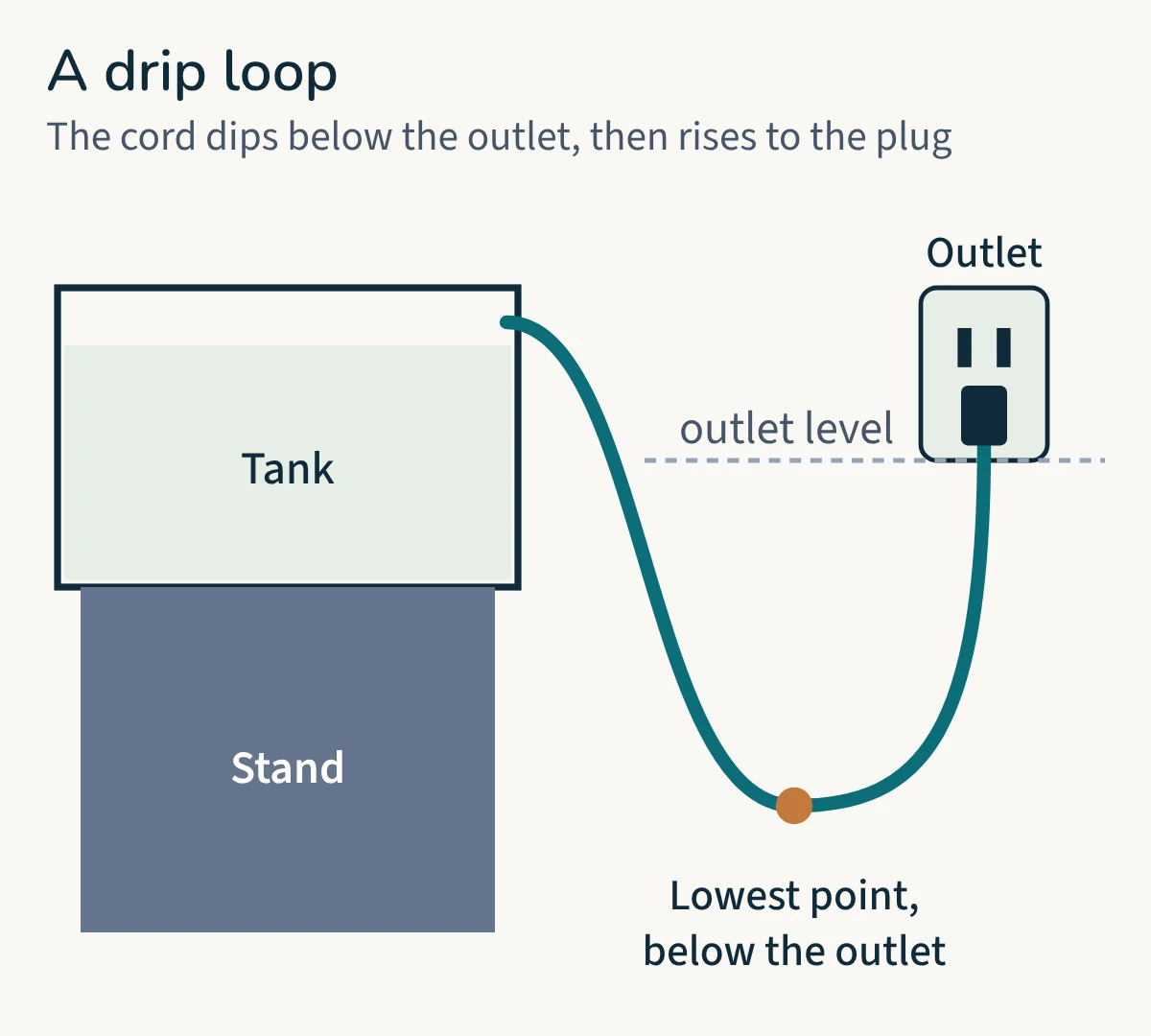
Aqueon: “Make sure to read all instructions before assembling and installing equipment and always make sure to incorporate a drip loop on any electrical items.” For the heater: “Do not plug the heater in yet.” Hydor, a heater maker, says in its Theo manual: “Always ensure the water level stays above the ‘Minimum water level’ mark shown on the heater”.
Fill halfway with conditioned, room-temperature water
Aqueon: “Fill the aquarium about halfway with room temperature water that has been treated with water conditioner. Place a plate or saucer on the bottom to avoid stirring the gravel as the water enters.” Its setup sheet: “Add Water Conditioner as directed”.
Place the decor
Aqueon adds decor at this point, taller pieces at the back. On plants, Aqueon says: “Live plants and fish, should not be added until the aquarium has been running for at least 48 hours.” Tetra plants during setup. Before your hands go into a running tank, unplug everything (Safety, above).
Top up before the filter starts
Aqueon fills to 1 inch below the rim once the decor is in; Tetra fills to the bottom of the top frame. Use conditioned water for this too.
Prime the filter and plug it in with a drip loop
Aqueon: “Prime the filter and plug it in using a drip loop. A drip loop is when you allow the cord to drop below the outlet before it rises up to plug in.” Fluval: “Do not allow filter pump to run dry.”
Plug in the heater only when it is under water, then fit the cover and light
Hydor: “Do not connect the heater to the power supply when it is not submerged in water.” Aqueon’s setup article says: “After 10 minutes, plug the heater in.” Aqueon’s Pro heater manual asks instead “for a minimum of 30 minutes prior to powering”, as quoted in our heater roundup. Your heater’s own manual has the final word. Aqueon puts the light on a timer.
Cycle the tank
Sources describe two ways, fishless or with a few fish at first; our guide to cycling a fish tank sets out both and the makers’ timings.
Add fish a few at a time
Aqueon’s first-60-days guide: “Always test water before purchasing new fish, and only buy a few fish at a time. Wait at least a week between new fish additions.” Our guide to aquarium fish for beginners lists species and water ranges; our quarantine guide covers holding new fish apart.
Where Aqueon’s and Tetra’s steps differ
| Step | Aqueon | Tetra |
|---|---|---|
| First fill | About halfway (setup article) | About one-third |
| Final fill | 1 in below the rim (setup article); 1/2 in from top of frame (setup sheet) | To the bottom of the top frame |
| Live plants | After 48 hours running (setup article) | During setup, in warm enough water |
| Heater | 10 minutes in water (setup article); 30 minutes (Pro heater manual) | No wait given; temperature takes 24 hours to settle |
| Before fish | 24 hours (setup sheet); 48 hours (60-day guide); “a few days” (dos and don’ts) | 24 hours, to check the equipment |
Neither maker’s wait is a cycle (step 11).
Troubleshooting a new setup
| Problem | What to do, and what the sources say |
|---|---|
| Ammonia or nitrite rises once fish are in | Aqueon says these levels “may begin to rise until the nitrifying bacteria in your filter catch up.” See the note below and how to lower ammonia |
| Cloudy water after the first fish | Aqueon says a bacterial bloom “will clear in a few days. These blooms are usually harmless to fish.” See why tank water turns cloudy |
| Fish look unwell | Test the water, and ask an aquatic veterinarian about the fish |
On rising readings, Aqueon advises “water changes or chemical filtration media to prevent them from reaching dangerous levels. If in doubt, consult your local aquatic expert for assistance.”
Routine care is in our guide to cleaning a fish tank.
Ready to buy?
Start with our water conditioner roundup; our heater roundup sorts heaters by tank size.
Frequently Asked Questions
Q. How long do you have to wait to put fish in a new tank?
Sources differ on the equipment wait: 24 hours (Tetra; Aqueon’s setup sheet), 48 hours (Aqueon’s 60-day guide) or “a few days” (Aqueon’s dos and don’ts). Cycling takes longer; see our cycling guide.
Q. How long does water have to sit before putting it in a fish tank?
Aquarium Co-Op, an aquarium retailer, says chloramine “does not evaporate over time”, so dose conditioner, “and then you can immediately use the dechlorinated water for your aquarium with no wait time.”
Q. What is the first fish to put in a new aquarium?
Aqueon’s starter list includes “Zebra, Leopard & Pearl Danios” and “White Cloud Minnows”; the beginner fish guide compares more.
Q. Can you move a fish tank once it is set up?
Only once it is emptied of water and gravel, per Aqueon (step 1). Its moving guide says: “To begin, unplug the heater and allow it to cool for 30 minutes before removing it from the aquarium.”
Sources (12)
- Aqueon (aquarium-products maker), Setting Up a Freshwater Aquarium
- Aqueon (maker), Aquarium Setup sheet (PDF)
- Aqueon (maker), Starting a New Aquarium: the First 60 Days
- Aqueon (maker), How to Move an Aquarium
- Aqueon (maker), Aquarium Dos and Don’ts
- Aqueon (maker), Goldfish care guide
- Tetra (aquarium-products maker), How to setup an aquarium
- Fluval (filter maker), AquaClear 20/30/50/70 manual
- Hydor (heater maker), Theo heater manual
- ADA (planted-tank products maker), Amazonia Ver.2 manual
- Petbarn (Australian pet retailer), How to set up a fish tank
- Aquarium Co-Op (retailer blog), How to Properly Clean Your Fish Tank
Product prices and availability are accurate as of the date/time indicated and are subject to change. Any price and availability information displayed on Amazon.com at the time of purchase will apply to the purchase of this product.
