The short answer
Lower GH with partial water changes using a blend of tap water and RO or distilled water. Work the blend out as a weighted average: mix GH = (tap gallons × tap GH + RO gallons × RO GH) ÷ total gallons. Check the blend’s KH the same way, test it, and change water in small steps.
This guide covers general hardness (GH) alone in freshwater tanks: a target, the blend and testing. Here, “crashing” KH means KH falling below the floor you pick in step 3 (our reading). Our guide to softening aquarium water and lowering GH and KH covers lowering both together, mineral-leaching rock, setting up an RO unit and recharging a softening pillow.
Warning
If fish look unwell, test the water and contact an aquatic veterinarian. This guide covers water chemistry only; it does not diagnose or treat sick fish.
GH and KH: why lowering one can drop the other
API, a test-kit maker, says: “General hardness is the measure of calcium and magnesium ion concentrations dissolved in water.” It adds: “Carbonate hardness helps stabilize pH in the aquarium.”
- Dilution lowers both. ForAquarium, a fishkeeping guide site, says “a mixture of 50% tap water and 50% RO water will reduce the total GH and KH by half”, noting: “These estimates assume the RO water has a KH of 0 dKH.”
- KH products leave GH alone. Swell UK, an aquarium retailer, warns: “Avoid products which lower pH or KH as it is not the same and won’t remove the calcium and magnesium from the water.”
- Low KH has a cost. API: “Aquariums with very low KH are subject to rapid pH shifts if not monitored carefully.”
To lower KH too, see our GH and KH softening guide and what KH is.
GH ranges for common fish
For “a community aquarium with a variety of tropical fish”, API’s GH & KH kit leaflet says to “adjust the GH and KH to 3 – 6º (50-100 ppm).” Its table gives one range for GH and KH together. FishBase, a global fish species database, lists a “dH range” for many species; Practical Fishkeeping, a UK fishkeeping magazine, calls dH “essentially the same as GH”, adding “(But some experts debate this)”.
| Fish | API leaflet (GH & KH) | FishBase dH (degrees) |
|---|---|---|
| Neon tetra | 0º – 3º | 1 – 2 |
| Cardinal tetra | 0º – 3º | 5 – 12 |
| Discus (blue discus record) | 0º – 3º | 0 – 12 |
| Freshwater angelfish | 3º – 6º | 5 – 13 |
| Guppy | 6º – 11º | 9 – 19 |
| Molly (Poecilia sphenops) | 6º – 11º | 11 – 30 |
| Goldfish | 6º – 11º and 11º – 22º | 5 – 19 |
API’s rows read “Discus, Arowana, Elephantnose, Neons, Cardinals, Live Plants” (0º – 3º); “Most tropical fish including Angelfish, Cichlids, Tetras, Botia, Live Plants” (3º – 6º); “Most tropical fish including Swordtails, Guppies, Mollies, Goldfish” (6º – 11º); and “Rift Lake Cichlids, Goldfish, Brackish Water Fish” (11º – 22º). The two differ most for cardinals, where the ranges do not overlap, and mollies, where they meet only at 11 (our reading). Swell says: “Popular soft water fish include Discus and Cardinal tetras.”
For breeding discus, Practical Fishkeeping says: “A pH of 6.0-6.5, GH 2 and KH 1 is better – but you will need to make sure you make lots of water changes to prevent the pH from crashing.”
What you need
- A GH and KH test kit.
- RO, RO/DI or distilled water (our RO/DI system roundup).
- Buckets marked in gallons.
- A tap water conditioner (our water conditioner roundup).
The kit below is a pick from our freshwater test kit roundup.
| # | Preview | Product | Price | Link |
|---|---|---|---|---|
| 1 | 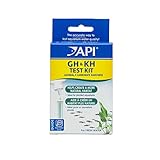 | API GH & KH TEST KIT Freshwater Aquarium Water Test Kit…API GH & KH Test Kit, liquid drops | $11.98 Prime | Check on Amazon |
Work out the blend before you mix
A mix’s GH is the weighted average of the waters in it (our arithmetic).
Mix GH = (tap gallons × tap GH + RO gallons × RO GH) ÷ total gallons. The same formula gives the mix’s KH. To find the tap share: (target GH − RO GH) ÷ (tap GH − RO GH).
Example A (example readings; our arithmetic): tap water at 14 dGH and 8 dKH; RO at 0 and 0; target about 6 dGH. Practical Fishkeeping says of RO water: “The pH is usually neutral, and the GH and KH are usually 0.” Test yours. For KH, Tetra, a water-care maker, says: “With regard to pH stability, the KH should not generally drop below 3 °dH to ensure the well-being of all aquarium inhabitants”.
- Tap share: 6 ÷ 14 ≈ 0.43. For 10 gallons (38 L) of new water, round to 4 gallons (15 L) of tap and 6 gallons (23 L) of RO.
- GH: (4 × 14 + 6 × 0) ÷ 10 = 5.6 dGH, about 100 ppm at API’s 17.9 ppm per degree.
- KH: (4 × 8 + 6 × 0) ÷ 10 = 3.2 dKH, just above Tetra’s floor.
Example B, where blending crashes KH (example readings): tap at 20 dGH but only 4 dKH. For 6 dGH the tap share is 0.3, so the mix’s KH is 0.3 × 4 = 1.2 dKH, under Tetra’s floor (our arithmetic). Then, if your species’ GH range in the table allows it, choose a higher GH target with more tap, or add KH back to the mix with a buffer (our reading): see our guide to raising KH and follow the label. Tetra, for its pH/KH Plus, says: “Remember that the maximum increase per day should not exceed 3 °dH.” Seachem’s GH remineralizer will not raise KH: Seachem says its Equilibrium “is intended to raise GH” and “will have no impact on the KH or pH of an aquarium”.
How the tank follows. Each change moves the tank part way: new tank GH = (1 − change share) × tank GH + change share × mix GH (our arithmetic). Here are 25% changes of Example A’s mix into a tank at 14 dGH and 8 dKH, with nothing in the tank adding minerals:
| After change | Tank GH (dGH) | Tank KH (dKH) |
|---|---|---|
| Start | 14.0 | 8.0 |
| 1 | 11.9 | 6.8 |
| 2 | 10.3 | 5.9 |
| 3 | 9.1 | 5.2 |
| 4 | 8.3 | 4.7 |
| 8 | 6.4 | 3.7 |
The tank approaches the mix’s GH but never drops below it (our arithmetic). 25% is an upper limit, not a target (step 6).
Lowering GH step by step
These steps are for freshwater tanks. Before step 1, read the test reagents’ safety lines, from API’s safety data sheets:
| Line | GH reagent sheet | KH reagent sheet |
|---|---|---|
| Signal word | “DANGER” | “DANGER” |
| Hazards | “Causes serious eye damage.”; “May cause an allergic skin reaction.”; “Suspected of causing cancer.”; “Use only outdoors or in a well-ventilated area.” | “Causes severe skin burns and eye damage.” |
| Gear | “Wear protective gloves/protective clothing/eye protection/face protection.”; “Safety glasses with side shields. Chemical goggles.”; “Wear chemical protective gloves, e.g. PVC.” | “Wear protective gloves/protective clothing/eye protection/face protection.”; “Safety glasses with side shields; or as required, Chemical goggles.”; “Wear general protective gloves, eg. light weight rubber gloves.” |
| Eyes | “IF IN EYES: Rinse cautiously with water for several minutes. Remove contact lenses, if present and easy to do. Continue rinsing.”; “Immediately call a POISON CENTER or doctor/physician.” | The same two lines |
| Skin | “IF ON SKIN: Wash with plenty of soap and water.” | “IF ON SKIN (or hair): Remove/Take off immediately all contaminated clothing. Rinse skin with water/shower.” |
| Swallowed | “IF SWALLOWED, REFER FOR MEDICAL ATTENTION, WHERE POSSIBLE, WITHOUT DELAY.” | Label: “IF SWALLOWED: Rinse mouth. Do NOT induce vomiting.” First-aid section: “Immediately give a glass of water.”; “First aid is not generally required. If in doubt, contact a Poisons Information Centre or a doctor.” |
| Storage | “Store locked up.” | “Store locked up.” |
Test GH and KH in the tank, the tap water and the RO or distilled water
Wear the gear in the table. API’s directions: fill a clean tube with “5 ml of water to be tested”, add GH Test Solution “1 drop at a time”, and “Cap test tube & invert several times after each drop.” Count drops until the water “turns from orange to green”; the count is the GH. KH turns “blue to yellow”. Note your kit’s unit (FAQ below). On swallowing, the sheets differ: the GH sheet’s first-aid section allows inducing vomiting only “Where medical attention is not immediately available or where the patient is more than 15 minutes from a hospital or unless instructed otherwise”, while the KH label says “Do NOT induce vomiting.” So for any exposure, call a poison center or doctor first (our reading); in the US, the National Capital Poison Center, a nonprofit, says to “call a poison center at 1-800-222-1222”.
Find where the GH comes from
Swell says: “If your tap water has low GH but your tank water has a high GH, first check that there is nothing buffering GH, like calcareous decor, then use dechlorinated tap water in water changes to bring GH down.” Our softening guide covers decor and substrate.
Pick a GH target and a KH floor
Take GH from your species (table above; where the two columns differ, the sources do not settle it). Tetra’s KH floor is for “generally”, and the table’s 0º – 3º row and Practical Fishkeeping’s breeding-discus figures (GH 2 and KH 1, quoted above) sit below it. Practical Fishkeeping says: “Because KH makes up part of the GH value, you can’t have a KH higher than your GH level.” The sources do not reconcile these (our reading), so for soft-water fish check your species’ care guide or an aquatic professional before using 3 as your floor.
Work out the blend
Use the volume you will change, as in Example A. If its KH falls under your floor, see Example B.
Mix and test the new water in a bucket
Treat the tap share with a conditioner; API says to use its Tap Water Conditioner “when adding or changing water”. Pete’s Aquatics, a hobbyist’s blog: “Prepare replacement water outside the tank and test it before use.” Aqueon: “Be sure to match temperatures of the new water with the aquarium.” Sources differ on unmixed RO. Swell’s lower-GH guide says “Neat RO can be used in conjunction with a GH test kit to slowly bring GH down to required levels”, while its softening guide says “Once you move exclusively to use RO however the pH, GH and KH can drop dangerously low, so use a buffer, even if you want very soft water for Discus, to prevent the pH and KH from crashing.” Practical Fishkeeping says “You must never use raw RO water.” and that “if there’s no KH to buffer acids in the fish wastes, or from photosynthesis and the respiration of fish and plants, the pH will fluctuate wildly or drop to a dangerous level.” A blend keeps some KH in the new water (our reading).
Change the water with the power off
Aqueon’s cleaning checklist says: “Unplug the filter and heater.” Aquarium Co-Op, an aquarium retailer, says: “Before removing any water, make sure to turn off or unplug all equipment. Aquarium heaters and filters are not meant to operate without water and therefore can become damaged when running in dry air.” Hydor, a heater maker, recommends that its heater is “turned off and unplugged from the power socket at least 30 minutes before any waterchange”. Aqueon: “Avoid water changes of more than 25% as larger water changes can stress your fish and upset the balance in your aquarium.” API: “It is not recommended to do more than 30% because it may cause loss of bacteria and be stressful on the fish.” These are upper limits, not targets (our reading). Refill first. Hydor says its heater “can ONLY then be turned back on when the Aquarium is full and the heater is completely submerged.” Then, in Aqueon’s words: “Plug the filter and heater back in.”
Retest and repeat until the tank reaches your target
For a major GH change, Seachem, in its FAQ on its GH product, recommends “doing so in increments over time, preferably through simply matching ideal water parameters in the water used for water changes.” With fish in the tank, Aqueon says to “never make sudden or drastic changes to pH or any other water parameters.” Once there, keep using the same blend, and keep testing; API advises testing weekly.
Softening pillows, peat and botanicals: GH or KH?
| Product or material | What the source says | Source |
|---|---|---|
| API Water Softener Pillow | “works to lower calcium and magnesium levels” | API (maker) |
| sera super peat | “Gentle reduction of water hardness”; “lastingly lowers the KH” | sera (maker) |
| Peat, almond leaves | Lower KH and pH; “Do not affect GH” | hygger (equipment maker) |
| Peat | “help lower both GH and KH” | Glass Grown (retailer) |
API’s kit leaflet says the pillow “removes calcium and magnesium ions”; neither it nor the pillow page says what it does to KH. Our softening guide gives API’s directions, recharge steps and the pillow sheet’s protective gear and first aid.
On peat, Glass Grown Aquatics, an aquarium plant and livestock retailer, says botanicals are “really only going to budge you a couple degrees of hardness”. Pete’s says driftwood, leaves and peat “should not be presented as precise GH-removal tools”. The sources disagree on whether peat lowers GH, and none gives an amount. Our guide to lowering aquarium pH covers peat and leaves for pH.
Troubleshooting
- GH creeps back up. API’s leaflet: “Topping off with tap water simply adds more minerals to the aquarium, resulting in a steady increase in GH.” Recheck the decor (step 2).
- Water from a house softener. Practical Fishkeeping says most swap “calcium and magnesium for sodium”, leaving water with “too much sodium to be used safely with fish.”
Ready to buy?
Our freshwater test kit roundup compares GH and KH kits, our guide to the best water for a fish tank compares RO and distilled water, and our Water Lab gathers guides such as lowering nitrates in a fish tank.
Frequently Asked Questions
Q. Will distilled water lower GH in a fish tank?
API’s leaflet says “partial water changes with deionized water will gradually reduce GH to the desired level.”; Swell says distilled water “should have a general hardness and carbonate hardness of zero”. Sources differ on using it unmixed (step 5).
Q. How many ppm is 1 dGH?
API’s kit chart reads one drop, or 1º, as 17.9 ppm; Practical Fishkeeping gives “one degree equal to about 17.9mg/l”. For a reading in ppm, divide by 17.9 for degrees (our arithmetic).
Q. Why is my GH high but my KH low?
GH and KH count different minerals (API, above); Swell notes that tap water with “high pH and GH but low KH!” is possible. Example B shows why it is the hard case to blend.
Q. What GH counts as soft water?
Swell’s scale: “0-4 °dH (0-70 ppm) is very soft, 4-8 °dH (70-140 ppm) is soft, 8-12 °dH (140-210 ppm) is medium, 12-18 °dH (210-320 ppm) is hard and 18-30 °dH (320-530 ppm) is considered very hard.”
Sources (25)
- API, GH & KH kit (maker)
- API, kit leaflet (maker)
- API, GH reagent SDS (maker)
- API, KH reagent SDS (maker)
- API, softener pillow (maker)
- API, conditioner (maker)
- API, routine care (maker)
- Practical Fishkeeping, lowering hardness (magazine)
- FishBase (species database): neon, cardinal, discus, angelfish, guppy, molly, goldfish
- Tetra, pH/KH Plus (maker)
- Seachem, Equilibrium and KH (maker)
- Seachem, overdose FAQ (maker)
- sera, super peat (maker)
- Aqueon, checklist (maker)
- Aqueon, do’s and don’ts (maker)
- Aqueon, pH (maker)
- Hydor, heater FAQ (maker)
- National Capital Poison Center (nonprofit)
- hygger, softening (maker blog)
- Swell UK, lower GH (retailer)
- Swell UK, softening (retailer)
- ForAquarium, KH (fishkeeping guide site)
- Aquarium Co-Op, aquarium cleaning (retailer blog)
- Glass Grown Aquatics, soft water (retailer blog)
- Pete’s Aquatics, lower GH (hobbyist blog)
Product prices and availability are accurate as of the date/time indicated and are subject to change. Any price and availability information displayed on Amazon.com at the time of purchase will apply to the purchase of this product.
