The short answer
Test the tank and your tap water, then dilute nitrate with partial water changes made in steps; Fluval’s kit leaflet says to change 20% once a freshwater reading is above 50 mg/L. Cut the waste behind it: food, stocking, dirty gravel and filters. Plants and nitrate media help, but Seachem says plants do not replace water changes.
These steps are written for freshwater tanks; saltwater figures have their own section below. For what makes nitrate climb in the first place, see our explainer on why aquarium nitrate runs high.
Warning
If fish look unwell, test the water and contact an aquatic veterinarian. This guide covers water care only; it is not a diagnosis or a treatment for sick fish.
What you need
- A nitrate test. API, a test-kit maker, gives a 0-160 ppm range for its standalone Nitrate NO3 Test Kit and says ppm “are equivalent to milligrams per liter”, so the ppm and mg/L figures below compare directly. The MultiTest kit from Seachem, a water-care and test-kit maker, reads 0-50 mg/L, with values “expressed as nitrite and nitrate rather than nitrogen” (Seachem: divide by 4.4 to convert nitrate to nitrogen).
- Ammonia and nitrite tests too. Fluval, an aquarium equipment and test-kit maker, warns in its kit leaflet: “HIGH LEVELS OF NITRITE WILL INTERFERE WITH NITRATE READING.”
- A gravel siphon and a bucket, plus a tap water conditioner for the refill water. Our water conditioner roundup compares them.
Test reagents carry their own warnings. For its Tetra Test NO3- kit (not one of the two below), Tetra, a fish food and water-care maker, warns: “Attention: The contained testing liquid is very toxic to aquatic life with long lasting effects. Avoid any contact to your aquatic environment. Always keep out of reach of children.”
Both kits below are from our freshwater aquarium test kit roundup. It notes that the Seachem kit stops at 50 mg/L and that API publishes a range only for its standalone nitrate kit, not for the Master kit, which also tests ammonia and nitrite.
| # | Preview | Product | Price | Link |
|---|---|---|---|---|
| 1 |  | API Freshwater Master Test Kit 800-Test Freshwater Aquarium…Liquid kit with nitrate | $35.98 Prime | Check on Amazon |
| 2 |  | Seachem MultiTest: Nitrite & Nitrate 75 TestsNitrite and nitrate kit | $22.14 Prime | Check on Amazon |
A reading at the very top of a kit’s scale may mean the real level is higher than the chart can show (our reading). On the Seachem kit that top is 50 mg/L, the line Fluval, Tetra and Aqueon draw for freshwater.
Pick your target first
The sources give different figures. Some are for other kinds of tank (planted, saltwater), and even for a plain freshwater tank they differ: Fluval, Tetra and Aqueon draw the line at 50, while Seachem and TFH aim lower.
| Source | Figure | Applies to |
|---|---|---|
| Seachem guide | Not “far above around 40 mg/L” | Any system |
| Seachem guide | About 10-20 mg/L | Planted freshwater tanks |
| Seachem MultiTest page | Under 20 mg/L is “advantageous” | Kit page, fresh or marine |
| Tetra (kit FAQ) | Below 50 mg/L | Most freshwater aquariums |
| Aqueon | Above 50 ppm is “undesirable” | Freshwater aquaria |
| Fluval (kit leaflet) | Act above 50 mg/L | Freshwater |
| TFH Magazine | Ideal at most 5-10 ppm; 20-50 too high | Its whole scale (below) |
The TFH figures come from a TFH Magazine feature (a fishkeeping magazine): “the ideal is a maximum of 5 to 10 ppm. Levels of 20 to 50 ppm are too high. Freshwater tanks can be at the higher end, with marine fish-only setups at the lower end and reef tanks as near zero as possible.” Aqueon is an aquarium equipment maker.
Seven steps to bring nitrate down
Test the tank and the tap, and compare the reading with the table
No source names one number for every tank: Seachem’s 10-20 mg/L is for planted tanks, Fluval, Tetra and Aqueon draw the freshwater line at 50 mg/L, and Seachem and TFH aim lower. Aqueon says “Some tap water sources are high in nitrate, so it is a good idea to test your tap water before using it.” Fluval: “If in doubt, test dechlorinated municipal tap water for nitrate concentrations before performing the water change.” If ammonia or nitrite reads above zero, our guides to lowering ammonia and lowering nitrite cover those readings.
Change part of the water, not all of it
The amounts by source are in the table below: Fluval gives 20% above 50 mg/L, Tetra around 30%, and TFH starts at no more than 15%, with a gravel vacuum, for very high readings. Swell UK, an aquarium retailer, sets two conditions for its 50% figure: refill water “of the right temperature” that “has been treated for chlorine or chloramine”. Prepare it as Seachem describes, “adding water conditioners, buffers, and supplements as needed”, and follow Fluval: “Slowly add replacement water to avoid fluctuations in other water characteristics.” Seachem cautions that “rapid shifts in water parameters will tend to be more stressful to the fish than helpful”, and calls a 100% change “never recommended, as it will be extremely stressful to the fish and potentially catastrophic to the beneficial bacteria colonies”.
Clean about a third of the gravel each time
Seachem’s routine is to “use a siphon to clean out about 1/3 of the substrate with every water change (once per week)”, which it says prevents buildup while “avoiding the ammonia and nitrite spikes that can result from over-enthusiastic gravel cleaning”. Our guide to cleaning a fish tank walks through a full routine.
Cut the food, not the meals
TFH’s test is simple: “Make sure they finish their food in two minutes or less.” It suggests trying two or three small feedings a day in place of one big one, and Seachem says fish “should not be starved in the name of nitrate reduction”. Each day, TFH adds, “Remove any sources of decomposition”: neglected food, dead fish or invertebrates, and dead or dying plant leaves.
Rinse filter media gently, a part at a time
Where the mechanical media also house the bacteria, TFH says to “replace only part of the medium at each cleaning”; matted media get “a gentle cleaning in a bucket of tank water”. The exotics service of the Royal Veterinary College (RVC), a UK veterinary university, cautions: “It is never advisable to completely clean and refresh the tank as this will wipe out the healthy bacteria and lead to increased toxin accumulation.”
Check how many fish the tank holds
Seachem notes that “Aquariums that are too small for the fish they contain will have higher concentrations of nitrate”. Fluval’s leaflet says: “Never overstock the aquarium.” When careful feeding has not helped, TFH concludes “you probably have too many fish for your setup”, and in its words “you must either get rid of some or buy a larger aquarium”.
Retest, then keep a weekly check
TFH’s plan for very high readings is to “Keep testing” until the level reaches 5 to 10 ppm, then “establish a maintenance routine”. API’s kit page says “Aquarium water should be tested for nitrate once a week”; its FAQ says “weekly or bi-weekly” (API’s word), or whenever you suspect high nitrate. Tetra’s kit FAQ also says weekly, and more often for new setups, heavily stocked tanks and tanks that are fed heavily.
How much water to change: the sources side by side
| Source | Amount | When |
|---|---|---|
| Fluval (kit leaflet) | 20% | Freshwater above 50 mg/L |
| Tetra (kit FAQ) | Around 30% | Nitrate too high |
| TFH Magazine | Up to 15%, then 10-20% a day | “Very high” nitrate, with a gravel vacuum |
| Aqueon | About 10% a week | Established tank, routine |
| TFH Magazine | At least weekly; 50% or more “much more effective” | Routine freshwater care |
| Swell UK (retailer) | 50% | Refill treated and at the right temperature |
For a high reading, the kit makers give 20% (Fluval, above 50 mg/L) and about 30% (Tetra). TFH starts smaller at very high levels because “going from polluted water to fresh, clean water can be just as harmful to your fish as the nitrates themselves”. TFH’s routine advice is that “The minimum schedule should be weekly”, and it says such large changes “are not generally possible with a marine tank”.
Why the refill water sets a floor
Seachem works the numbers for a tank at 100 mg/L: one 30% change leaves 70, a second 49 and a third 34.3. Those figures only hold for refill water with no nitrate in it, and Seachem says the method “is also dependent on the availability of a low-nitrate water source”. Swell UK puts it simply: “As long as your tap water has a lower nitrate level than your tank water, by replacing it, your nitrate level will go down.”
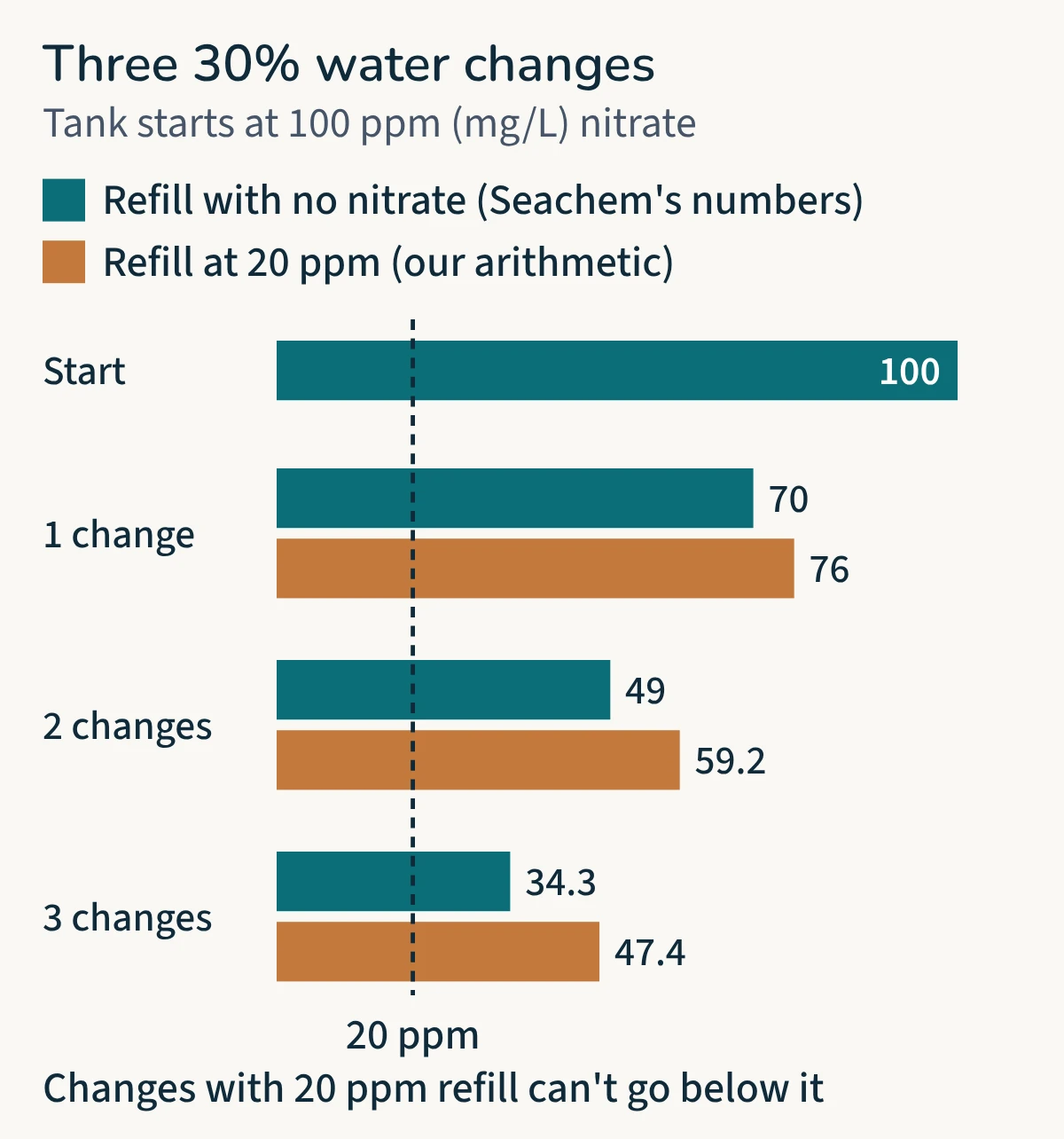
Run the same three changes with 20 ppm refill water and the tank ends near 47 ppm; more changes bring it closer to 20 ppm but never under it (our arithmetic). When the tap itself is the source, TFH’s options are “a water purifier such as a reverse-osmosis unit, or you’ll have to buy suitable water for your aquarium”. Our guide to the best water for a fish tank compares tap, RO and distilled water and what each needs before use.
Lowering nitrate between water changes
Plants and nitrate uptake
Seachem says “Plants will remove nitrate from the water”, and TFH calls a heavily planted tank “the most natural way to have low nitrate levels”, but adds that “plants can only utilize a certain amount of wastes”. Seachem is firmer: “plants should not be used as a replacement for water changes or good aquarium maintenance.” To use nitrate, Seachem says plants need a high-quality light, buffers and minerals suited to plants, “a consistent source of bioavailable carbon” and “a wide spectrum of nutrients”; when nitrate still builds up in a planted tank, it is “typically because they are lacking an essential nutrient”. Our guide on how often to fertilize aquarium plants covers feeding them. Plants also need some nitrate left: in Seachem’s words, “if the fish keeper reduces nitrate to 0, the plants may die”.
Nitrate media and removers
Each claim below is the maker’s, for its own product. Follow the label for amounts.
- Seachem de*nitrate (denitrifying media). The flow limit is the catch: Seachem says it “absolutely must be used at a flow rate of 50 GPH or less”, slower than most filters manage, so it “typically recommends using this media in a reactor instead”. Run faster, “de*nitrate will develop large colonies of aerobic bacteria instead.” Its directions add three conditions: bring very high nitrate below 20 mg/L with water changes first, use enough to remove nitrate at least as fast as it forms (the label gives amounts), and rinse off dust before use. Its FAQ suggests prefiltering with a sponge or filter floss so detritus does not clog it. In planted tanks Seachem says bacterial methods “may work too well”.
- API Nitra-Zorb (resin pouch). API describes it as “a filtration media in a pouch format that works to remove harmful toxins, such as ammonia, nitrate, and nitrite, from freshwater aquariums”, and says it “Fits most canister filters on the market”; the pouch goes in the “path of water flow in the aquarium filter”. For this product, API says to “use whenever nitrate measures above 20 ppm (mg/L)”; it is “recharged in a salt solution”, and API says: “Use as directed on product label.”
TFH’s caution covers both kinds: nitrate-adsorbing media and denitrifying filters “will do nothing to eliminate the cause of the problem”. Fluval’s leaflet adds that the oxygen-free conditions denitrification needs are “a condition difficult to obtain or control in most standard aquarium installations”, and that a number of denitrification systems “can be useful in the marine environment, but they are often quite expensive”.
How fast each method works
| Method | Pace the source gives | Source |
|---|---|---|
| Water changes | Each change removes its own share | Seachem |
| Small daily changes | 10-20% a day until 5-10 ppm; no total time | TFH Magazine |
| de*nitrate | After several days of use, nitrate should start to fall and level off gradually at about 4-5 mg/L, under the conditions above | Seachem directions and FAQ |
| Nitra-Zorb | No time to a result; recharge every 5 days while nitrate shows, until 20 ppm or less; replace the pouch after 2 months | API directions |
| Plants | No timeline in our sources | Seachem, TFH |
API’s own wording for that schedule: “recharge every 5 days until nitrate is reduced to 20 ppm (mg/L) or less. Replace pouch after 2 months.”
Saltwater tanks
Tetra’s kit FAQ says marine tanks should ideally stay under 20 mg/L. Fluval’s leaflet says saltwater tanks with invertebrates “should never have concentrations above 20 mg/L”, with a 20% change once they reach it, and that “For saltwater systems that do not contain invertebrates, follow the freshwater guidelines”. Seachem says “saltwater tanks that contain corals should have nitrate levels as low as possible”, and TFH’s scale (above) puts marine fish-only tanks lower than freshwater and reef tanks near zero. For saltwater refills Seachem says to “either purchase pre-made saltwater or use a salt mix and RO/DI water”, and in reef tanks to “keep water changes to no more than 30% of the tank at a time to avoid stressing the fish and corals”. API describes Nitra-Zorb for freshwater aquariums.
Mistakes and troubleshooting
- Nitrate barely moves after a change. Test the refill water (see the floor above), and check whether the first reading sat at the top of your kit’s scale.
- Nitrate showing up in a new tank. Fluval notes that “In normal start-up conditions, nitrate appears after a few weeks”, as the biological filter matures. Our guide to cycling a fish tank covers that stage.
Our Water Lab has a guide to each reading.
Ready to buy?
Our freshwater aquarium test kit roundup compares nitrate kits and their ranges, and our Water Care & Testing section gathers test kits, conditioners and RO/DI systems.
Frequently Asked Questions
Q. What is the fastest way to lower nitrates?
A water change. Seachem warns that rapid shifts stress fish, and TFH that a jump to clean water can harm them as much as the nitrate. Sizes differ: Fluval gives 20% above 50 mg/L, TFH starts at 15% or less for very high readings, and Swell UK, a retailer, says 50% with treated, right-temperature water.
Q. Can I lower nitrates without water changes?
The sources disagree on how far. Tetra’s kit FAQ says live plants and its own products can reduce the need for frequent water changes; Seachem says plants are not a replacement for them, and TFH says media do not remove the cause.
Q. What are the signs of high nitrates in a tank?
TFH says nitrate “is invisible and odorless”, so a test is how you know the level. TFH and API both link nitrate to algae: API says excess nitrate “can stimulate algal blooms”, and TFH says “An algae bloom usually indicates high aquarium nitrate levels, though algae is able to grow in newly set-up tanks with nitrate levels as low as 10 ppm.” If fish look unwell, test the water and contact an aquatic veterinarian.
Q. Can fish recover from high nitrates?
Only an aquatic veterinarian who examines the fish can say. This guide covers the water: lower the reading in partial changes, as in step 2.
Sources (12)
- API, Nitrate NO3 Test Kit (maker)
- API, Nitra-Zorb Aquarium Filter (maker)
- Seachem, Guide: Controlling Nitrate (maker)
- Seachem, MultiTest Nitrite/Nitrate (maker)
- Seachem, de*nitrate (maker)
- Tetra, Tetra Test NO3- (maker)
- Fluval, Nitrate Test Kit instructions (maker)
- Aqueon, Freshwater Aquarium Water Quality (maker)
- Aqueon, The Nitrogen Cycle (maker)
- Royal Veterinary College, The Aquarium Nitrogen Cycle (veterinary school factsheet)
- TFH Magazine, Keeping Up with Nitrate (publication)
- Swell UK, How to get nitrates down in an aquarium (retailer guide)
Product prices and availability are accurate as of the date/time indicated and are subject to change. Any price and availability information displayed on Amazon.com at the time of purchase will apply to the purchase of this product.