The short answer
Sources describe three ways for a freshwater planted tank: a pressurized system (cylinder, regulator, bubble counter with check valve, diffuser, often a solenoid on a timer), a DIY yeast bottle, or CO2 tablets in a reactor. Seachem Flourish Excel is a carbon supplement that Seachem says is not CO2. Test pH and KH, and watch your fish.
This guide covers freshwater planted tanks only. Our beginner plants guide lists the CO2 each easy species needs.
Warning
If fish look unwell, test the water and contact an aquatic veterinarian. This page covers equipment and water chemistry only; it does not diagnose or treat sick fish.
What you need
- Every CO2 system type: a KH test and a pH test. Fluval, an aquarium equipment maker, in its CO2 kit manual: “It is strongly recommended to test pH and KH levels regularly and adjust CO2 infusion to your specific aquarium water values.”
- Pressurized: The 2Hr Aquarist, a planted-tank fertilizer maker, lists “cylinder, regulator, bubble counter, tubing, diffuser or reactor, and a timer”, plus a check valve. It says: “Using dedicated polyurethane CO2 tubing prevents leakage, as standard silicone air tubing allows gas to escape.” On cylinder size: “Choose a cylinder size that fits your cabinet and that you can actually transport for refill.”
- DIY yeast: a kit, tubing and a diffuser. Tablets: sera’s CO2-Tabs plus and its reactor.
CO2, pH and KH
Seachem, a water-care maker, says “an increase in CO2 will result in an increase in carbonic acid, followed by an increase in bicarbonate and its concomitant hydronium ion, which results in a pH decrease.” Our KH guide explains the buffer. JBL, a German aquarium products maker, in its test-kit leaflet: “For an optimal CO2 fertilisation, however, the carbonate hardness should not be below 5 °dH.” Tetra, another water-care maker, on its pH/KH Plus page: “With regard to pH stability, the KH should not generally drop below 3 °dH”.
Reading a pH/KH chart. JBL: “The point where the pH you have measured intersects with the KH value you have measured corresponds to the CO2 content of your water.” It warns: “This method should only be used if no pH-lowering substances, such as nitrate or peat, are in the water.” The 2Hr Aquarist says “the popular use of Aquasoil in aquariums immediately renders the table useless”.
The pH-drop method. The 2Hr Aquarist: “As a very general guide, you should aim for a relative pH drop of 1 point between a degassed sample of your tank water and the tank at peak CO2 saturation.” Its setup article: “If your KH is between 1-10 dKH, a 1.0 pH drop from the degassed sample corresponds roughly to 30+ppm of CO2.” To degas, “draw a sample of tank water and stir or shake it in the air for a few minutes before measuring its pH.” It warns: “Do not use the tank’s own pH with the CO2 simply switched off.”
Both kits are from our freshwater test kit roundup.
| # | Preview | Product | Price | Link |
|---|---|---|---|---|
| 1 | 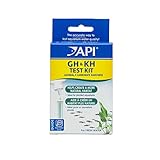 | API GH & KH TEST KIT Freshwater Aquarium Water Test Kit…For the KH reading | $11.98 Prime | Check on Amazon |
| 2 |  | API Freshwater Master Test Kit 800-Test Freshwater Aquarium…For the pH reading | $35.98 Prime | Check on Amazon |
| Source | CO2 figure | Scope |
|---|---|---|
| JBL | “between 15 and 30 mg / l”; “20–25 mg/l CO2 has proven to be ideal” | Aquarium water |
| JBL | “up to 35 mg/l may be required” | “so-called scapes” |
| Tropica | “about 10-15 mg CO2 per L” | “Medium” plants |
| Tropica | “15-30 mg CO2 per L” | “Advanced” plants |
| The 2Hr Aquarist | “25ppm – 35ppm” | “A good starting point” |
Tropica, an aquarium plant and fertilizer maker, gives Medium a second band on its chart, “6-15 mg CO2 per L”, and says “A bit of CO2 (e.g. 3-5 mg per L) is better than nothing.” The 2Hr Aquarist: “Certain species will be more sensitive to CO2 levels (e.g. discus) than others. Therefore, the CO2 target must be relative, based on observation of the tank inhabitants, and not just an absolute value.” Its setup article: “Discus are more sensitive to CO2 and start showing distress towards 40ppm of CO2.” EHEIM, a filter and equipment maker, in its solenoid manual: “Only increase the C02 supply gradually and spread over several days.”
Pressurized CO2, step by step
Before any step with your hands in the water: unplug
Fluval’s AquaClear filter manual: “CAUTION – Always unplug or disconnect all appliances in the aquarium from electricity supply before placing hands in water, before putting on or taking off parts and while the equipment is being installed, maintained or handled.” With your hands out, restart the filter first: for an AquaClear, Fluval says to “Fill filter case completely with water.”, then “Plug power cord into electrical outlet. Allow 30-45 seconds for priming.”, and warns: “IMPORTANT – DO NOT OPERATE FILTER WITHOUT WATER”. Other filters follow their own manual. Hydor, a heater maker, says on its water-change page that its heater “can ONLY then be turned back on when the Aquarium is full and the heater is completely submerged.” Then plug every other appliance back in.
Stand the cylinder upright, secured and out of the sun
Airgas, a US industrial gas supplier, in its CO2 safety data sheet: “Contains gas under pressure; may explode if heated.” and “May displace oxygen and cause rapid suffocation.” It says: “Cylinders should be stored upright, with valve protection cap in place, and firmly secured to prevent falling or being knocked over.”, “Cylinder temperatures should not exceed 52 °C (125 °F).”, “Protect from sunlight. Store in a well-ventilated place.” and “Keep out of reach of children.” For its small disposable cartridge, Fluval says: “Do Not Incinerate. Do Not Puncture.”, “Do Not heat or store at temperatures above 60 °C (140 ° F).”, “Do Not inhale or discharge CO2 gas towards face or body. Keep out of reach of children.” and “The CO2 cartridge is Not refillable.” The limits differ: follow your own cylinder’s label (our reading).
Fit the regulator with its valve closed
Fluval: “Make sure that the regulator valve is closed (turn fully clockwise)” and “Caution: Ensure not to cross thread.” For refillable cylinders, The 2Hr Aquarist: “Make sure there is a working O-ring securing the connection between the regulator and the cylinder. No white tape/thread seal/plumber’s tape should be used in the joint as the seal is made by the O-ring between the cylinder and regulator and not by the screw threads on the regulator/cylinder.” Airgas: “Use equipment rated for cylinder pressure.” and “Do not open valve until connected to equipment prepared for use.”
Add the solenoid and plug it into a timer
EHEIM says to “pay attention to the direction of flow” and: “Keep the C02 hose between the pressure reducer and the solenoid valve as short as possible as overpressure builds up with a closed solenoid valve.” It adds: “Never use the appliance with a damaged mains cable or power supply unit.” and “It is recommended to form a drip loop with the mains cable to prevent any water running along the cable to the mains socket.”
Fit the bubble counter and check valve
Fluval: “Unscrew bubble counter/check valve, fill with water and close (hand tight).” The 2Hr Aquarist: “A one-way check valve prevents aquarium water from flowing back up the CO2 tubing from the CO2 diffusion device.” EHEIM puts its non-return valve “between the solenoid valve and the C02 feed unit (for example a C02 diffusor)” and warns: “Non-return air valves for commercially available air diaphragm pumps are not suitable as, due to the C02, they begin to leak after a short operating period.” Airgas: “Use a back flow preventative device in the piping.” For its own CO2 sets, EHEIM says: “Use only original EHEIM C02 -Safe Ø 4/6 mm hoses for the complete hose installation. Unsuitable hoses may burst.”
Place the diffuser or reactor
Unplug all appliances first. Fluval: “Maximum CO2 diffusion is achieved by placing CO2 diffuser at the bottom of the tank.” Then restart and prime the filter, and plug the heater and every other appliance back in (step 1).
Open the cylinder valve
On a cylinder with its own valve, The 2Hr Aquarist: “Open the valve at the top of the cylinder. You should see the cylinder pressure gauge jump.” It adds: “If you hear the sound of gas escaping even when the regulator knob is turned off, the connection between the regulator and the cylinder may not be tight enough. Close the valve at the top of the cylinder and tighten the connection.”
Open slowly and set a bubble rate
For its 45 g kit (tanks up to 30 US gallons), Fluval says to “slowly open regulator until you see bubbles. Adjust bubble rate to 1 bubble every 2 seconds.” The 2Hr Aquarist warns that bubble counters “do not give good estimation for CO2 levels as different bubble counters produce different sized bubbles.”
With gas flowing, check for leaks
The 2Hr Aquarist: “using a paintbrush, apply soapy water to all the joints in the system. Turn on the solenoid and release CO2 gas through the regulator. If there is a leak, large bubbles will be visible.” Keep soapy water out of the tank, and unplug all appliances first (step 1) if a joint is under the water (our reading). If you find a leak, close the cylinder valve before tightening (our reading of step 7).
Set the timer
Sources differ. Fluval: “For best CO2 economy and performance, turn regulator off when aquarium is not illuminated.” The 2Hr Aquarist: “start CO2 2 to 3 hours before lights come on; set the timer to turn CO2 off about 1 hour before lights out.”
Measure, then raise CO2 gradually
(EHEIM, above). A drop checker goes inside the tank: unplug all appliances first, then restart the filter and plug everything back in (step 1). Dennerle, a German aquarium products maker, lists its long-term test’s colors: “Blue = too little CO2”, “Green = CO2 optimal” and “Yellow = too much CO2.” The 2Hr Aquarist’s view of green differs (our reading): “it takes just 10-15ppm of dissolved CO2 to turn drop checker solutions green”, so “drop checkers are only useful for aquariums targeting lower levels of CO2 saturation”, with “a time lag of around 60-90 minutes.” It says: “Always be present to observe your animals when adjusting CO2.”
DIY yeast CO2
Swell UK, an aquarium retailer, says yeast kits ferment yeast, sugar and water, that they “are best for small to medium-sized aquariums” and that their output changes over time.
- Do not restrict the output. NT Labs, a UK aquarium water-care maker, on restricting CO2 at night, says to “ensure the vessel is able to handle an increase in pressure” and warns: “Homemade CO2 injection using plastic bottles may swell/explode if the output is restricted.”
- At night, NT Labs says “an air pump on a timer so it only comes on at night can assist with gaseous exchange, dissipating CO2 at the surface to prevent overdosing.” Our oxygen guide covers air pumps.
- Placing the diffuser: unplug all appliances first, then restart the filter and plug everything back in (step 1).
- Check valve: Buce Plant, an aquarium plant retailer, lists a “Check valve” among its DIY parts. None of the yeast sources we read gives amounts, so follow your kit’s instructions.
CO2 tablets
sera, a German aquarium products maker, pairs CO2-Tabs plus with an in-tank diffusion reactor. Its leaflet:
- Place the reactor with all appliances unplugged (step 1): “in an area of constant water movement, for example close to the filter outlet”, top edge “ideally 5 mm / 0.2 in. below the water surface”. “Use the sera CO2 diffusion reactor only if sufficient filtration and water agitation are provided.” Restart the filter and plug everything back in after.
- Dose with all appliances unplugged and plugged back in after (step 1): “Do not touch the tablets with wet or moist hands and push them into the tablet slot of the sera CO2 diffusion reactor immediately.” Dose “in the morning or before noon”. “Avoid overdosage!”
- If the water clouds: “immediately carry out a 30% partial water change and double the intervals between tablet applications.” A water change puts your hands in the tank: unplug all appliances first, and restart the filter and plug everything back in after (step 1). Our water-change guide covers the heater and refill.
- After water changes: “There will be air inside the sera CO2 diffusion reactor after the weekly partial water changes. This air can escape when removing the rubber stopper briefly, and the reactor will be ready to use again.” Unplug all appliances first, and restart the filter and plug everything back in after (step 1).
- Storage: “Store in a cool and dark place! Secure lid tightly after each use! Keep out of reach of children and pets!”
sera: “The CO2 requirement depends on many factors such as lighting duration and intensity, type of planting, water current and many more. A basic rule is:”
| Water volume | sera’s dosage |
|---|---|
| 45 – 60 liters (12 – 16 US gal.) | 1 tablet “every 3rd – 4th day” |
| 60 – 90 liters (16 – 24 US gal.) | 1 tablet “every 2nd – 3rd day” |
| 90 – 120 liters (24 – 31.7 US gal.) | 1 tablet “every 2nd day” |
sera’s table starts at 45 liters (12 US gal.) and gives no dose for smaller tanks. It says: “The actual requirement is easy to monitor with the sera CO2 long-term indicator. Dosage can be adjusted accordingly.”
Seachem Flourish Excel: a carbon supplement, not CO2
Seachem calls Excel “a beneficial carbon supplement” and says it “contains neither buffers nor minerals of any kind, so it will have no impact on pH, GH, or KH when used as recommended”. Of “liquid carbon” and “liquid CO2”: “We don’t use those terms in our packaging or marketing because they are inaccurate.” Also: “Flourish Excel™ is not an algicide”.
- Handling: Seachem’s safety data sheet carries the signal word “Warning” and “H315-Causes skin irritation”, “H319-Causes serious eye irritation”, “H317-May cause an allergic skin reaction”, “H334-May cause allergy or asthma symptoms or breathing difficulties if inhaled.” and “H335-May cause respiratory irritation”. It says “P280: Wear eye or face protection”, “P264: Wash hands thoroughly after handling”, “P301+P330+P331 – IF SWALLOWED: rinse mouth. Do NOT induce vomiting.”, “P303+P361+P353 – IF ON SKIN: Remove all contaminated clothing. Rinse skin with water.” and “IF IN EYES: Rinse cautiously with water for several minutes. Remove contact lenses, if present and easy to do. Continue rinsing. Immediately call a POISON CENTER or physician.” In the US, the National Capital Poison Center, a nonprofit, says to “call a poison center at 1-800-222-1222”.
- Who it suits: asked whether it suits a given tank, Seachem answers: “Possibly. Flourish Excel™ is exclusively intended for freshwater planted tanks and not every type of aquarium fish is suited to this type of environment. Research your fish to know what kind of aquarium environment they prefer.”
- Seachem’s dose: “On initial use or after a major (> 40%) water change, use 1 capful (5 mL) for every 40 L (10 US gallons). Thereafter use 1 capful for every 200 L (50 US gallons) daily or every other day.” It notes “each cap thread is approximately 1 mL.” That is the label amount, not a starting point to exceed (our reading). Seachem: “Where possible, always opt to do multiple smaller doses rather than one large dose.”
- Plants: “If you have Anacharis in an aquarium in which you are dosing Flourish Excel™ we recommend using Flourish Excel™ every other day rather than daily.” And: “Large doses of Flourish Excel™ can sometimes cause some melting of the leaves of Vals.”
- Fish: “a large overdose can stress more sensitive fish and plants”. “We recommend to alter nutrient levels slowly (do not overdose this product) and keep water changes to 30% of the tank or less.”
- Hands: if your hand goes in the water to dose, unplug all appliances first, then restart the filter and plug everything back in (step 1).
Too much CO2, and common mistakes
Aquarium Co-Op, an aquarium retailer: “Excessive amounts of CO2 in aquarium water can cause fish to gasp at the surface or ultimately suffocate if the problem is not corrected.” The 2Hr Aquarist says “fish become lethargic and feed less readily” first, and of gasping near the surface: “tune down CO2 and improve gas exchange.” If fish gasp or look unwell, test the water and contact an aquatic veterinarian.
- Air stones: sources differ. Swell, a retailer: “Airstones and venturis will drive off CO2, so don’t combine the two.” NT Labs: “Air pumps are only useful at night if the method of CO2 injection cannot be regulated.” For an overdose, JBL says to aerate, and Co-Op says “increased aeration using an air stone can help alleviate this problem.” Buce Plant’s DIY parts list includes an “Airstone”.
- Blaming CO2 alone. See our guides to why aquarium plants die and lowering aquarium pH.
Ready to buy?
See our planted aquarium light, plant fertilizer and planted substrate roundups, or our Equipment Explained guides.
Frequently Asked Questions
Q. How can I add CO2 to my aquarium naturally?
NT Labs calls yeast kits “kits that can produce natural CO2”. Without added CO2, Tropica says plants have to do with “what is naturally released by fish and bacteria inside the aquarium, which is inadequate for plants of the categories MEDIUM and ADVANCED.”
Q. When should I add fish to a tank with CO2?
The 2Hr Aquarist says: “Fish should be added to the aquarium when CO2 levels are at a low point.” It adds: “CO2 does not off-gas immediately when the CO2 system is turned off – it can take many hours for CO2 to dissipate.” And: “A gradual increase in CO2 levels is recommended to allow fish to acclimate.”
Q. What is the cheapest way to add CO2?
The 2Hr Aquarist calls yeast systems “the simplest and cheapest option, but they need frequent maintenance, drift in output, and are best kept to small aquariums where expectations are modest”.
Q. Do bubblers add CO2 to an aquarium?
NT Labs says: “Surface agitation increases gaseous exchange, the process of oxygen entering and carbon dioxide exiting the water.”
Sources (13)
- Fluval, CO2 Kit 45 g and AquaClear manuals (maker)
- EHEIM, solenoid valve manual (maker)
- Airgas, CO2 SDS (industrial gas supplier)
- Hydor, heater support page (maker)
- JBL PRO AQUATEST and sera CO2-Tabs plus leaflets (makers; hosted by retailer Hornbach)
- Dennerle, CO2 Long-Term Test (maker)
- Tropica, Fertiliser and CO2 (plant and fertilizer maker)
- Seachem, chemistry guide, Excel dosing, Excel FAQ and Excel SDS (maker)
- Tetra, pH/KH Plus (maker)
- NT Labs, CO2 guide (maker)
- The 2Hr Aquarist, CO2 setup and pH/KH chart (fertilizer maker’s blog)
- Buce Plant, Swell UK and Aquarium Co-Op CO2 guides (retailers)
- National Capital Poison Center (nonprofit)
Product prices and availability are accurate as of the date/time indicated and are subject to change. Any price and availability information displayed on Amazon.com at the time of purchase will apply to the purchase of this product.