The short answer
Fluval Stratum for a soil with shrimp in mind; UNS Controsoil for a soil UNS says needs no rinsing, if you will cycle the tank first; Seachem Flourite Black for a gravel Seachem says need not be replaced.
Our verdict
Our Top Picks
We have not tested these products: eight substrates from eight makers, compared on maker pages, Amazon listings and owner reports, checked November 6-7, 2026.
Compare the picks
Compare the 8 planted substrates
8 of 8 planted aquarium substrates
| Planted aquarium substrate | Suited to | Grain | Type and water effect (maker) | Price | Specs |
|---|---|---|---|---|---|
Fluval StratumVolcanic soil, 3-5 mm | Aqua soilShrimp | Volcanic soil; slightly acidic | Check current price | ||
No independent test; owner reports. | |||||
UNS ControsoilAqua soil, no rinse (UNS) | Aqua soilShrimp | Soil and ash; lowers hardness | Check current price | ||
Buce Plant, which sells it, reviewed it; no independent review found. | |||||
NilocG PlatinumSoft-water soil (NilocG) | Aqua soilCaridina shrimp | Ash soil; pH 6.2-6.5 | Check current price | ||
No independent test; specs are the maker's. | |||||
LANDEN THRIVAAqua soil, mixed grain | Aqua soilShrimp | Soil; mildly acidic | Check current price | ||
No independent test; specs are the maker's. | |||||
Aqueon Plant and ShrimpSpherical clay soil | Clay soilShrimpSnails | Spherical clay | Check current price | ||
No independent test; specs are the maker's. | |||||
Flourite BlackClay gravel (Seachem) | Clay gravelNo pH change | Clay gravel; no pH change | Check current price | ||
No independent test; specs are the maker's. | |||||
FlorinBase LateriteLaterite base layer | Base layerIron | Laterite clay; no pH rise | Check current price | ||
No independent test; specs are the maker's. | |||||
Diamond BlackQuartz gravel, 1-2 mm | Quartz gravel | Quartz gravel | Check current price | ||
No independent test; specs are the maker's. | |||||
Soil, Clay Gravel or Inert Gravel?
Bulk Reef Supply, an aquarium retailer, calls aquarium soil “full of nutrients”; for gravel: “If you’re trying to supplement nutrients for plants in gravel, consider using root tabs.” See our plant fertilizer guide.
Fluval, UNS and LANDEN describe ammonia from their soils; see how to cycle a fish tank. If fish look unwell after a substrate change, test the water and contact an aquatic veterinarian.
How We Chose These Substrates
How this guide was built
built from manufacturer documentation, published guides and owner reports; we have not tested these products ourselves.
What each pick had to pass
- Aquarium safety and effect on water
- Suitability for plants and fish
- Grain size and ease of planting
- Ease of rinsing and setup
- Value: bag size, and coverage where the maker gives it
- Seller: sold by Amazon.com, or by the maker’s own company at or below its list price. NilocG’s Amazon seller has nilocg.com’s company name and address; LANDEN’s site names Aquarium Suppliers LLC, its Amazon seller, at a different address.
Sources and left-outs
Sources and left-outs
We found no independent test of any pick; UNS publishes one it says a third party ran, unnamed and unlinked. Fluval Bio-Stratum, CaribSea Eco-Complete, ADA Amazonia and Tropica soil failed our seller check. Our aquarium sand guide covers planted sands.
Detailed Reviews
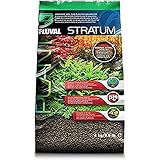
Fluval Stratum, Volcanic soil, 3-5 mm
Verdict
A volcanic soil Fluval says supports “a neutral to slightly acidic pH” and softens water (“regular KH testing is recommended”).
Evidence: No independent test; owner reports. r/PlantedTank: Fluval Stratum, bag size not stated.
Its FAQ: “We recommend gently rinsing Stratum in a large colander or similar device without agitating the substrate to remove fine dust particles.” “Stratum is a natural soil product, and like any other organic matter, adding it to an aquarium has the potential to slightly increase ammonia levels. If the aquarium is established, this should not present a problem. We recommend using an Ammonia Test Kit (Item #A7869) to ensure your aquarium is safe for fish.” “The pH of Stratum is mildly acidic, and over time slowly impacts the pH of aquarium water. Note that the buffering capacity of the water influences the soil’s effect on it: if the aquarium KH is moderate, the water will remain more neutral, and if the aquarium KH is low, the water will become more acidic.” Asked why water “became very acidic”: “It’s likely that your water is very soft and has a low buffering capacity.” “We do not recommend cleaning Stratum like gravel or sand, as doing so will cause the soil to break down prematurely.” “It’s safe to mix Stratum with other soil substrates, such as Bio-Stratum. We do not recommend mixing Stratum with any other substrates, as they can cause Stratum to break down prematurely.”
r/PlantedTank owners (2021): one uses it “with root tabs. Roots are great” (and separately a garden-soil mix); another finds it “very light and my plants get uprooted constantly”.
Specs (linked: 8.8 lb)
- Grain: “3 – 5 mm” approximate size (Fluval)
- Replace: “every 1-2 years” (Fluval)
Pros
- Soil Fluval says gives newborn shrimp “a refuge from predators”
Cons
- Can make low-KH water more acidic, per Fluval
- Replace every 1-2 years as nutrients deplete and the soil compacts, per Fluval
UNS Controsoil, Aqua soil, no rinse (UNS)

Verdict
A soil and volcanic-ash blend UNS says needs “No Rinsing”, “does not contain high nutrient levels that can cause spikes in ammonia levels” and “lowers total water hardness”.
Evidence: Retailer review (sells it), not independent. Buce Plant: UNS Controsoil, size and color not stated.
UNS on cycling: “Ammonia provides a jumpstart in a newly set up aquarium quickly without the use of third party chemicals and/or additional product(s). As ammonia decreases, nitrate levels increase. Once this step begins, livestock additions may be considered. This process is often referred to as ‘cycling a tank’. UNS Controsoil begins this process by immediately releasing minimal amounts of ammonia into the water column. Based on controlled tests performed, an aquarium may be cycled in less than 2 weeks time when using Controsoil.” That test, which UNS says an independent third party ran against an unnamed competing soil in RODI water for two weeks with no water changes: “During the 2 week test period, ammonia levels spiked following the 6th day. This was due to the absence of water changes. Weekly water changes are always highly recommended to prevent ammonia spikes. A spike can be potentially lethal to all aquarium livestock.” In it, Controsoil “stabilizes pH levels to 6.8pH over time”; “Actual results may vary due to differences in water quality and use of aquarium-related product(s).” UNS pairs 3 liters with its 9-gallon 45U tank. Buce Plant, which sells it, adds that with any aquasoil “frequent water changes are key early on”.
Specs (linked: Black, Normal, 3 L)
- Grain: “normal (5mm)” (UNS brand text on the Amazon listing)
Pros
- No rinsing, per UNS
Cons
- Ammonia spiked without water changes in the test UNS publishes
NilocG Platinum Aquasoil, Soft-water soil (NilocG)

Verdict
A Japanese ash soil NilocG says “Buffers water to 6.2-6.5”, with no starting-water condition given.
Evidence: No independent test; maker specs. Source: NilocG product page.
NilocG lists “Normal: Particle size 3.0mm-5.0mm” and “Powder: Particle size 1.6mm-3.0mm”; the linked bag is sold as “Normal Powder”, and NilocG does not say which.
Specs (linked: Black, 8 L, 16 lb per NilocG)
- Grain: unclear for this bag (see above)
Pros
- Will “buffer water for over a year when using RO”, per NilocG
Cons
- No rinsing, ammonia or capping directions found from NilocG
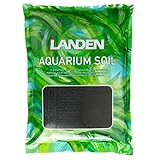
LANDEN THRIVA Aqua Soil, Aqua soil, mixed grain
Verdict
A soil LANDEN says is “rich in organic acids and nitrogen nutrients” and helps “lower the hardiness and pH level of water”.
Evidence: No independent test; maker specs. Source: LANDEN product page.
LANDEN says it “does not require rinsing”; its Amazon listing adds, “The soil is naturally sourced, and the particles have been specially processed to make them stable enough to go straight into the water, but it’s even better to wash them before use if you want.” Fill over a bowl or bag; “The initial cloudiness of the water would gone quickly as the filter system runs.” Cautions: “Expect a temporary ammonia spike initially, and this is a normal occurrence. To ensure safety, avoid adding fish or shrimp for one week.” (listing safety information); “Note: For stable ammonia levels, frequent partial water changes are advised in the first two weeks. Water conditions generally stabilize after one week.” (listing); “Suggest to wait for at least a week until your filtering system is stable for cycling if you want to move in any fish or shrimp.” (LANDEN).
Specs (linked: Black, Mixed size, 5 L)
- Grain: “Normal 3-5mm” (LANDEN’s page text, shared by its Mixed, S, M and L bags and not tied to the linked one); the linked Mixed bag “Φ1-5mm” (listing)
- Depth: “6-8cm” average (LANDEN)
Pros
- Nutrient soil that goes in without rinsing, per LANDEN
Cons
- Temporary ammonia spike expected; no fish or shrimp for a week, per LANDEN
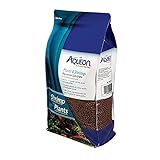
Aqueon Plant and Shrimp, Spherical clay soil
Verdict
A clay soil whose “spherical shape maintains its form over time and doesn’t breakdown into compressed soil,” says Aqueon’s text on the Amazon listing.
Evidence: No independent test; maker specs. Source: Aqueon text on the Amazon listing.
The listing calls it “a great option for a variety of freshwater plants, shrimp, snails and tropical fish”. Its safety information (Amazon listing): “Use in a well-ventilated area. Avoid inhaling dust. May cause skin irritation. Keep out of reach of children. Do not use in food production.”
Specs (linked: 5 lb)
- Material: clay (listing)
Pros
- Spherical clay that keeps its shape, per the listing
Cons
- No pH, grain or set-up figures on the listing
Seachem Flourite Black, Clay gravel (Seachem)

Verdict
A “stable porous clay gravel” that Seachem says “will not alter the pH of the water” and “is good for the life of the aquarium and need not be replaced.”
Evidence: No independent test; maker specs. Source: Seachem product page.
Seachem: “most effective when used alone as an integral substrate bed, but it may be mixed with other gravels.” “Although it is pre-washed, because Flourite® Black is a natural product, it may become dusty in transit and require rinsing before use to remove any residual dust.” Fill slowly over a bowl; “Initial cloudiness is normal. To remove cloudiness, use mechanical filtration (such as filter floss).”
Specs (linked: 3.5 kg / 7.7 lb)
- Material: clay gravel (Seachem)
Pros
- No replacement needed, per Seachem
Cons
- Dust and cloudiness at set-up, per Seachem
- No grain size published by Seachem
Brightwell FlorinBase Laterite Powder, Laterite base layer
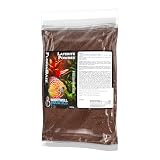
Keepers starting a new planted tank who want an iron-rich base layer.
$25.72 from AmazonAs of Nov 7, 09:58 UTCVerdict
A “Pure and natural Laterite clay powder concentrate” that Brightwell calls an “Ideal medium for use under gravel or substrates in planted freshwater aquariums”; it “Will not elevate pH”.
Evidence: No independent test; maker specs. Source: Brightwell product page.
It is a base layer, not a full substrate. Brightwell: “Normally use 15 grams (maximum 30 grams) of FlorinBase Laterite powder for every U.S. gallon (3.8 L ) of aquarium capacity. For new setups, sprinkle powder over the bottom surface of the dry aquarium prior to adding any other gravel.” For best results (see our layering guide), Brightwell covers it with its Substrat VF granules (“This will allow plant roots to get easy access to the laterite, while preventing clouding”), then Substrat F (“Do not blend this layer with the first two layers”), then either leaves Substrat F on top or adds “whatever gravel you prefer”. Substrat VF and F are separate Brightwell products, not in this lineup or seller-checked. The powder needs no rinsing, but the two layers above it do: “Note: FlorinBase Laterite powder does not require rinsing. Both Substrat VF and Substrat F should be rinsed well before using.” “Laterite powder can cause a temporary reddening or clouding of the aquarium water. This usually dissipates within a few hours. It is recommended that you use a saucer to pour water on to when filling the aquarium.”
Specs (linked: 1000 g)
- Dose: 15 g per US gallon, maximum 30 g (Brightwell)
Pros
- Laterite “Rich in a plethora of natural minerals, particularly iron”, per Brightwell
Cons
- Used under a cap layer; new setups start with a dry tank, per Brightwell
Who should buy it
Keepers starting a new planted tank who want an iron-rich base layer.
Aqua Natural Diamond Black, Quartz gravel, 1-2 mm

Keepers wanting fine black gravel in a tank without snails or bottom feeders.
$14.69 from AmazonAs of Nov 7, 09:58 UTCVerdict
Quartz gravel “Graded to 1–2 mm” that “falls between sand and traditional pebble gravel”, says Aqua Natural’s text on the Amazon listing.
Evidence: No independent test; maker specs. Source: Aqua Natural text on the Amazon listing.
Pisces USA, its maker, says in its FAQ that AquaNatural gravels “are suitable for planted aquariums”; it makes no pH claim for this gravel. Directions (Amazon listing): “Rinse until water runs clear, place in base of aquarium. Not reccommended for snails or bottom feeders.”
Specs (linked: 10 lb)
- Grain: 1-2 mm (listing)
Pros
- Fine 1-2 mm quartz, per the listing
Cons
- “Not reccommended for snails or bottom feeders” (Amazon listing)
- Our reading: no nutrient claim from Pisces
Who should buy it
Keepers wanting fine black gravel in a tank without snails or bottom feeders.
Frequently Asked Questions
Q. Is sand or gravel better for a planted tank?
Modern Aquarium, a plant retailer: “While gravel is not the best substrate for planted tanks, it’s still a great choice for undemanding aquarium plants and, with supplemental fertilization, can allow you to grow most, if not all, aquarium plants in your aquarium.” It warns fine sand “may compact too tightly over time”, but sand “may be the best substrate” for anubias or java fern grown on rocks or driftwood.
The bottom line
Final Verdict
Soil for nutrients and softer water, Flourite Black for a lasting gravel bed, laterite under gravel: each per its maker.
Product prices and availability are accurate as of the date/time indicated and are subject to change. Any price and availability information displayed on Amazon.com at the time of purchase will apply to the purchase of this product.