The short answer
Cut the heat: lights off, curtains closed. Then open the lid, blow a fan across the water and add an air stone. For a faster drop, float a sealed frozen bottle; Aqueon’s limit for a floating bag of ice is 2 or 3°F in 4 hours. If that is not enough, Aquarium Co-Op calls a chiller the most reliable fix.
Aqueon, an aquarium equipment maker, explains the risk: as water warms, a fish “needs more oxygen”, while “the ability of water to hold dissolved oxygen drops with rising temperature”. Water type matters too: “saltwater holds less oxygen than freshwater of the same temperature”. Aqueon adds that “Short heat spells are usually no cause for panic, but the warmer the weather and the longer it lasts, the more problematic it can be.”
Aqueon names the first sign of heat stress: “rapid gill movement or gasping for air at the surface”.
How Hot Is Too Hot for a Fish Tank?
It depends on the fish. Aqueon’s summer article gives most tropical fish 74-80°F, common goldfish 60-70°F and fancy goldfish 68-74°F. Its temperature article adds that “above 90°F, the beneficial bacteria that maintain balance in an aquarium begin to die”, which can bring ammonia and nitrite spikes (one maker’s figure, not found elsewhere).
Axolotls need much cooler water. The University of Kentucky’s axolotl colony keeps them at 60-65°F and says they “should never be kept above about 22°C (72°F)”. For other species, see our fish tank temperature guide by fish type.
What You Need
- An accurate thermometer. Bulk Reef Supply, an aquarium retailer, says to check it “at least once a day—more frequently during heat waves”. Aquarium Co-Op, an aquarium retailer, suggests a digital one “with an alarm that beeps if the water gets too hot”.
- A fan (clip-on, USB or table fan).
- A screen or mesh lid if your fish jump.
- An air pump with an air stone, or a sponge filter.
- Clean, food-safe plastic bottles that seal, to freeze.
- Dechlorinated water for top-offs and water changes.
- A GFCI-protected outlet: Bulk Reef Supply’s safety guide says “All of your equipment should be GFCI protected.”
Two thermometers from our roundups fit, one of each thermometer type and mounting. The Simple Deluxe’s probe sits in the water, so it “reads the water rather than the glass”, says our aquarium thermometer roundup. The hygger HG073-S, from our stick-on thermometer roundup, tapes to the outside glass and shows a 24-hour high and low. Its temperature accuracy has a catch: it reads the glass, and our thermometer roundup warns that “a cold room or a draught can pull the reading away from the water”, so keep it out of the fan’s airflow.
| # | Preview | Product | Price | Link |
|---|---|---|---|---|
| 1 |  | Simple Deluxe LCD Digital Aquarium Thermometer, Reptile…Probe in the water | $8.20 Prime | Check on Amazon |
| 2 |  | hygger Digital Aquarium Thermometer Records Max Min…Shows 24-hour high and low | Check on Amazon |
How to Cool Fish Tank Water, Step by Step
Check the temperature and note the daily high
Compare it with your fish’s range above.
Cut the heat coming in
Turn the aquarium light off, or for planted and reef tanks shorten its hours, and close the curtains on a sunny window (Aqueon). Aquarium Co-Op adds hot air from vents, ovens and dryers, and one more equipment category: powered extras such as a UV sterilizer or skimmer, which “become sources of unwanted heat”.
Turn the heater down
Aqueon says “Turn your heater down, but not off”, in case the room cools and it stays unplugged; Aquarium Co-Op says to remove it with other unnecessary equipment. Neither choice cools the water: “Heaters can’t cool,” as the top comment in a 2018 r/Aquariums thread put it. A heater that keeps heating past its setting may be stuck: Aquarium Science, a hobbyist reference site, says heaters “usually fail in the “on” position”. Aquarium Science advises a backup, such as a separate aquarium heater controller; our aquarium heater roundup covers how heaters fail. Unplug a heater before you lift it out, and follow its manual.
Take the lid off, or swap it for a screen top
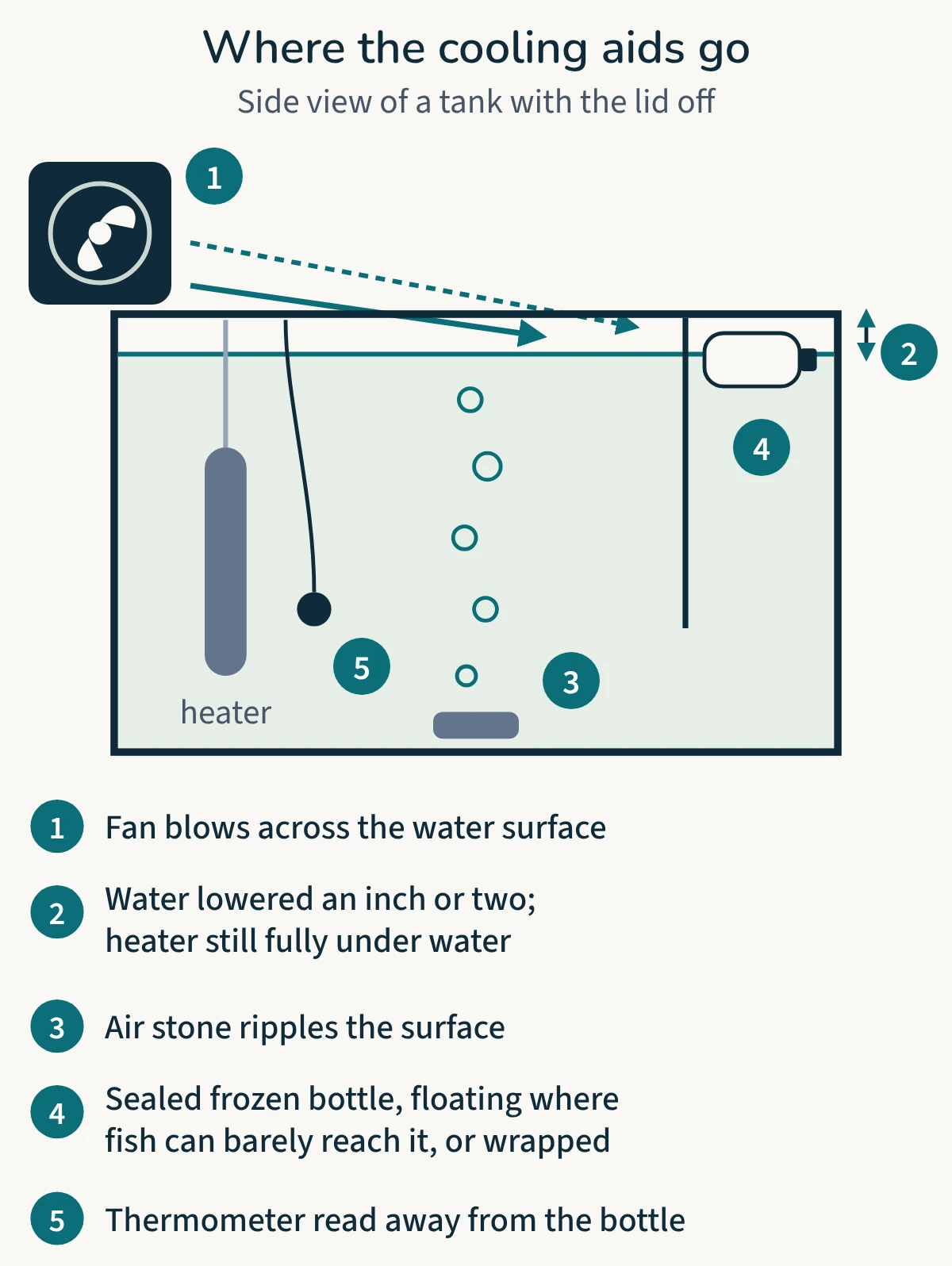
Aqueon suggests lowering the water “an inch or two to prevent fish from jumping out”, no lower: Hydor, a heater maker, says its heaters “MUST NOT be used out of water”.
Aim a fan across the water surface
The airflow speeds evaporation, which takes heat from the water. Bulk Reef Supply says most reefers see “a temperature drop of a couple degrees”, depending on room temperature, surface area and fan power. Clip the fan where it cannot fall in, and loop its cord below the outlet so drips fall off before the plug (The Spruce Pets’ drip loop).
Add an air stone
Its bubbles stir the surface and speed evaporation, and Aquarium Co-Op notes that “warm water holds less dissolved oxygen than cool water”. More in how to increase oxygen in a fish tank.
Top off evaporated water to that line
Freshwater: dechlorinated water (Bulk Reef Supply). Saltwater: RO/DI water, because, Reef Builders wrote in 2017, “only the fresh water evaporates, and the salt is left behind”.
Feed lightly
Bulk Reef Supply suggests “Feeding lightly or skipping a day”, and holding off on adding new fish.
For a faster drop, float a frozen bottle
Freeze clean water in a sealed, food-safe bottle, not loose ice. Bulk Reef Supply says tropical fish that linger by it can get cold shock, so put it somewhere “somewhat restricted to fish access”, such as a filter compartment, or wrap it in a bag or thin cloth, and read the thermometer away from it. For a floating bag of ice, Aqueon says “not to lower the temperature more than 2 or 3 degrees F in a 4-hour period”. Swap bottles as they thaw; remove them once the temperature is safe. Aquarium Co-Op warns that the ice method is time-intensive and the temperature “becomes extremely volatile”.
Or change some water for slightly cooler water
Bulk Reef Supply says dechlorinated water “just a few degrees below tank temperature”. Hydor says to unplug its heaters “at least 30 minutes before any waterchange”.
Common Mistakes
- Keeping the glass lid on. Bulk Reef Supply says closed lids “can trap warm, humid air and increase heat retention”.
- Cooling too fast. Aqueon says to make any temperature change gradual.
- Letting water fall below that line. Bulk Reef Supply says low water can “expose heater elements” and cut filter flow.
- Insulation on its own. Caudata Culture, an amphibian-keeping site, says on an undated page “By itself, insulating the tank has no effect”; it helps alongside other cooling.
When the Tank Keeps Overheating
If the steps above are not enough, Aquarium Co-Op calls a chiller “the most reliable solution”, which can cost “several hundred to over $1000, depending on the size of your aquarium”. 2Hr Aquarist, a planted-tank brand, notes that chillers “emit a lot of heat themselves”, and Aqueon says to install one “in a well-ventilated space”. See why to use a chiller and how to size one.
If fish still gasp once the water is back in range, test ammonia and nitrite: Aqueon says these “may begin to rise” in hot weather. If your fish look unwell, contact an aquatic veterinarian. We do not diagnose or treat fish.
Ready to buy?
Our aquarium thermometer roundup compares a budget probe, a calibrated reference thermometer and a stick-on.
Frequently Asked Questions
Q. Can I put ice cubes in my fish tank to cool it down?
Sources differ. Aqueon says to avoid it unless the cubes are made with reverse osmosis or dechlorinated water. Bulk Reef Supply says to avoid ice in the tank altogether, because of “rapid, localized temperature shifts”.
Q. How fast can I cool a fish tank?
Of the sources we read, only Aqueon gives a figure, and only for a floating bag of ice: no more than 2 or 3°F in 4 hours.
Q. Does a fan really cool a fish tank?
Yes, by evaporation. 2Hr Aquarist says that “In areas with drier air, fans can be used to lower the temperature by a few degrees”. Caudata Culture notes that fans work with a screen lid, not a hood.
Q. Is an aquarium chiller necessary?
Not for every tank. Aqueon says “Aquariums with cold-water fish or sensitive corals may require a chiller”.
Q. How do I keep an axolotl tank cool?
Use the same steps, and never house them “where they are exposed to direct sun” (University of Kentucky). Bulk Reef Supply calls chillers “especially valuable for sensitive species like axolotls”.
Sources (14)
- Aqueon (maker), How to Keep Your Aquarium Cool in Summer Heat
- Aqueon (maker), Fish Tanks and Water Temperature
- Aquarium Co-Op (retailer), 5 Easy Methods for Cooling Aquarium Water During a Heat Wave
- Bulk Reef Supply (retailer), Beat the Heat: 10 Tips to Keep Your Aquarium Cool This Summer
- Bulk Reef Supply (retailer), 10 Tips to Keep Your Aquarium Cool During Summer
- University of Kentucky Ambystoma Genetic Stock Center, Guide to Axolotl Husbandry
- Bulk Reef Supply (retailer), Basic Aquarium Safety
- Hydor (maker), Do I need to turn the Heater OFF when I am doing a water change?
- Aquarium Science (hobbyist reference), Aquarium Heaters
- 2Hr Aquarist (planted-tank brand), High Temperatures and Planted Tanks
- Reef Builders (publication), Topping Off Your Tank With Freshwater
- The Spruce Pets (publication), What Is an Aquarium Drip Loop?
- Caudata Culture (amphibian hobby site), Aquarium Cooling Methods
- r/Aquariums (forum), What can I do to cool down my tank (2018)
Product prices and availability are accurate as of the date/time indicated and are subject to change. Any price and availability information displayed on Amazon.com at the time of purchase will apply to the purchase of this product.