The short answer
Not strictly. Aqueon, an equipment maker, says bettas “do not necessarily need a filter”, and UF/IFAS says small, lightly filtered tanks can work with frequent water changes. But a betta’s ammonia builds up in any tank unless something removes it, and a filter’s bacteria clear it between changes. Aqueon adds that a filter means better water and less work.
Sources split on this. UF/IFAS, the University of Florida’s extension service, writes that male bettas thrive in small containers when water quality is managed. In a 2022 r/bettafish thread asking “Does he need a filter?”, most replies we could read said yes, and a few said no. Both views hold up once you see where a betta’s waste goes and who removes it: bacteria in a filter, or you with a bucket.
What a filter does in a betta tank
An aquarium filter does two jobs. It catches floating debris (mechanical filtration), and its filter media, often a sponge, gives bacteria a surface to grow on (biological filtration). The second job is the one the filter question is really about.
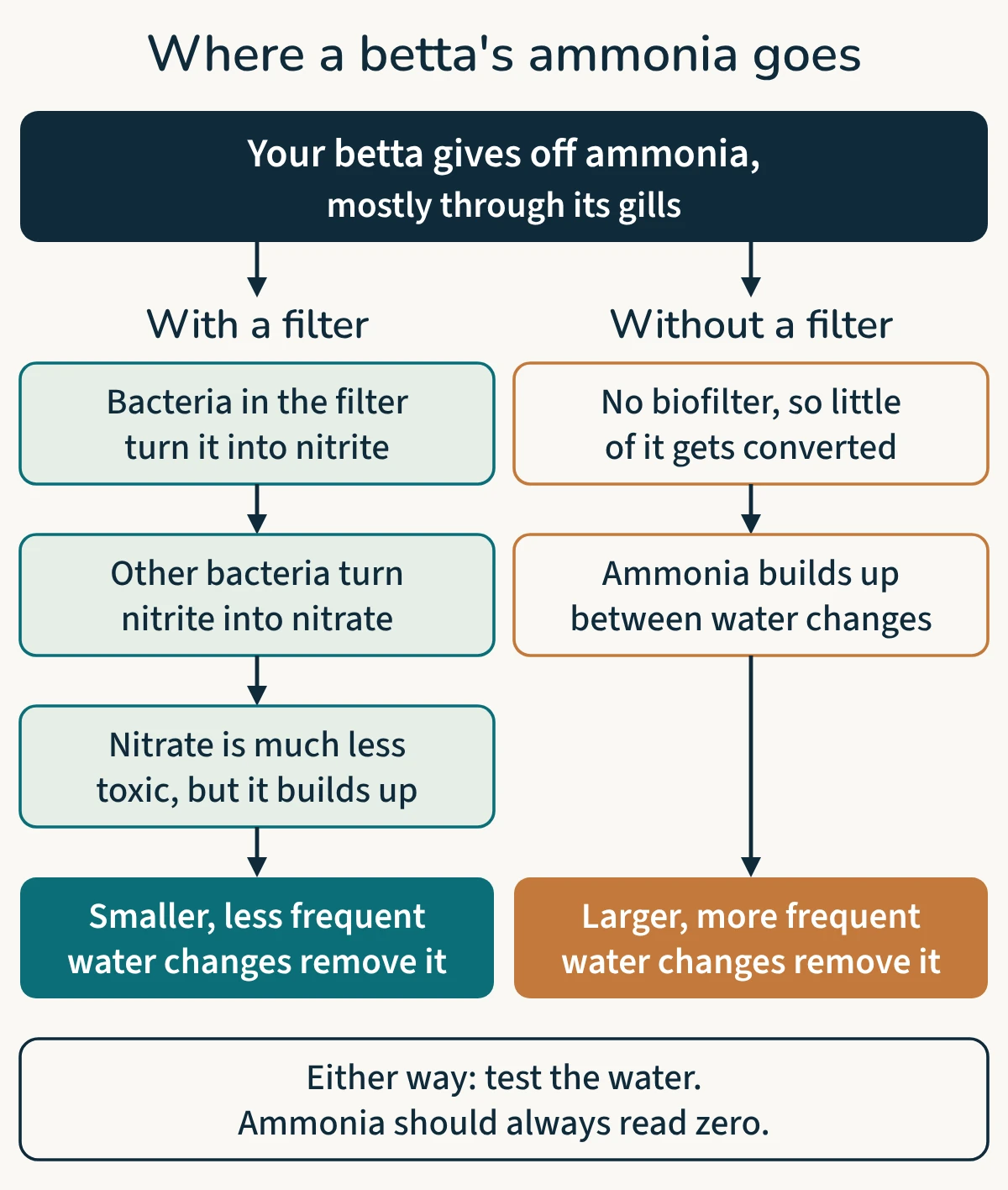
Fish make ammonia all the time. UF/IFAS’s ammonia guide says most of it leaves “by diffusion through the fish’s gills into the water”, and that “even a starved fish will produce some ammonia.” API, a test-kit maker, says fish “continually release ammonia into the aquarium through their gills, urine and solid waste”, and uneaten food adds more.
Bacteria clear it in two steps, the nitrogen cycle. One group turns ammonia into nitrite; a second turns nitrite into what UF/IFAS calls “the much less toxic nitrate”. In a pond, those bacteria live on the mud and plants. In a tank, UF/IFAS says, “a biological filter (“biofilter”), must be provided as a place where the bacteria can colonize and flourish.” A new one needs “six to eight weeks” to build up enough bacteria, which is why a new filter is cycled before it can be trusted (how to cycle a fish tank walks through it).
Nitrate is the end of the line. It stays in the water until a water change removes it, so a filter cuts the work of water changes but does not end it.
Why this matters: “At low concentrations, ammonia causes stress and damages gills and other tissues,” UF/IFAS writes, and the water can look clear while it happens, because “the only way for a producer or aquarist to know if ammonia is present is to test the water.”
Why bettas get by without one
Three facts explain why so many bettas live in unfiltered cups and bowls.
- They breathe air. Bettas are labyrinth fish: UF/IFAS describes a labyrinth organ above the gills, “allowing them to breathe air” at the surface, so still, low-oxygen water troubles them less than it would most fish. That solves oxygen, not waste. The same guide says their gills “primarily excrete the waste products ammonia and carbon dioxide”, so the ammonia still goes into the water.
- Their wild water is shallow and still. UF/IFAS says wild bettas live “in standing waters, including shallow ponds, rice paddy fields, and even puddles”, and that in the breeding season they “move to shallow water edges to breed”. At one site in Thailand the water averaged about 2 inches deep, with low oxygen and “heavy emergent vegetation”: shallow, but thick with plants.
- The trade keeps them small. Farms grow males in “half-pint liquor flasks”, changing water by adding it at the top, and stores hold them in small plastic cups (UF/IFAS).
UF/IFAS draws a clear conclusion: “male bettas thrive in small containers as long as water quality, nutrition, and other health management considerations are properly managed,” and adds that “water quality is not dependent on the size of the container, but rather on management and husbandry.” Aqueon’s care guide agrees that the labyrinth organ makes it “possible for them to live in small aquariums without circulation”.
Aqueon’s own setup article leans the other way: “Betta fish are hardy, but they can be sensitive to bacteria buildup. So make sure you have clean water and a good filtration system.” The difference is who does the managing. UF/IFAS spells it out: small tanks with little filtration “should be managed to include frequent water changes so that uneaten feed as well as ammonia and other dissolved wastes are not allowed to reach harmful levels”.
Filtered vs unfiltered: the work each one takes
Aqueon is the one maker we found that gives both routines on one page, so the table uses its figures, with UF/IFAS and API for testing.
| With a filter | Without a filter | |
|---|---|---|
| What clears the ammonia | Bacteria in the filter, once it has cycled (UF/IFAS) | You, at each water change |
| Water changes (Aqueon) | 10% every week or 25% every 2 weeks | One third every 3 to 4 days, in small unfiltered containers |
| Feeding (Aqueon) | Once or twice a day | Sparingly, once a day |
| Ammonia tests | Several times a week for a new tank’s first 4-6 weeks, then weekly (API) | Weekly (UF/IFAS, for fish-farm systems); more often whenever ammonia shows (UF/IFAS) |
| What to watch | Current too strong for a betta (UF/IFAS, Aqueon) | Ammonia creeping up between changes |
Forum commenters ask for far more work than Aqueon’s schedule. On a 2013 Fish Forums thread, one wrote that it “is possible to have a Betta without a filter but you would need to do daily water changes of at least 50%, if not more”; another, that “a 15L (3 gallon) tank is perfectly fine to have without a filter. You will need to do 100% water changes every other day”. Aqueon, for its part, says: “Never change all of your betta’s water at one time!”
The figures don’t agree, so let a test kit settle it for your tank. UF/IFAS’s rule: “In healthy ponds and tanks, ammonia levels should always be zero.”
Note
No filter or water-change routine treats illness. If your betta looks unwell, test the water and contact an aquatic veterinarian; UF/IFAS points to working “with a fish veterinarian” for proper diagnosis.
Why a betta’s filter should be gentle
A filter fixes the ammonia problem and can create a current problem. UF/IFAS, citing flow research it does not detail, writes: “Bettas prefer calm water as shown by research using flow as a stressor, so heavy filtration may actually be harmful to a betta’s health and welfare.” Aqueon’s setup article says to “Look for a low-flow filter. Strong currents might hurt your fish’s fragile fins”.
Whatever the filter type, check its rated tank size against your tank and look at its flow rate; flow gentleness is the point of Aqueon’s low-flow advice. Two ways to get gentler flow:
- A sponge filter. Many run on an air pump: bubbles rising up a tube pull water through a sponge, where the bacteria live. How a sponge filter works explains the parts.
- A filter with its own flow control, turned down. Our guide to reducing filter current starts with the controls makers build in, then outlet placement and baffles.
The sponge filter below is a betta pick in both our sponge filter roundup and our 10-gallon filter roundup (in the 10-gallon roundup, the pick for tanks that already run an air pump). AQQA’s page says it is “suitable for 5-20 gallon tanks” and “works great in breeding fry tanks, shrimp and betta fish tanks”. It needs an air pump, which is not included, and AQQA gives no flow figure: the air pump sets the flow rate, so neither roundup could verify how gentle its flow is.
| # | Preview | Product | Price | Link |
|---|---|---|---|---|
| 1 |  | AQQA Aquarium Sponge Filter for 5-20 Gallon, Submersible…Air-driven, 5-20 gal | Check on Amazon |
Ready to buy?
Our sponge filter roundup compares eight sponge filters by each maker’s tank size, air pump needs and cleaning cautions, including picks for betta and 10-gallon tanks.
Do plants or a bubbler replace a filter?
Plants slow ammonia down; in the one study we found, they did not stop it. A 2026 study in Animals kept bettas in 2-liter tanks (about half a gallon) with no filter or aeration, with waste removed after feeding and the water topped up daily. Over 25 days, ammonia “increased over time in all groups”, planted or not, but every planted group built up significantly less ammonia than the bare tanks. It is one study, in very small tanks, with water kept at 21 ± 2 °C (about 66-73 °F, worked from the study’s Celsius figure), cooler than Aqueon’s range for bettas.
Heavily planted, filterless “Walstad” tanks are the exception one commenter names. On the r/bettafish thread, they wrote that the style works “but it relies on having an overabundance of deep substrate (think around 2″ minimum) and enough plants to make it tough to find your fish.” One owner there keeps a betta with plants and no filter: “No, you don’t need a filter for a beta fish. I have mine “Zuko” in a tank with lots of live plants and an air stone just in case.”
A bubbler is not a filter. An air stone moves water and stirs the surface, but it holds no media for bacteria, and in a tank, UF/IFAS says, the bacteria need a biofilter to “colonize and flourish”. A sponge filter is the halfway house: the same air pump, with a sponge for the bacteria. Our air pump explainer covers when a tank needs a pump at all.
If you keep a betta tank without a filter
Some keepers go filterless on purpose, and some are waiting on a filter. Either way, the routine below comes from the sources above.
Buy an ammonia test kit first
Ammonia is colorless and, UF/IFAS notes, odorless even at toxic levels, so a test is the only way to know it is there. API’s instructions are to test “several times a week for 4-6 weeks when you start a new aquarium”, then weekly.
Use the biggest tank you can
Aqueon says “larger habitats are more stable and easier to maintain”. Our betta tank size guide lists the minimums vets and retailers give.
Change part of the water on a schedule
Aqueon’s figure for small unfiltered containers is one third every 3 to 4 days, never all of it at once. Treat tap water with a water conditioner before it goes in, as Aqueon says to.
Feed sparingly
Aqueon says once a day in unfiltered containers, with all food eaten “in two minutes or less” and any leftovers removed.
Act the day ammonia shows
UF/IFAS says to reduce or stop feeding first, for a short time (it gives 1-3 days as an example), and that “A 25% to 50% water change will help remove some ammonia, assuming the incoming water source does not contain ammonia.” Test more often until it reads zero again; our guide to lowering ammonia has the full steps. For the long term, UF/IFAS says keepers of a tank without a biofilter “should strongly consider incorporating one.”
Tip
Adding a filter later? A new biofilter needs six to eight weeks to build up bacteria (UF/IFAS), so keep up the water changes and tests while it does. How to set up a betta fish tank covers the rest of the kit.
Frequently Asked Questions
Q. Do betta fish need a heater?
Aqueon, a heater and tank maker, says to use a heater “If the aquarium is kept in rooms below 76°”, and to keep betta water “between 76° and 85° F”; its setup article gives “about 76 to 81° Fahrenheit”. UF/IFAS sets a lower floor for the room’s air, not the water: an unfiltered, unheated container needs “no less than 22°C (71.6°F)”. Our 5-gallon heater roundup compares small-tank heaters.
Q. How long can a betta live without a filter?
None of the sources we read gives a number of hours or days; it depends on how fast ammonia builds in your tank. A betta whose filter has stopped is, for now, in an unfiltered tank: follow the routine above, starting with an ammonia test.
Q. Do bettas need a filter in a 5-gallon tank?
Neither Aqueon nor UF/IFAS names a tank size at which a filter becomes necessary. Aqueon’s water-change figures are for small unfiltered containers (a third every 3 to 4 days) and filtered aquariums (10% a week); it gives none for a 5-gallon tank without a filter, so test the water to set your own schedule. The sponge filter above is rated by AQQA for 5-20 gallon tanks.
Q. Can a betta live in a bowl?
Sources disagree. UF/IFAS calls the domestic male betta “well suited to the small aquaria” and bowls it is usually kept in, given good husbandry. A 2024 study of eight males in Animal Welfare found that 0.5-liter bowls cut swimming and that “at least a 10-L aquarium is required to ensure full expression of swimming behaviour” (10 liters is about 2.6 gallons).
Q. Why do pet stores keep bettas in cups?
Males fight, so each is kept alone, and UF/IFAS says “At the retail level, male bettas are typically kept in small plastic cups either on a shelf or floating in aquariums.” It adds that bettas “have evolved to survive in conditions similar to their shipping and holding environments”, and that retailers manage water quality while they do.
Sources (9)
- UF/IFAS Extension, Evolution, Culture, and Care for Betta splendens (FA212)
- UF/IFAS Extension, Ammonia in Aquatic Systems (FA16)
- Aqueon (maker), Betta Care Guide
- Aqueon (maker), Betta Fish Tank Setup
- API (test-kit maker), API Ammonia Test Kit
- Oldfield and Murphy, Life in a fishbowl: Space and environmental enrichment affect behaviour of Betta splendens, Animal Welfare, 2024
- Effects of Aquatic Plants on Water Quality, Microbial Community, and Fish Behaviors in Newly Established Betta Aquaria, Animals, 2026
- r/bettafish (forum), Can I add a betta fish to this with no filter? Does he need a filter?
- Fish Forums (forum), Bettas Without Filters
Product prices and availability are accurate as of the date/time indicated and are subject to change. Any price and availability information displayed on Amazon.com at the time of purchase will apply to the purchase of this product.