The short answer
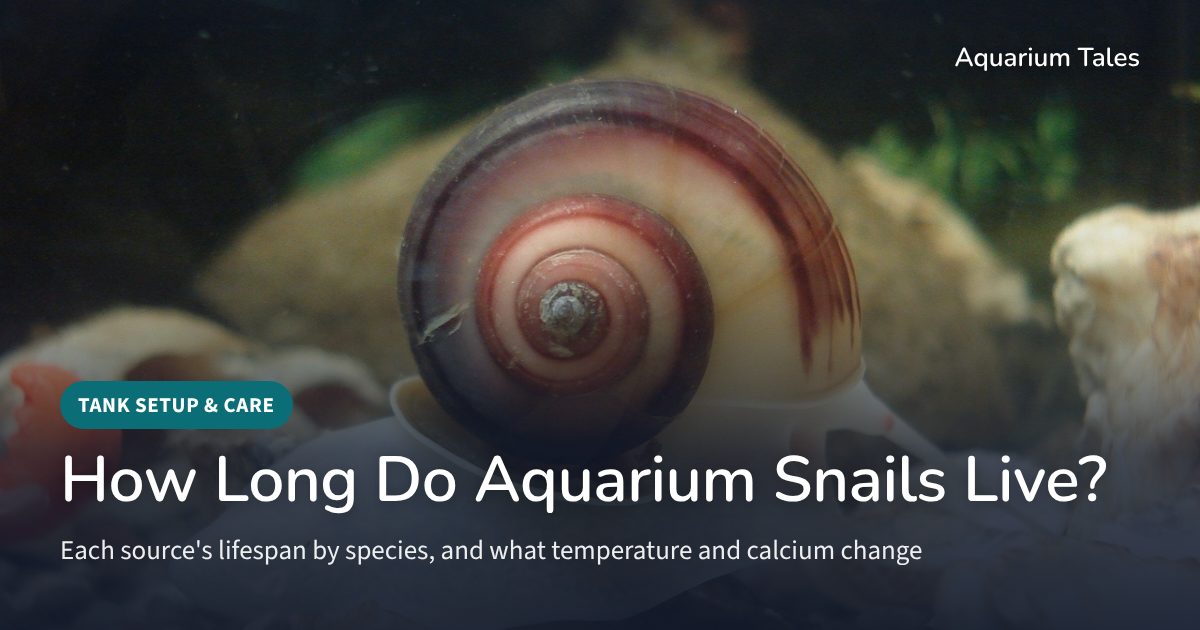
Aquarium Breeder, a hobby blog, says “Most aquarium snails live 1–3 years.” Figures differ: its chart gives bladder snails 6 to 9 months on average, and mystery snail figures run from an average of 1 to 2 years (Aquarium Co-Op, a retailer) to 3 to 4 years (Aqueon, a maker). Cooler water may lengthen apple snails’ lives, within limits.
Each row below says what its source measures. This guide covers freshwater snails only.
Aquarium Snail Lifespans by Species
Buce Plant, a live-plant retailer, gives “up to” figures in what it calls “some general notes” on three pest snails.
| Snail | Source: what it gives | Figure |
|---|---|---|
| Mystery | Aquarium Co-Op: average, “depending on the water temperature” | 1–2 years |
| Mystery | Aqueon: “live” | 3–4 years |
| Mystery | Breeder chart: average; maximum | 1–3 years; 4 years |
| Apple snails | applesnail.net: at 77°F (25°C; °F is our conversion); cooler | 12–16 months; can get over 3 years (lower temperatures; no figure given) |
| Nerite | Aquarium Co-Op: “about” | 1–2 years |
| Nerite | Aqueon: “thought to live at least” | 3 years; hobbyist reports of 5 |
| Nerite | Breeder chart: average; maximum | 1–3 years; up to 5 |
| Nerite | Breeder FAQ: “usually”; some, “with stable water parameters and calcium supplementation” | 2–3 years; reported up to 5 |
| Ramshorn | Buce Plant: “up to” | 1 year |
| Ramshorn | Breeder chart: average; maximum | 1–2 years; up to 3 |
| Bladder | Buce Plant: “up to” | 2 years |
| Bladder | Breeder chart: average; maximum | 6–9 months; up to 1 year |
| Malaysian trumpet | Buce Plant: “up to” | 3.5 years |
| Malaysian trumpet | Breeder chart: average; maximum | 1–2 years; up to 3.5 |
| Rabbit | Aqueon: “thought to live up to” | 3 years |
| Rabbit | Breeder chart: average; maximum | 1–3 years; up to 5 |
| Assassin | Breeder chart: average; maximum | 2–3 years; up to 5 |
applesnail.net, an apple snail reference site, writes about apple snails as a group; Aqueon says “Mystery snails (Pomacea spp.) are a type of apple snail”.
Upper limits differ on the same question: bladder snails up to 2 years (Buce Plant) or 1 (Aquarium Breeder’s chart; 1.5 in colder water, its text says), ramshorns 1 or 3 (same order), rabbit snails 3 (Aqueon) or 5. The mystery snail figures answer different questions: Aquarium Co-Op’s is an average tied to temperature; Aqueon’s names no measure. Aquarium Breeder also varies within its page: its opening says “Nerites ~2–3 years”, its chart 1 to 3 on average. For bladder snails it gives “Bladder snails ~1 year.” (opening), “usually 6 to 12 months” (text; its FAQ says “typically”) and 6 to 9 months on average (chart), and its bladder guide says “The life span ranges from 3 – 12 months and greatly depends on the environment temperature.”
Only Aquarium Breeder, of these sources, gives an assassin snail figure; its species guide says “Up to 5 years in captivity, provided you don’t starve them or drop the pH.” It also warns: “But if your tank is completely pest-free, your assassins will eventually starve unless you supplement their diet.”
The Rest of Aquarium Breeder’s Freshwater Chart
Its chart lists 16 more freshwater snails, shown as given; land and saltwater rows are left out. No other source here gives these figures.
| Snail | Average | Maximum |
|---|---|---|
| Horned nerite | 2–3 years | 5 years |
| Giant Colombian ramshorn | 3–4 years | 5 years |
| Japanese trapdoor | 3–5 years | 10 years |
| Devil spike | 3–5 years | 6 years |
| Pagoda | 1–2 years | 5 years |
| White wizard | 2–4 years | 5 years |
| Hairy | 1–2 years | 3 years |
| Spixi | 2–3 years | 5 years |
| Ladybug | 1–2 years | 3 years |
| Pond | 1–2 years | 3 years |
| Chopstick | 2–3 years | 4 years |
| Batman | 1–2 years | 3 years |
| Small pond | 1 year | 2 years |
| Ear | 1 year | 2 years |
| Black panther | 2–3 years | 5 years |
| Blue turbo | 2–3 years | 5 years |
How to Read the Chart for Your Snail
Name the species first
Aquarium Co-Op says bladder, ramshorn and Malaysian trumpet snails are “often called pest snails”. Our guide to why snails appear in an aquarium has a table for telling them and their eggs apart.
Allow for its age when it arrived
Aquarium Breeder says rabbit snails grow slowly, so “it can take them close to 1 year to become adults”; by our reading, an adult rabbit snail may already be close to a year old.
Check the water before you blame age
Aquarium Breeder’s signs of old age: “Older snails become less active, eat less, and their shell may become thin or pitted. If they are past their species’ typical lifespan and showing these signs, it’s likely old age.” Pits can also reflect low calcium. applesnail.net explains that as an apple snail ages, its outer shell layer tends to wear thin and the calcium-rich layer beneath can dissolve in water low in calcium, leaving small pits, but it says “one cannot speak of a dangerous problem, as long as this process is slow and the snail gets enough time to reinforce the innerlayer by adding more calcium.” Aquarium Co-Op says of mystery snails: “If you see pits and divots in your snail’s shell, try dosing mineral supplements”. A GH test shows whether your water is soft; see the cautions below first.
What Shortens or Lengthens a Snail’s Life
Temperature
Aquarium Co-Op says of mystery snails: “Keeping the water on the cooler side may slow down its metabolism and increase its longevity.” For apple snails, applesnail.net gives “A general rule: keep the temperature between 18 and 28°C (65-82°F).” It warns: “If the temperatures drops below 10°C (50°F) the apple snail becomes completely inactive and will die within a few days.” Aquarium Breeder says bladder snails “can stretch to 1.5 years” below 65°F (18°C), “but that also slows their metabolism and breeding.” It adds, of most aquarium snails: “Don’t let the temperature drop below 50°F — that’s fatal.”
Cooler has limits. The University of Florida’s IFAS Extension, a university extension service, says Florida’s wild applesnails “are not known to withstand water temperatures below 10°C (50°F)”. It says the spike-topped applesnail “is marketed as an aquarium species”. Of that species in the wild, it says: “This species has a lower tolerance for cold water than the Florida applesnail”. Aqueon says rabbit snails “prefer warmer temperatures (76° – 84°F)”. And Aqueon warns: “If you already have fish or other creatures in your aquarium, never make sudden or drastic changes to pH or any other water parameters.” Your fish set the range too; our guide to what temperature a fish tank should be lists ranges by fish type.
Hardness and calcium for shells
Aquarium Co-Op says mystery snails “cannot live in soft water environments. They require lots of calcium and other minerals in their water and diet to grow a healthy, smooth shell.” API, a test-kit maker, says “General hardness is the measure of calcium and magnesium ion concentrations dissolved in water” and “soft water is low in these minerals”. No maker or authority page used here gives a GH target for snails, so this guide gives none. Aquarium Co-Op’s nerite guide says: “If you have soft tap water and notice your snails are getting cracked or eroded shells, increase the minerals in their water and food to keep the damage from progressing.”
Aqueon says: “Snails – and shrimp – need an ample supply of calcium for healthy shell growth, so if you use reverse osmosis or deionized water, add Aqueon Water Renewal to replenish essential minerals and trace elements.” Water Renewal is Aqueon’s product; follow any mineral product’s label. applesnail.net says to make sure your fish tolerate calcium-rich (hard) water before you add calcium supplements. And Aqueon’s rule applies here too: “If you already have fish or other creatures in your aquarium, never make sudden or drastic changes to pH or any other water parameters.” Softening water lowers the same GH; our guide to softening aquarium water and lowering GH and KH covers that side.
Copper
Aqueon says “Some medications contain copper sulfate and other chemicals that are harmful to snails and other invertebrates.” and “Always read package instructions and ingredient lists before using any treatment in your aquarium.” Aquarium Co-Op says of mystery snails: “As with most snails, they are sensitive to salt and copper-based medications, so please remove them if the aquarium is being treated with those chemicals.” UF IFAS, in its guide to copper in marine aquaculture and aquarium systems, says “Invertebrates should be removed prior to treatment with copper.” Of copper and other metals in tap water, applesnail.net’s care page says “Apple snails are very sensitive for these compounds (especially copper)” and advises a water preparation product that removes metals; our water conditioner roundup lists what each pick claims. This guide gives no treatments or doses; for sick fish, contact an aquatic veterinarian.
Food and tankmates
Aquarium Co-Op says “nerite snails can starve to death if there is not enough algae in the tank or other fish are outcompeting them for food”. Aqueon’s advice: “Feed sparingly and remove uneaten food to avoid water quality problems.” Our guide to what aquarium snails eat covers foods and amounts. Aquarium Co-Op lists “fish food” first in a mystery snail’s diet; our tropical fish food roundup compares flakes, granules and pellets.
Aquarium Breeder says “If you keep any of these, your snails won’t live out their full lifespan”: loaches (clown, yoyo and khuli), pufferfish of any species, certain cichlids (especially larger ones) and assassin snails. Aquarium Co-Op says assassin snails “ambush and eat other snails, even those that are much larger in size”.
Dead or Just Resting? How to Tell
Aquarium Co-Op says that if a mystery snail “has not moved in 24–48 hours, consider picking it up to see if it reacts”, and that an overpowering stench means it has died.
- Apple and mystery snails. applesnail.net says “apple snails can be very inactive for days”, and “Floating of an apple snail doesn’t indicate that there is something wrong or that he/she is dead.” Its check is to lift the snail out and touch the shell door: “If the shell is closed completely, then you can be sure that the snail is alive because once the snail is dead, the muscles are relaxed and the shell door stays at least partly open.”
- Rabbit snails. Aquarium Breeder says resting rabbit snails “curl up inside their shells, with their operculum repositioned to their aperture”, and that one which “has not moved for a while” is not necessarily dead.
- Bladder snails. Aquarium Breeder says “They do not have operculum (trapdoor)”, so by our reading the shell-door check cannot work for them. Aquarium Co-Op’s general snail guide says that if one “is hanging out of its shell or has a putrid odor, remove it from the tank to prevent the water from fouling.”
- New arrivals. LiveAquaria, an online livestock retailer, says: “Always follow the acclimation procedure even if your new arrival appears to be dead. Some fish and invertebrates can appear dead when they arrive and will usually revive when the acclimation procedure is followed correctly.” Our guide to adding new fish to an aquarium walks through the acclimation steps.
Once you are sure, take it out. Aquarium Co-Op’s nerite guide says: “If your snail is hanging out of its shell or has an unpleasant smell, remove it from the tank so that the body won’t cause a toxic spike in ammonia or nitrite.” Aqueon, writing about snail-killing products, warns that “a mass die-off of snails can over-burden your filter and cause ammonia and nitrite levels to rise”.
Quick check
After a snail dies, test ammonia and nitrite. Aqueon says “The only safe ammonia level is zero.” and “The only safe nitrite level is zero.” Keep testing until both read zero; above zero, our guide to high ammonia in an aquarium covers the causes and fixes. If several snails die young, our guide to why snails die in an aquarium covers the water-side causes. If your fish look unwell too, test the water now and contact an aquatic veterinarian.
Two kits from our freshwater aquarium test kit roundup cover the tests in this guide. The roundup says the API master kit has “No GH, KH, chlorine or phosphate test, so hardness needs a second kit”, and of the API GH & KH kit: “Two separate tests to run, on top of any master kit.”
| # | Preview | Product | Price | Link |
|---|---|---|---|---|
| 1 |  | API Freshwater Master Test Kit 800-Test Freshwater Aquarium…For ammonia and nitrite | $35.98 Prime | Check on Amazon |
| 2 | 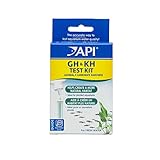 | API GH & KH TEST KIT Freshwater Aquarium Water Test Kit…For GH (shell minerals) | $11.98 Prime | Check on Amazon |
Ready to buy?
Our freshwater aquarium test kit roundup compares nine kits; our Tank Setup & Care section has more care guides, snails included.
Frequently Asked Questions
Q. How long can aquarium snails live out of water?
Aqueon says Malaysian trumpet snails “are known to live in buckets of used gravel for over a year” (it does not say dry); Aquarium Co-Op says they “have been known to survive in dry, used gravel for many months”.
Q. If bladder and ramshorn snails live only a year or two, why do they keep coming back?
Buce Plant says bladder snails “are ready to breed when they reach around 40 days old”, and Aquarium Co-Op says snail eggs “can take 1-4 weeks to hatch, depending on the species and water temperature”. It adds that snails “can only create new babies if they have enough sustenance”; our guide to getting rid of pest snails without chemicals starts there.
Q. Is it bad to leave a dead snail in a fish tank?
Aquarium Co-Op says to take it out “so that the body won’t cause a toxic spike in ammonia or nitrite”; see the Quick check above.
Sources (18)
- Aquarium Breeder (hobby blog), Snail Lifespan Chart
- Aquarium Breeder (hobby blog), Assassin Snail guide
- Aquarium Breeder (hobby blog), Rabbit Snail guide
- Aquarium Breeder (hobby blog), Bladder Snail guide
- Aquarium Co-Op (retailer blog), Mystery Snails
- Aquarium Co-Op (retailer blog), Nerite Snails
- Aquarium Co-Op (retailer blog), Pest Snails
- Aquarium Co-Op (retailer blog), Top 7 Freshwater Snails
- Aqueon (maker), Types of Aquarium Snails
- Aqueon (maker), Aquarium pH
- Aqueon (maker), Freshwater Aquarium Water Quality
- Buce Plant (plant retailer blog), All About Pest Snails
- applesnail.net (reference site), FAQ
- applesnail.net (reference site), Care
- UF IFAS Extension (university extension), Applesnails of Florida
- UF IFAS Extension (university extension), Copper in Marine Aquaculture and Aquarium Systems
- API (maker), GH & KH Test Kit
- LiveAquaria (livestock retailer), Acclimation Guide
Product prices and availability are accurate as of the date/time indicated and are subject to change. Any price and availability information displayed on Amazon.com at the time of purchase will apply to the purchase of this product.