The short answer
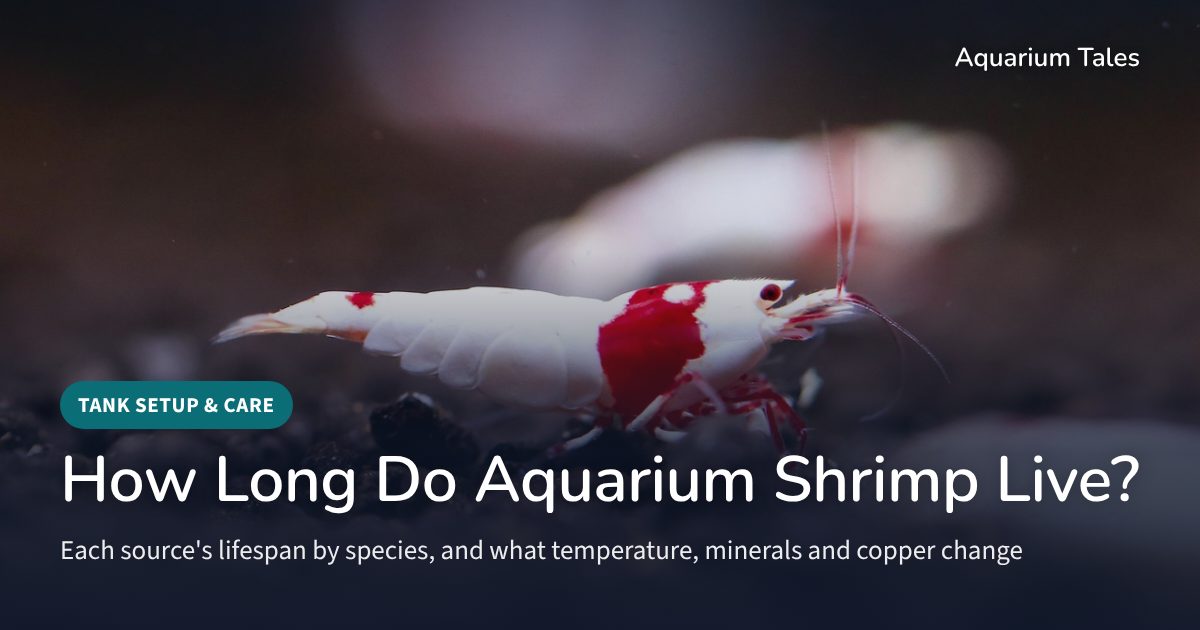
General figures for dwarf shrimp run from “1 to 2 years” (Aquarium Breeder, a hobby blog) to “two to three years” (Chris Lukhaup, who sells Shrimp King foods, writing for retailer Aquarium Co-Op). Species differ: care sources mostly give cherry shrimp about 1 to 2 years, Amano shrimp 2 to 5 years or more, and vampire shrimp up to 10.
Aquarium Breeder says “all information about the lifespan is the result of multiple and combined experiences of shrimp keepers and some scarce presumptions from some biologists.” This guide covers freshwater shrimp only.
Aquarium Shrimp Lifespans by Species
“Breeder” is Aquarium Breeder; its chart gives an average and a maximum (“Optimal”).
| Shrimp | Source: what it gives | Figure |
|---|---|---|
| Cherry (Neocaridina davidi) | Breeder chart; FAQ | 12–18 months, max 2 years; 12–24 months, but in warm water “often dying in under a year” |
| Cherry | Reefs.com (aquarium news site): “under optimal conditions” | around 1–2 years |
| Cherry | Shrimpy Business (shrimp store): “typically”; “capable of” | about 1 year; up to twice that |
| Cherry | Flip Aquatics (shrimp store) | 1–2 years |
| Chocolate (N. davidi) | Flip Aquatics | 1.5–2.5 years |
| Crystal red (Caridina cantonensis) | Flip Aquatics | 1–2.5 years |
| Blue bolt (Caridina cf. cantonensis) | Flip Aquatics | 1.5–2 years |
| Amano (Caridina multidentata) | Breeder chart; FAQ | 2–3 years, max 5+; 2–5 years |
| Amano | Flip Aquatics | 3–5 years |
| Amano | Lukhaup | “eight years old and over” |
| Ghost (Palaemonetes) | Breeder chart; FAQ (“usually”; “sometimes”) | 12–18 months, max 3 years; 1–2 years, up to 3 |
| Bamboo (Atyopsis moluccensis) | Breeder chart; FAQ | 6–7 years, max 7; 2–5 years |
| Bamboo | Aquatic Arts (shrimp store) | about 4 years |
| Bamboo (as Singapore flower shrimp) | Flip Aquatics | 1–2 years |
| Vampire (Atya gabonensis) | Breeder chart (Cameroon fan); FAQ (“in a mature, stable tank”) | 8–10 years, max 10; 8–10 years |
| Vampire | Aquatic Arts: “up to” | 10 years |
Only Flip gives the chocolate, crystal red and blue bolt figures. Some figures differ on the same question. For bamboo shrimp, Flip gives 1 to 2 years and Aquatic Arts about 4, while Aquarium Breeder’s chart (6 to 7 on average), its FAQ (2 to 5) and its opening (“filter-feeders like Bamboo and Cameroon shrimp can live up to a decade”) all differ. For Amano shrimp, Lukhaup’s “eight years old and over” sits well above Flip’s 3 to 5. Ghost figures may not fit yours: Aquarium Co-Op says “Many species of grass shrimp, whisker shrimp, long arm shrimp, and even prawns” are all called ghost shrimp.
How to Read the Chart for Your Shrimp
Name the species
Aqueon, an aquarium maker, says “Most crystal and bee shrimp require soft, low pH water”, while ghost, Amano, bamboo and red cherry shrimp “are not particular about pH or alkalinity as long as extremes are avoided”.
Count the colony, not one shrimp
UF IFAS Extension, a university extension service, says cherry shrimp reach sexual maturity “at around 30 days”, that “The incubation time for the eggs ranges from 16 to 19 days” (one source; Aquarium Breeder gives 12 days at 86°F, 21 at 75°F and 35 at 68°F), and that clutches run “between 43 to 60 eggs”. By our reading, a breeding colony can outlast any one shrimp.
Treat several deaths as a water question
Seam Oasis, a shrimp store, says: “If an otherwise healthy adult shrimp dies without warning, natural aging may be the cause. However, repeated deaths within a short period usually indicate an environmental issue rather than old age.” Lukhaup goes further: “If several shrimps die within a short time in an aquarium, this is generally due to poisoning” (see Copper below). Test the water first; for sick-looking shrimp or fish, contact an aquatic veterinarian.
What Shortens or Lengthens a Shrimp’s Life
Temperature
Aquarium Breeder says “Warmer water speeds up molting, breeding, and aging.” Its FAQ says that at 68°F (20°C) Neocaridina “can live up to 2 years”, while at 78°F (26°C) “they rarely exceed 14 months”; its temperature table, for 73–78°F (23–26°C), says “Average lifespan drops to 12–18 months”. The same page says “Most dwarf shrimp tolerate 64–72°F.” and “A heater is only needed if temperatures drop below 64°F or fluctuate more than 3–4 degrees daily.” Only this blog gives those figures. Aqueon says “Caridina shrimp from Sulawesi need a higher pH and alkalinity, along with higher temperatures.” No maker or authority page used here gives a temperature range for shrimp, and retailer and blog ranges differ; Aquarium Co-Op’s advice for Caridina is to “ask the seller what conditions the shrimp were kept in”. For fish, our guide to what temperature a fish tank should be gives the ranges by fish type.
Water, molting and minerals
For dwarf freshwater shrimp, Aqueon says requirements “vary depending on species, although ammonia and nitrites should always be undetectable, and nitrates should be below 10 ppm.” Aquarium Co-Op’s cherry shrimp guide says that because they keep molting, “you also want to make sure to include calcium in their diet. This can be done by adding small amounts of crushed coral to the substrate or filter.” That is cherry shrimp advice; Aqueon says “Most crystal and bee shrimp require soft, low pH water”, so check your species before adding minerals.
Buce Plant, a live-plant retailer, says failed molts “are usually linked to too large of water changes, a poor diet, or wrong parameters (GH, KH, PH)”, and “If you do too big of a water change too quickly, you may shock the shrimp into prematurely molting, leaving them more vulnerable, which can lead to the death of your shrimp.” For soft-water Caridina, our guide to softening aquarium water and lowering GH and KH covers that side.
Two kits from our freshwater aquarium test kit roundup cover these tests. No maker or authority page used here gives a GH or KH target for shrimp, so the GH & KH kit tells you your water’s hardness, not whether it suits your shrimp. The roundup says the API master kit has “No GH, KH, chlorine or phosphate test, so hardness needs a second kit”, and of the API GH & KH kit: “Two separate tests to run, on top of any master kit.”
| # | Preview | Product | Price | Link |
|---|---|---|---|---|
| 1 |  | API Freshwater Master Test Kit 800-Test Freshwater Aquarium…For ammonia and nitrite | $35.98 Prime | Check on Amazon |
| 2 |  | API GH & KH TEST KIT Freshwater Aquarium Water Test Kit…For GH and KH | $11.98 Prime | Check on Amazon |
Copper, food and tank mates
Aqueon: “When using plant supplements or medications, avoid products containing copper, as it is toxic to freshwater shrimp.” Lukhaup writes that “many medications for ornamental fish or algae conditioners contain copper as an active ingredient. Such agents should never be used in aquariums containing shrimps!” He adds: “In particular, traces of heavy metals such as copper, which can originate from copper pipes in the water system or from heating coils in hot water boilers, are highly toxic for invertebrates such as shrimps. Even tiny amounts of these metals can be lethal, especially in soft water. Water conditioners can reduce the danger to a certain extent, but it is recommended to only use water that is completely free of copper in a shrimp tank.” He also warns that “Newly purchased aquatic plants from nurseries may also be harmful to shrimps”, especially plants “cultivated above water”, since sprays used on them are “highly poisonous to shrimps”, so “new plants should be watered for several weeks before being planted in a shrimp aquarium.” This guide gives no treatments or doses. Our guide to what shrimp eat in a fish tank compares makers’ feeding directions and their copper statements.
Aquarium Co-Op says “Bettas are notorious for going after shrimp.” Its rule: “if it can fit in its mouth then it’s a predator”, though “when provided with enough hiding spaces shrimp can co-exist with larger fish, but there will always be a risk.”
Molt or Dead Shrimp? How to Tell
Swell UK, an aquarium retailer, says “Typically, adults moult every three or four weeks.”
- A molt: Swell says a translucent shrimp on the bottom “is almost certainly a moult”, and many molts “have a split along their backs”. Aquarium Co-Op says an Amano molt “looks like a dead shrimp but is empty inside and clear in color.”
- A dead shrimp: Swell says “If you spot a lifeless shrimp that has turned a pale pink colour, then it has likely passed away. This is easier to see when you’re keeping blue, black or yellow cherry shrimps, but even red cherry shrimps quickly lose their colour after death and turn a pale shade of pink.”
- Clear-bodied shrimp: Aquarium Co-Op calls Amano shrimp “another translucent shrimp” and says ghost shrimp have “clear-colored bodies”, so by our reading the translucent test can fail for them. No source here gives a dead sign for either; if unsure, test ammonia and nitrite (below).
- After a molt: Swell says the shrimp “goes into hiding”, and “After two or three days, they should go back to their lively selves and start buzzing around your aquarium again”.
- A cold new arrival: Lukhaup says shrimp in packages that arrive below 59°F (15°C, our conversion) “can become very still or fall into a stiff state and when the water gets warmer they just continue to be active.” He gives no way to tell a chilled shrimp from a dead one.
Swell says some keepers leave molts and dead shrimp for the colony, but warns: “don’t stand by if you spot several dead individuals. This is likely indicative of a larger problem, like poor water parameters, and leaving lots of dead shrimp to rot and pollute your water will only make this problem worse.”
Quick check
After shrimp die, test ammonia and nitrite; Aqueon says both “should always be undetectable” for dwarf shrimp. Keep testing until both read zero; above zero, our guide to what causes ammonia in fish tank water covers the causes and fixes.
Ready to buy?
Our test kit roundup compares nine freshwater kits, and our Tank Setup & Care section gathers the care guides.
Frequently Asked Questions
Q. How long do aquarium shrimp live in the wild?
Aquarium Breeder says “There is no single biological study about the lifespan of dwarf shrimp in the wild.” A 2018 study in the journal Crustacean Research sampled one introduced cherry shrimp population, in Japan’s Tomoe River, monthly for a year; it says the evidence “suggests life span for this species is approximately 10–15 months”. Mote Marine Laboratory & Aquarium, a nonprofit lab and public aquarium, says glass shrimp (Palaemon paludosus) “only live for a year and usually die post-spawning season”. Aqueon names “the basic ghost shrimp” “typically sold as feeder shrimp” Palaemonetes paludosus, a name WoRMS, a taxonomic register, lists under Palaemon paludosus; Mote’s figure covers that one species, not every shrimp sold as ghost shrimp.
Q. Why did my new shrimp die in the first week?
Aqueon, an aquarium maker, says “never place dwarf freshwater shrimp in a newly set up aquarium!”, and Seam Oasis says “Ensuring the tank is fully cycled before adding livestock is one of the most important preventive measures.” Aquarium Breeder says they “didn’t reach the end of their natural lifespan”, and names “ammonia or nitrite spike, copper contamination, sudden temperature swings, or failed molting”; Lukhaup names copper pipes and plant sprays (above). Swell says “make sure that you acclimate them slowly when you first add them to your aquarium. The best way to do this is by drip acclimating them.”, and Seam Oasis and Buce Plant also advise drip acclimation.
Q. Are aquarium shrimp hard to keep?
Swell UK says they are “incredibly easy to keep, provided you keep their water parameters stable and in an acceptable range”, once they have been drip acclimated and “given some time to settle”. Aquarium Co-Op says Caridina shrimp are “usually more expensive and difficult to care for” than Neocaridina, and asks for an aquarium “that is very mature – meaning that the tank has been running for many months”.
Q. How long do cherry shrimp take to grow?
UF IFAS says the young “emerge from the eggs as miniature versions of the adult”, “only around 1 to 2 millimeters” long (about 0.04 to 0.08 inch, our conversion), and grow by molting; maturity is in step 2.
Sources (17)
- Aquarium Breeder (hobby blog), lifespan chart
- Aquarium Co-Op (retailer blog), by Chris Lukhaup of Shrimp King
- Aquarium Co-Op, top 5 shrimp
- Aquarium Co-Op, cherry shrimp
- Aquarium Co-Op, Amano shrimp
- Crustacean Research (journal), Mitsugi and Suzuki 2018
- Mote Marine Laboratory & Aquarium, glass shrimp
- WoRMS (taxonomic register), Palaemonetes paludosus
- UF IFAS Extension (university extension), cherry shrimp
- Aqueon (maker), freshwater shrimp care
- Reefs.com (aquarium news site), cherry shrimp
- Shrimpy Business (shrimp store), cherry shrimp
- Flip Aquatics (shrimp store), shrimp as pets
- Aquatic Arts (shrimp store), bamboo vs. vampire shrimp
- Seam Oasis (shrimp store), why shrimp die
- Buce Plant (plant retailer blog), why shrimp die
- Swell UK (aquarium retailer), dead or moulting
Product prices and availability are accurate as of the date/time indicated and are subject to change. Any price and availability information displayed on Amazon.com at the time of purchase will apply to the purchase of this product.