The short answer
Test GH and KH in the tank and your tap water, and check rocks or substrate that add minerals. Then dilute: change water in small amounts with RO, RO/DI or distilled water that has minerals added back. API’s softening pillow lowers GH in the filter. Sources disagree on peat and driftwood, and Swell UK calls salt-softened household water unsuitable.
GH is the calcium and magnesium in the water; KH, carbonate hardness, “helps stabilize pH in the aquarium”, in the words of API, a test-kit maker. This guide is about hardness in freshwater tanks. For pH alone, see our guides to lowering aquarium pH and what causes high pH; our Water Lab gathers our pH, ammonia, nitrite and nitrate guides.
Warning
If fish look unwell, test the water and contact an aquatic veterinarian. This guide covers water chemistry only; it does not diagnose or treat sick fish.
What you need
- A GH and KH test.
- RO/DI or distilled water (steps 4-6).
- A remineralizer (step 7).
- A bucket for mixing.
- A tap water conditioner; our water conditioner roundup compares them.
The picks below come from our freshwater test kit roundup, our RO/DI system roundup and our guide to the best water for a fish tank, which compares remineralizers.
| # | Preview | Product | Price | Link |
|---|---|---|---|---|
| 1 | 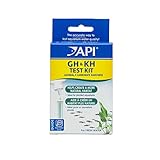 | API GH & KH TEST KIT Freshwater Aquarium Water Test Kit…GH and KH test | $11.98 Prime | Check on Amazon |
| 2 | 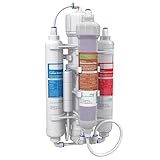 | Aquatic Life RO Buddie 4-Stage Aquarium Water Filter…RO/DI unit | $69.99 | Check on Amazon |
| 3 |  | Brightwell Aquatics Remineraliz-P RO DI Water Conditioner…Remineralizer | $15.90 Prime | Check on Amazon |
Hardness figures: the sources differ
| Source | Figure | Scope |
|---|---|---|
| API (test-kit maker) | GH “between 3-6°” | “a community aquarium” |
| hygger (equipment maker) | GH, soft: “4-8 dGH/70-140 ppm” | “just references” |
| Tetra (water-care maker) | KH “approximately < 5 °dH” | Discus |
| Tetra | KH not “below 3 °dH” | pH stability, “generally” |
| USGS (federal agency) | Hardness, soft: “0 to 60 mg/L” | Classifies all waters, as calcium carbonate; not a fish target |
hygger converts “1 dGH=17.9 ppm or 17.9 mg/L”, so check which unit your kit reads. The figures differ, so this guide picks no single target (our reading).
Softening step by step
Decide whether your fish need softer water
API says GH and KH “should match their natural habitat”. Buce Plant, an aquarium plant retailer, says most store fish “have been bred in captivity”, and suggests adjusting for a wild-caught fish “if it’s drastically different from its origin.” The two differ; decide by your species (our reading).
Test GH and KH in the tank and in your tap water
Note the unit your kit reads (see the figures above). If the tap reads softer than the tank, something in the tank may be adding minerals (our reading; step 3).
Check what is adding minerals
Fluval, a filter maker, says in its AquaClear manual: “CAUTION – Always unplug or disconnect all appliances in the aquarium from electricity supply before placing hands in water, before putting on or taking off parts and while the equipment is being installed, maintained or handled.” Maidenhead Aquatics, a UK aquarium retailer, advises avoiding “decor in your tank which leaches minerals and makes the water hard and more alkaline e.g. limestone, barnacles etc.” It also advises a lime-free substrate. Buce Plant names Seiryu and Pagoda stone as “known to raise water hardness”, and says crushed coral or crushed oyster shells raise GH and KH. None of the sources we read covers replacing rock or substrate in a running tank, so check what you add before you remove anything (our reading). Then, as the cleaning checklist of Aqueon, an aquarium equipment maker, says: “Plug the filter and heater back in.”
Check your RO unit’s conditions before you buy
For the RO Buddie in the box above, Aquatic Life’s manual lists warranty conditions: “This warranty will be void if defects occur due to failure to observe the following conditions”. The unit “should only be connected to a potable municipal or potable well cold water supply.” Also: “Do not use with water that is of unknown quality without adequate disinfection before or after the unit.” “Incoming water hardness must not exceed 10 grains per gallon or 170 ppm.” “Incoming water pressure must be between 40 and 80 PSI.” For pressure, the manual says a pressure regulator is required above 80 PSI and a booster pump is needed below 40 PSI. The list also sets limits for TDS, temperature, pH and iron. Test your tap first (our reading). Other units carry their own conditions.
Install and flush the RO unit as its manual says
Aquatic Life warns: “Before installing this unit, find out if you have Chloramines in your water supply. Contact your local water company for this information.” If you do, it says to follow its chloramine page first, since “Failure to do so may result in a ruined RO Membrane and poor filtered water quality.” Because “All RO Membranes contain a preservative to keep them sterile”, it says to “FLUSH THE MEMBRANE FOR 30 MINUTES. DISCARD ALL WATER FROM THIS FIRST 30 MINUTES OF OPERATION.” On the +DI model: “DO NOT CONNECT THE DI RESIN CARTRIDGE UNTIL THE MEMBRANE HAS BEEN FLUSHED.” It adds: “DO NOT operate the unit unattended.” and “DO NOT ALLOW THE UNIT TO FREEZE.” And: “WARNING: Do not drink water that has been filtered with a DI resin cartridge.”
Or buy soft water; Swell UK warns against salt-softened household water
Swell UK, an aquarium retailer, says distilled water “should have a general hardness and carbonate hardness of zero”, but “It should not be used for a fish tank in its raw form.” On home softeners, Swell says: “Many domestic tap water softeners use salt (sodium ions,) to soften tap water for drinking, so that’s not suitable for freshwater aquarium fish species.” It is the only source we read on this.
Add minerals back before the water goes in
This is for freshwater tanks. Swell warns: “Once you move exclusively to use RO however the pH, GH and KH can drop dangerously low, so use a buffer, even if you want very soft water for Discus, to prevent the pH and KH from crashing.” For Remineraliz-P in the box above, Brightwell’s label says: “Do not add this product directly to an aquarium without first diluting in water as directed.” It also says: “Remember to adjust pH and temperature of the water prior to adding it into an aquarium housing live organisms.” Its caution: “May cause eye or skin irritation. If in eyes, flush with water for 15 minutes, get medical attention. If on skin, wash thoroughly with water. Keep out of reach of children. Not for human consumption.” Follow the label for the amount; this guide gives none. Pete’s Aquatics, a hobbyist’s blog, says in a shrimp-tank guide to “Prepare replacement water outside the tank and test it before use.” Test GH, KH and pH of the mix.
Blend it in through small water changes
These steps are for freshwater tanks. Unplug first: Fluval’s manual says to “Always unplug or disconnect all appliances in the aquarium from electricity supply before placing hands in water”. Hydor, a heater maker, says “Hydor Heaters MUST NOT be used out of water.” It says to turn them off and unplug them “at least 30 minutes before any waterchange”. Maidenhead says that after “a series of small regular water changes with R.O. water”, the general hardness will be seen to decrease. Treat any tap water with conditioner; API says to use its Tap Water Conditioner “when adding or changing water”. As Aqueon says, “Be sure to match temperatures of the new water with the aquarium.” Swell notes: “If you do a water change with hard water, the resultant bounce in GH levels are not good for the fish.” No hardness source we read gives a size per change, so test after each (our reading). Plug the filter back in once the tank is refilled. Turn the heater back on only when, in Hydor’s words, “the Aquarium is full and the heater is completely submerged.”
Or soften in the filter with a softening pillow
API says to use its Water Softener Pillow “when testing indicates water hardness above the desired level.” Unplug first: Fluval’s manual says to “Always unplug or disconnect all appliances in the aquarium from electricity supply before placing hands in water”. API’s directions: “Rinse pouch under tap water. Place pouch in path of water flow in the aquarium filter. Activity of the pillow lasts 48 hours. After 48 hours, recharging is necessary.” The SDS lists “sulfonic acid, sodium salt” as an ingredient; no source we read says whether the pillow adds sodium to the water. Plug the filter and heater back in afterward.
Recharge the pillow, and handle it as its safety sheet says
Unplug first: Fluval’s manual says to “Always unplug or disconnect all appliances in the aquarium from electricity supply before placing hands in water”. API says to “dissolve 3 Tbsp. of API AQUARIUM SALT in 7 oz. of tap water”, then “Rinse pouch in tap water, then soak in salt solution for 2 hrs. Place back in filter; no need to rinse.” Also: “When not in use, store pouch in recharging solution; do not let pillow dry out.” API’s FAQ gives two answers on reuse: it “can be reused many times before purchase of a new one is necessary”, and it “can be recharged and re-used up to 4 times”. Replace it, API says, “when it ceases to function properly after recharging.” The safety data sheet says: “Causes serious eye irritation.” “Wear protective gloves/protective clothing/eye protection/face protection.” Its handling section says: “Avoid all personal contact, including inhalation.” and “Always wash hands with soap and water after handling.” For eyes, the label says: “IF IN EYES: Rinse cautiously with water for several minutes. Remove contact lenses, if present and easy to do. Continue rinsing.” and “If eye irritation persists: Get medical advice/attention.” The first-aid section says: “Wash out immediately with fresh running water.” and “Seek medical attention without delay; if pain persists or recurs seek medical attention.” On lenses it differs from the label: “Removal of contact lenses after an eye injury should only be undertaken by skilled personnel.” For skin: “Flush skin and hair with running water (and soap if available).” and “Seek medical attention in event of irritation.” If swallowed: “Immediately give a glass of water.” and “First aid is not generally required. If in doubt, contact a Poisons Information Centre or a doctor.” In the US, the National Capital Poison Center, a nonprofit, says to “call a poison center at 1-800-222-1222”. Plug the filter and heater back in once the pouch is back in the filter.
Peat and driftwood: the sources disagree
Glass Grown, an aquarium plant and livestock retailer, says peat and driftwood lower GH and KH, but adds: “Now, adding botanicals to soften the water is really only going to budge you a couple degrees of hardness. Even less if you do water changes often.” hygger lists driftwood, almond leaves and peat as lowering KH and pH, and says leaves and peat “Do not affect GH”. In its shrimp-tank guide, Pete’s Aquatics says they “should not be presented as precise GH-removal tools”. Before placing peat or driftwood, unplug: Fluval’s manual says to “Always unplug or disconnect all appliances in the aquarium from electricity supply before placing hands in water”. Aqueon, on peat in a filter: “Use a mesh media bag to keep it contained and use only peat products designed for aquariums.” TFH Magazine, a fishkeeping magazine, says: “Dosing should be as per the manufacturer’s instructions.” It warns: “it is possible to overdose tannins unintentionally in the aquarium by using too many leaves or too much peat”. And: “leaves, peat, and their extracts should be dosed in moderation and with care.” For driftwood, Galapagos, a pet products maker, says: “We recommend presoaking natural woods in a separate tub of water and changing the water daily.” It says to “consider boiling the wood for one hour to sterilize before adding to your aquarium.” Boiling water scalds, so handle it with care (our caution). Plug the filter and heater back in once your hands are out. Our driftwood roundup compares woods.
Retest weekly and keep KH from bottoming out
API’s GH & KH kit page says: “Testing water parameters weekly helps prevent invisible water problems that can be harmful to fish.” Tetra, a water-care maker, says: “With regard to pH stability, the KH should not generally drop below 3 °dH to ensure the well-being of all aquarium inhabitants”.
Troubleshooting
- pH swings after switching to RO. API says: “Aquariums with very low KH are subject to rapid pH shifts if not monitored carefully.” Swell’s answer is a buffer (step 7); our guide to raising aquarium pH covers rebuilding buffer.
- GH creeps back up. Recheck the decor and substrate (step 3) and the tap water in your mix (our suggestion).
Ready to buy?
Our freshwater test kit roundup compares kits, including GH and KH tests.
Frequently Asked Questions
Q. Will distilled water lower hardness in a fish tank?
Yes: Pete’s Aquatics’ shrimp-tank guide calls dilution “The reliable way to lower GH”. Add minerals back first (step 7).
Q. Will aquarium salt lower hardness?
None of the sources we read says so. Seachem, a water-care maker, notes that “sodium is not a contributing cation to GH levels”, so salt would not count toward GH (our reading).
Q. Does water conditioner lower hardness?
API’s Tap Water Conditioner page lists chlorine, chloramines and heavy metals, not hardness; Glass Grown says “Some conditioners specifically target hardness”.
Q. Can I use rainwater to soften aquarium water?
hygger lists rainwater mixed with tap water. Aquarium Store Depot, a retailer’s blog, cautions that “it can collect many pollutants from the environment and may pollute your tank as well”. A GH and KH kit will not show pollutants (our reading).
Sources (23)
- API, General & Carbonate Hardness Test Kit (maker)
- API, Water Softener Pillow (maker)
- API, Water Softener Pillow Safety Data Sheet (maker)
- API, Tap Water Conditioner (maker)
- Aquatic Life, RO Buddie Installation, Operation & Maintenance Guide (maker)
- Brightwell Aquatics, Remineraliz-P (maker)
- Tetra, pH/KH Plus (maker)
- Seachem, Equilibrium (maker)
- Fluval, AquaClear Power Filter Manual (maker)
- Hydor, Do I need to turn the heater off when doing a water change? (maker)
- Aqueon, Aquarium Cleaning Checklist (maker)
- Aqueon, Aquarium pH: How to Safely Adjust pH (maker)
- hygger, How to Soften Aquarium Water Naturally (maker blog)
- Galapagos, Driftwood Medium (maker)
- National Capital Poison Center, Poison Control (nonprofit poison center)
- USGS, Hardness of Water (federal agency)
- TFH Magazine, Leaf Litter & More: How to Naturally Lower Aquarium pH (publication)
- Swell UK, How to soften aquarium water (retailer help guide)
- Maidenhead Aquatics, Keeping Soft Water Fish (retailer blog)
- Buce Plant, How to Adjust Water Hardness in the Aquarium (retailer blog)
- Glass Grown Aquatics, How to Soften Hard Water for Sensitive Fish (retailer blog)
- Pete’s Aquatics, How to Safely Lower GH in a Shrimp Tank (hobbyist blog)
- Aquarium Store Depot, How to Soften Aquarium Water (retailer blog)
Product prices and availability are accurate as of the date/time indicated and are subject to change. Any price and availability information displayed on Amazon.com at the time of purchase will apply to the purchase of this product.