The short answer
Tropica, a Danish plant grower, rates Amazon frogbit, red root floater, Salvinia minima and greater duckweed easy, with low light and CO2 needs; Riccia fluitans is medium on all three. Aquarium Co-Op, a retailer, warns that floaters covering the whole surface may shade plants below and reduce oxygen. Texas lists all salvinia and water lettuce: no possession “except as authorized”.
Buce Plant, a plant retailer, says floaters “sit at the surface with direct access to atmospheric carbon dioxide” and so grow faster than submerged plants.
How to read the care fields
Tropica is a Danish aquarium-plant grower; its difficulty rating is an icon. Buce Plant, Aquarium Co-Op and Modern Aquarium sell plants, Planted Box is a plant shop’s blog, and hygger makes aquarium equipment. The Spruce Pets article is by Jessie Sanders, DVM, an aquatic veterinarian (updated August 21, 2026). Inch conversions are ours.
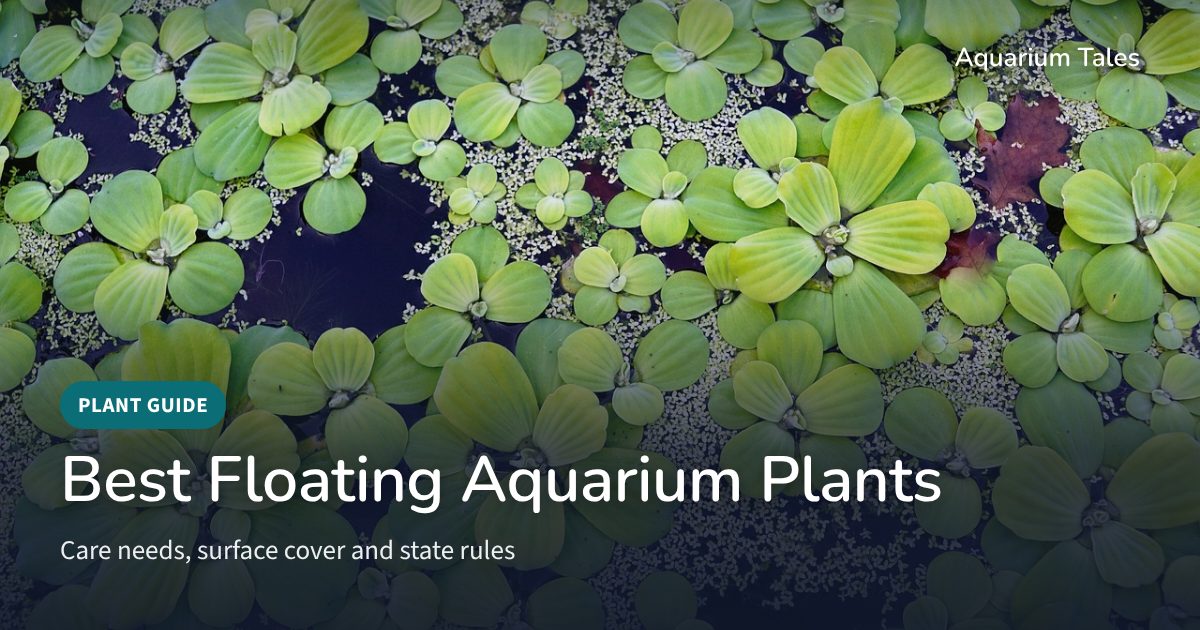
Leafy floaters: frogbit, red root floater, salvinia and water lettuce
- Amazon frogbit (Limnobium laevigatum)
- Light need: low (Tropica); hygger’s blog says it “thrives in soft water and high-light-intensity conditions”.
- CO2 need: low (Tropica).
- Growth rate: medium (Tropica). Co-Op says it “propagates by sending out runners” and “can be easily removed in large clumps”.
- Placement: the surface; Tropica says it is “particularly suitable for open aquariums”.
- Difficulty: easy (Tropica’s icon).
- Roots: Tropica calls them “fine, long and decorative”, and Co-Op says they “can reach all the way down to the substrate”; The Spruce Pets says it has “relatively short roots”.
- Why keepers use it: Tropica says the roots “provide protection to gouramies and other surface fish”.
Tropica: “When the nutrient level in the water decreases, it will grow much slower which makes it a great indicator of the available nutrients.” Washington lists it and California rates it (below).
- Red root floater (Phyllanthus fluitans)
- Light need: low (Tropica); “Low to High (6 to 8 hours daily)” (Buce Plant).
- CO2 need: low (Tropica); not required (Buce Plant).
- Growth rate: medium (Tropica); fast (Buce Plant).
- Placement: “Water Surface Canopy, Livestock Shade” (Buce Plant).
- Difficulty: easy (Tropica’s icon, Buce Plant).
- Color: Tropica says “The more intense the light, the browner the leaves will become”; Buce Plant says the leaves “can turn blood red when kept under high light”.
- Water spangles (Salvinia minima) and Salvinia natans
- Light need: low for S. minima (Tropica); “Low to High” for S. natans (Buce Plant); hygger says water spangles want “medium to high light intensity”.
- CO2 need: low (Tropica); not required (Buce Plant).
- Growth rate: Tropica’s row is blank, but its text says S. minima “grows quickly if there is sufficient nutrition and light”; fast for S. natans (Buce Plant).
- Placement: the surface; Tropica calls S. minima “A decorative plant for open aquariums”.
- Difficulty: easy (Tropica’s icon, Buce Plant).
- Roots: The Spruce Pets says water spangles “have very long roots” that, “Depending on your aquarium depth”, “may interfere with fish swimming”.
Florida treats the two species differently, and Texas lists every salvinia (below).
- Water lettuce and dwarf water lettuce (Pistia stratiotes)
Buce Plant lists “Dwarf Water Lettuce” as a common name of Pistia stratiotes, and The Spruce Pets says the dwarf and regular kinds “are usually sold interchangeably”. Fields from Buce Plant:
- Light need: low to high. CO2 need: not required. Growth rate: fast.
- Placement: “Water Surface Canopy, Nitrate Removal, Shrimp Shelter”.
- Difficulty: easy.
- Size: Buce Plant lists “Leaves 3–6 in. tall” and “Roots 4–12 in. long”; hygger’s blog says dwarf water lettuce “can grow up to 2.5cm” (about 1 in).
The Spruce Pets calls water lettuce “an invasive species”. Texas and Florida list it (below).
Duckweed, Riccia and hornwort
- Duckweed (Lemna minor) and greater duckweed (Spirodela polyrrhiza)
Fields for greater duckweed from Tropica:
- Light need: low in its table; its text says “Thriving in low to moderate lighting”.
- CO2 need: low. Growth rate: the row is blank; the text says it “grows rapidly”.
- Placement: the surface. Difficulty: easy (icon).
Tropica: “Regular thinning is recommended to prevent excessive coverage and ensure balanced light distribution to submerged plants.” For common duckweed, the sources read here give no light, CO2 or difficulty rating. The Spruce Pets says it “is VERY hard to eliminate once it is in your system”. Texas lists dotted duckweed (Landoltia punctata) (below).
- Riccia fluitans (floating crystalwort)
Tropica and Buce Plant both call it a liverwort.
- Light need: medium (Tropica); “Medium to High” (Buce Plant).
- CO2 need: medium (Tropica, which says it “thrives best with added CO2 and in good growing conditions”); “Optional (Recommended to achieve pearling)” (Buce Plant).
- Growth rate: medium (Tropica); fast (Buce Plant).
- Placement: “Floating Surface Cover, Foreground Carpet (Tied to Hardscape), Crevice Accent” (Buce Plant); Tropica says “new shoots always grow towards the surface”.
- Difficulty: medium (Tropica’s icon); “Easy to Medium (High maintenance due to frequent trimming)” (Buce Plant).
- Hornwort (Ceratophyllum demersum), floating
- Light need: low (Tropica); “Medium to High (Adaptable to Low Light)” (Buce Plant); Co-Op says it “can grow under low to high light”.
- CO2 need: low (Tropica); not required (Buce Plant); Co-Op says it “does not require carbon dioxide (CO2) injection”.
- Growth rate: blank (Tropica); moderate to fast (Buce Plant); Co-Op says “With enough light and nutrients, hornwort can easily grow 1-4 inches (3-10 cm) per week.”
- Placement: Co-Op says it “grows best as a floating plant” and that a planted or attached end “tends to rot away”; Tropica says “it is nevertheless possible to plant it in the bottom”.
- Difficulty: easy (Tropica’s icon); “Easy / Beginner” (Buce Plant).
- Shade: Buce Plant says floating hornwort “provides excellent shade”; Planted Box says its “fine leaves filter light only moderately”.
Shade, nitrate, oxygen and flow
- Shade. Tropica says Salvinia minima “tends to shade light from the plants at the bottom”, and of frogbit: “It may become necessary to remove some to avoid that the plants beneath it still gets some light.” Buce Plant calls thinning “crucial so that your floating plants do not block all light from reaching your submerged stem and ground plants below.”
- Nitrate. Co-Op says “Floating plants grow very quickly and therefore are great at absorbing toxic nitrogen chemicals from the water.” Buce Plant says floaters consume “nitrates, ammonium, and excess nutrients that fuel nuisance algae”. Our guide to high nitrate levels covers testing and causes.
- Oxygen. Co-Op: “make sure not to let them cover the entire water surface or else they may out-shade the plants below and reduce the amount of dissolved oxygen in the water.” For betta tanks it says to “leave about 50% (or more) of the water surface clear of leaves so that there is room for adequate gas exchange at the surface”. See how to increase oxygen in a fish tank.
- Flow and filters. Buce Plant: “Keep surface agitation minimal, as heavy water flow or splashing filters will trap water on top of the leaves and cause them to rot.” It suggests “an airline tubing loop or floating ring to shield your aquarium floaters from direct filter return or bubbling air stones.” The Spruce Pets says water spangles “prefer still water compared to fast-moving surface water”. Co-Op says hornwort “tends to prefer gentle flow” and that its needles can get “sucked up by your filter intake”.
State and federal rules
Habitattitude, a campaign the U.S. Fish and Wildlife Service co-sponsors, says to “choose species that are not considered invasive in your state” and to check with “your state fish and wildlife agency or natural resources agency”. On water lettuce, The Spruce Pets says: “NEVER allow it to reach natural water sources.” Lists read on November 16, 2026:
- Federal. 7 CFR 360.200 (2024 edition) lists four salvinias, each called giant salvinia (S. auriculata, S. biloba, S. herzogii, S. molesta), and Azolla pinnata as noxious weeds. S. minima, S. natans, water lettuce, common water hyacinth (Eichhornia crassipes), frogbit, red root floater and the duckweeds above do not appear in it (our reading).
- Texas. Texas Parks and Wildlife lists “All species of genus Salvinia, including but not limited to Salvinia molesta (Giant salvinia) and Salvinia minima (Common salvinia)”, waterlettuce, floating water hyacinths and dotted duckweed: “No person may possess or place them into water of this state except as authorized by the department.”
- Florida. Rule 5B-64.011 (last amended 1993) puts “Salvinia spp., (excluding S. minima)” and Eichhornia (waterhyacinth) in Class I, for which “Under no circumstances will these species be permitted for possession, collection, transportation, cultivation, and importation except as provided in Rule 5B-64.004”. By our reading that includes S. natans. Waterlettuce is Class II, which “shall not be imported or collected from the wild.”
- Washington. The state’s noxious weed board lists Limnobium laevigatum (other common names include “Amazon frogbit”) on the state quarantine list: “It is prohibited to transport, buy, sell, offer for sale, or distribute plants or plant parts of quarantined species into or within the state of Washington”.
- California. The Department of Food and Agriculture rated L. laevigatum (South American spongeplant) A in May 2015, noting it “is occasionally available in the aquarium trade”. Its ratings page says “A-rated pests are prohibited from entering the state” but also that ratings “are not laws, but are policy guidelines”.
Light, fertilizer and a nitrate test
Buce Plant’s floater pages say to “Provide adequate lighting to encourage rapid growth” and to “Dose liquid fertilizers regularly because floating plants absorb nutrients directly from the water column at an accelerated rate.” In The Spruce Pets, Dr. Sanders writes: “Remember to test your water chemistry levels to ensure enough nitrate for your plant to survive or consider supplementation.” From our roundups:
- Light: the Fluval Plant 4.0 22W, for 15-24 inch tanks; Fluval lists IP67, but its manual says “DO NOT IMMERSE” (planted aquarium light roundup).
- Fertilizer: Seachem Flourish, which Seachem says “Does not contain significant levels of nitrogen or phosphorus” (plant fertilizer roundup).
- Nitrate test: the API Freshwater Master Test Kit, whose tests API lists as “pH, high range pH, ammonia, nitrite, and nitrate” (freshwater test kit roundup).
None of the sources read here names a light, fertilizer or test kit for floating plants; the cards show what our roundups verified.
| # | Preview | Product | Price | Link |
|---|---|---|---|---|
| 1 |  | Fluval Plant 4.0 LED, 22 Watts, 15-24 Inches | Bring out…App day cycle, planted | Check on Amazon | |
| 2 |  | Seachem Flourish Freshwater Plant SupplementTrace elements | $16.90 | Check on Amazon |
| 3 |  | API Freshwater Master Test Kit 800-Test Freshwater Aquarium…Liquid master kit | $35.98 Prime | Check on Amazon |
Ready to buy?
Our Substrate, Plants & Decor section gathers plant guides; for rooted plants below the floaters, see easy plants for beginners.
Frequently Asked Questions
Q. Do floating plants grow under a tank lid?
None of the sources read here covers lids. Tropica calls frogbit and Salvinia minima plants for “open aquariums”, and Buce Plant says to place floaters “ensuring the tops of the leaves remain dry”.
Q. Which floating plants suit a betta tank?
Aquarium Co-Op names “Amazon frogbit, red root floaters” among popular floaters for bettas, which “like to hang out near the water surface”. See how to set up a betta fish tank.
Q. Are there floating plants that don’t spread?
None of the sources read here calls one of these floaters slow-growing. Tropica rates growth medium for frogbit, red root floater and Riccia and leaves the row blank for Salvinia minima, greater duckweed and hornwort.
Q. Do goldfish eat floating plants?
Modern Aquarium says duckweed is “an alternative food source for some fish, including goldfish”. Co-Op says plant-eating animals “(such as goldfish, koi, African cichlids, and turtles) do not eat hornwort”.
Sources (13)
- Tropica: Limnobium laevigatum, Phyllanthus fluitans, Salvinia minima, Spirodela polyrrhiza, Riccia fluitans, Ceratophyllum demersum
- Buce Plant: Red Root Floater, Salvinia Natans, Water Lettuce, Riccia Fluitans, Hornwort
- Aquarium Co-Op: plants for breeding fish, hornwort care, betta fish plants
- The Spruce Pets, Jessie Sanders, DVM, floating aquarium plants (updated August 2026)
- Modern Aquarium, floating plants
- Planted Box, floating plants for aquariums
- hygger, the 10 best aquarium floater plants
- 7 CFR 360.200, 2024
- Texas Parks and Wildlife, prohibited aquatic species
- Fla. Admin. Code R. 5B-64.011, Prohibited Aquatic Plants
- Washington State Noxious Weed Control Board, South American spongeplant
- California Department of Food and Agriculture: Limnobium laevigatum rating (2015), weed ratings
- Habitattitude, aquarium fish
Product prices and availability are accurate as of the date/time indicated and are subject to change. Any price and availability information displayed on Amazon.com at the time of purchase will apply to the purchase of this product.
