The short answer
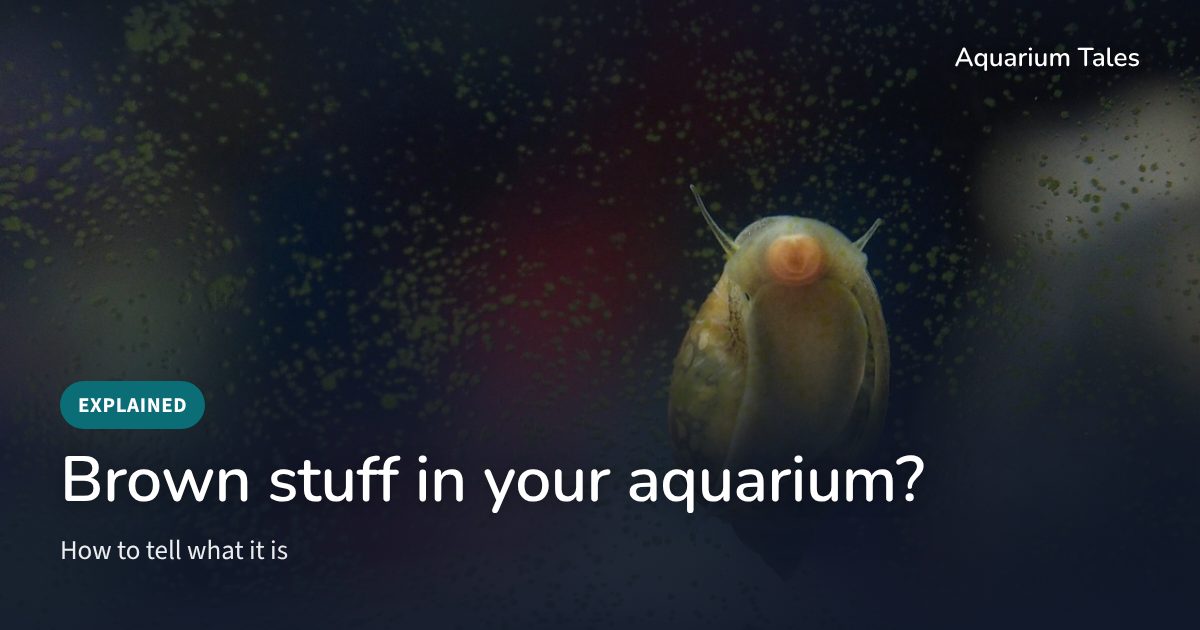
A dusty brown coat on glass, gravel and leaves that wipes off easily is usually diatoms, often called brown algae, and is common in new tanks. Brown fluff gathering on the gravel is mulm, broken-down waste. Brown slime that peels off in sheets and smells musty is cyanobacteria. Each needs a different fix.
Rub a patch with a fingertip or an algae sponge and watch what it does. The fix for one kind can be useless for another: Aquarium Co-Op, an aquarium retailer, says of cyanobacteria, “Your clean-up crew won’t be of much help”.
Wipe it, then look: what each kind of brown stuff is
| What you see | Likely cause | First move |
|---|---|---|
| Dusty brown coat on glass, gravel or leaves; wipes off easily | Diatoms (“brown algae”) | New tank: wait it out. Wipe for looks |
| Brown or black fluff in corners and on the gravel | Mulm (decaying waste) | Siphon it, or thin it if planted |
| Slimy sheet that peels off; musty smell | Cyanobacteria | Siphon it out; add flow if your fish handle it |
| Thick, bushy tufts on wood, décor or plants | Black beard algae | See our algae guide |
| Tea-colored water | Tannins or decaying matter | Test ammonia and nitrite |
| The leaf itself turns brown | A plant problem | See our plant guide |
Aquarium Co-Op says black beard algae is “usually black or grey in color (but sometimes reddish or brownish)”; our guide to what makes algae grow in an aquarium lists it.
Brown dust that wipes off: diatoms
Aqueon, an aquarium equipment maker, says “most brown algae are a form of diatom”. These single-celled algae build their cell walls from silica. Aquarium Co-Op says the coat “looks like a dusty, flour-like substance covering your aquarium walls, substrate, and other surfaces”.
In a new tank, diatoms are expected. Aquasabi, a German aquascaping retailer writing about planted freshwater tanks, says they “appear in a newly set-up tank after about one to three weeks” and that this is “absolutely normal, and you need not take any countermeasures”. Aqueon says they “will usually die off on their own after the tank cycles”.
When they keep coming back, something feeds them. The Spruce Pets, a pet-care publication writing about brown algae in general, names three things:
- Silica from “tap water that is high in silicic acid”, or from substrates such as silica sand.
- Nitrate from uneaten food, dead material or overstocking. “Increasing water changes to remove nitrates will slow the growth of these diatoms.” Aqueon says that when you see excessive algae growth, test your aquarium and tap water for nitrate and phosphate, and that “Nitrate (NO₃) should be below 10 ppm”.
- Dim light. “Those kept in dark places are more likely to develop Brown Algae issues”, because plants and green algae that like bright light compete for the same nutrients.
Clearing diatoms, step by step
Which steps apply: in a new tank, do steps 1 and 3 only; Aqueon, on cloudy new tanks, advises regular partial water changes “except during the first 30 days”. Steps 2 and 4 to 8 are for diatoms that keep coming back in an established tank.
Wipe the glass
Aquarium Co-Op says diatoms come off easily with an algae scrubber sponge. On an acrylic tank, it says to make sure you are “using an acrylic-safe scrubber” that “won’t cause micro-scratches everywhere”.
Established tank: wipe the décor and leaves, then siphon the gravel
That is The Spruce Pets’ order. If baby fish or shrimp share the tank, Aquarium Co-Op’s caution applies: “be very careful when gravel vacuuming”.
New tank: let the cycle finish and leave the filter alone
Wiping is for looks; time is the fix. Aqueon’s new-tank rule, given for cloudy water, is “Don’t mess with the filter”. API, a test-kit maker, says to test ammonia “several times a week for 4-6 weeks when you start a new aquarium, and then use it weekly”.
Established tank: test silicate
If diatoms persist despite enough algae eaters, Aquasabi says “you ought to check the silicate reading of your aquarium water with a water test”. Seachem, a water-care and test-kit maker, says “In reef or other marine aquaria, silicate should be 1 mg/L or less”, but “In freshwater, silicate is not critical”, so it gives no freshwater limit.
Established tank, after step 4: if the tap is the source, add RO or DI water as directed
Aqueon gives RO or DI water “when setting up your aquarium” if tap water is high in silicate, and for water changes pairs it with an additive: “use reverse osmosis or deionized water with Aqueon Water Renewal, Kent Marine R/O Right or Liquid R/O Right when doing water changes”. The Spruce Pets says to “Add reverse osmosis water to a water source that is high in nitrate or silica”, that is, mix it in. For water changes, neither gives a ratio or says to use plain RO water alone; follow the additive’s label.
Established tank, after step 4: use silicate-removing media last, and check its scope
Seachem says its PhosGuard media “rapidly removes phosphate and silicate from marine and freshwater aquaria”, but that “it will operate better in sea water and the need for it is better defined in sea water”. It is “not recommended for phosphate buffered freshwater”, as it “would remove the buffer until saturated”. Seachem also calls freshwater silicate “not critical” (step 4). In planted tanks, Aquasabi warns that “these products will also significantly reduce the phosphate content of the water, which can have a negative effect on the plants”.
Established tank: check the light hours
The sources differ. The Spruce Pets advises “at least eight hours of light each day”. Aqueon’s algae page says “A maximum of 6 to 8 hours of light is sufficient in unplanted aquariums, while planted aquariums need 10 to 12 hours”; its cloudy-water page says “Aquariums with live plants may need eight to 12 hours of light a day, but aquariums without plants can handle six hours or less”. Check your light maker’s guidance and, as Aqueon says, “Use a timer to provide a consistent photoperiod.”
Add grazers in a mature tank
Aqueon suggests you “introduce plecostomus, otocinclus or nerite snails to control brown algae in mature aquariums”, and adds: “Use caution when adding plecostomus to planted aquariums, as some species are known to eat broadleaf plants like Amazon swords and Anubias.”
Brown fluff on the gravel: mulm
Aquarium Co-Op describes a brown or black substance that seems to “collect like dust bunnies all over the floor of your fish tank”. JBL, a German aquarium-products maker, calls it brown dust “like small woolly mice or dust flakes”. It is mulm, or detritus: fish waste, plant leaves and leftover food broken down by bacteria. Both sources write about freshwater tanks.
Is it harmful? “Generally speaking, no”, says Aquarium Co-Op, as long as the tank has enough biological filtration; test ammonia and nitrite to check (see the last section). The caution is in a new tank: “If your tank is not cycled, detritus buildup could be a sign that your aquarium is reaching harmful levels of these nitrogen waste compounds.”
Whether to remove it depends on the tank, according to Aquarium Co-Op:
- No live plants: siphon it out; it can make the water a little cloudy.
- Live plants: it is often left as plant food; thin it if it buries short foreground plants.
Siphon the low-flow areas and behind décor, where Aquarium Co-Op says it piles up, but not every speck: JBL says “an aquarium should never be cleaned to a clinical degree”, since “Otherwise bacteria have no food basis and are killed.” With fry or shrimp in the tank, Aquarium Co-Op says some breeders use a turkey baster or airline tubing instead. A powerhead can blow mulm into the filter, but Aquarium Co-Op says that method suits “aquariums with fish that can swim in high currents”, and a filter full of mulm “may become clogged”, so rinse out the sludge regularly (in a new tank, step 3’s filter rule still applies).
Brown slime in sheets: cyanobacteria
Cyanobacteria are bacteria, not algae. Aquarium Co-Op says that in freshwater aquariums “it can also appear in shades of brown, black, or even red”, as a thick slime over gravel, décor and plants, and that “People have described the smell as earthy, musty, swampy, and foul”.
The sources differ on harm. Aqueon says “Left unchecked, they can suffocate live plants and even cause harm to fish”; Aquarium Co-Op says it “does not usually harm fish, it can potentially kill your plants”.
Aquarium Co-Op sees it where organic waste stagnates. Its fix is to remove the slime with a siphon, toothbrush or algae scraper, change water more often, clean the filter regularly, cut overfeeding, and improve flow with a stronger filter, a powerhead or moved décor; stronger flow suits fish that can swim in high currents, as its mulm guide says. Chemical and antibiotic treatments are outside this guide.
Brown water and brown leaves
Of brown water, Aqueon says “Sometimes it’s caused by decaying organic matter”; tannins from driftwood and, in planted tanks, “natural foliage which contains tannins” are another cause, and “tannins aren’t dangerous to your fish”. It adds that discolored water can also mean high ammonia or nitrite, so test first. Our guide to why aquarium water turns brown covers the causes.
If the leaf tissue itself is brown, look at the plant. Tetra, a fish-care maker, says “Too much phosphate often leads to brown spots developing on leaves”. Our guide to why aquarium plants turn brown covers the nutrient side.
When brown stuff points to a water problem
Brown stuff points to a water problem when it comes from decay: heavy mulm in an uncycled tank, rotting food or plants, or brown water in a tank with no driftwood, live plants or other tannin source. Test ammonia and nitrite. Aqueon’s line is “Ideally, your aquarium won’t have any nitrite or ammonia levels”; if yours are above zero, our guide to high ammonia in an aquarium covers the usual causes and how to bring it down.
Warning
If fish look unwell, test the water now and contact an aquatic veterinarian. Scrubbers, siphons and filter media treat the tank, not the fish.
Ready to buy?
Our roundup of aquarium vacuum cleaners compares the gravel siphons that lift debris out of the substrate, and our Cleaning & Maintenance section gathers more cleaning gear.
Frequently Asked Questions
Q. Is brown algae bad for fish?
The Spruce Pets says “Generally, Brown Algae diatoms won’t harm your fish if they are kept under control”. Brown stuff from decay is the kind to test for (see above).
Q. How long does it take brown algae to go away?
In a new tank, Aquasabi says diatoms are usually “crowded out by green algae a few weeks later”. A coat that keeps returning has a cause to find: silica, nitrate or dim light.
Q. Does brown algae mean my tank is dirty?
Not in a new tank, where Aquasabi calls it normal. The Spruce Pets, writing about brown algae in general, calls it “a sign that the water chemistry of your aquarium is not in optimal balance”; steps 4 to 8 look for the cause.
Q. Should I use a brown algae remover?
Aqueon says “Chemical algaecides should never be the first choice” and that products like its own remover “should always be used as a last resort”. Its rule: “Always follow product directions and remove carbon and other chemical media from your filter before using algae control chemicals.” On its cloudy-water page, Aqueon says “Don’t use the Aqueon Algae Remover if you have shrimp, lobsters, or crabs”, so check any product’s label for invertebrates, including snails like the nerites in step 8.
Sources (13)
- Aquarium Co-Op (retailer blog), How to Fight 6 Types of Algae in Your Fish Tank
- Aquarium Co-Op (retailer blog), What is Mulm or Detritus in Aquariums?
- Aquarium Co-Op (retailer blog), How to Get Rid of Blue-Green Algae in Aquariums
- Aquarium Co-Op (retailer blog), How to Clear Up a Cloudy Fish Tank
- Aqueon (maker), Prevention and Control of Nuisance Algae
- Aqueon (maker), How to Fix Cloudy Water in a New & Existing Tank
- The Spruce Pets (publication), How to Get Rid of Brown Algae in Your Fish Tank
- Aquasabi (retailer), Aquascaping Wiki: Brown algae (Diatoms)
- JBL (maker blog), Here’s how you clean your aquarium substrate correctly
- Seachem (maker), MultiTest Silicate
- Seachem (maker), PhosGuard
- API (maker), API Ammonia Test Kit
- Tetra (maker blog), Why aquarium plants turn brown