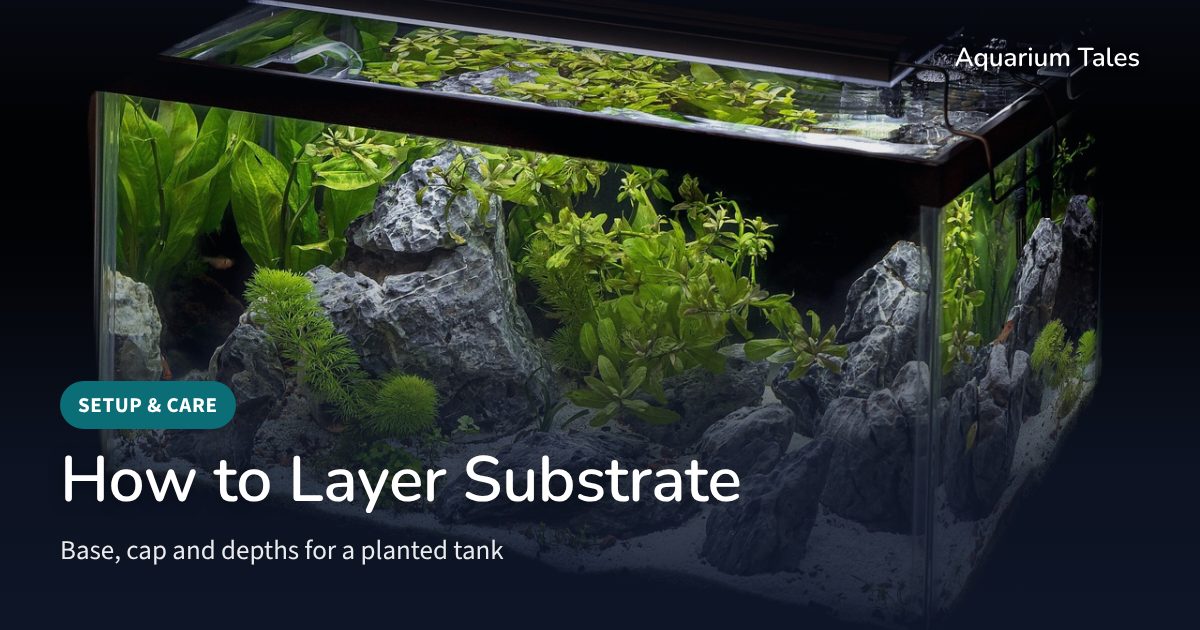
The short answer
Follow one maker’s system in its own order: any nutrient base or additive goes on the bare bottom and the main substrate over it, which ADA, Tropica and Buce Plant keep thin at the front and deeper at the back. A soil or fertilizer base is covered by gravel, sand or another substrate. Depths and caps differ by source.
This page covers setting up a freshwater planted tank with nothing living in it yet. Each depth below is the figure a maker or keeper gave for a named product or setup; where sources disagree, they are shown side by side. If fish in any tank look unwell, test the water and contact an aquatic veterinarian.
What you need
- The substrate system you chose, in the amount its maker gives for your tank size (see the table and the FAQ).
- A plate, bowl or board to break the stream of water when you fill.
- A large colander, only if your product calls for rinsing.
- Planting tweezers, and root tabs or capsules if your plants will need them.
- A freshwater test kit that reads ammonia and nitrite.
Each row is that maker’s own setup:
| System | Bottom layer | Top layer |
|---|---|---|
| ADA Amazonia Ver.2 | Amazonia supplement; Power Sand and additives optional | Amazonia Ver.2 |
| Tropica Plant Growth Substrate | 1 cm (0.4 in) where plants go | At least 4 cm (1.6 in) gravel |
| Tropica Aquarium Soil | None needed | Aquarium Soil |
| JBL | ProFlora AquaBasis plus | A natural substrate (Manado) |
| Seachem Flourite | None named | Flourite |
| Fluval Stratum | Stratum | Bio-Stratum, if plants struggle to root |
| Walstad, 1-gallon bowls | Soil, 1 in or less | Just enough sand |
These systems do not all combine. ADA’s Amazonia Ver.2 manual says: “Do NOT use this product concurrently with other manufacturer’s products.” Fluval, the maker of Stratum, says Stratum can be mixed with other soil substrates such as its Bio-Stratum, but does not recommend mixing it with other substrates, which can make Stratum break down early. CaribSea suggests other substrates make up no more than 50% of a mix with its Eco-Planted (formerly Eco-Complete Planted). Seachem says “Flourite® is most effective when used alone as an integral substrate bed, but it may be mixed with other gravels.”
How to layer substrate, step by step
Read your product’s own directions first
Bag sizes, layer order and mixing limits differ by maker. ADA, a Japanese substrate maker, sizes one 9-liter bag of Amazonia Ver.2 for a tank of “W60×D30×H36cm” (about 24 × 12 × 14 in) and says to adjust the amount for other sizes.
Rinse or skip, as your maker says
ADA says of Amazonia Ver.2: “Rinsing in water before use is NOT necessary, as it makes granules to crumble, and water cloudy.” Fluval recommends rinsing Stratum gently in a large colander, without agitating it, to remove fine dust. Seachem says Flourite may arrive dusty and “require rinsing before use to remove any residual dust”. CaribSea’s FAQ, answering how to rinse sand, says to rinse the substrate first unless you are using its Aragalive, Eco-Planted or Eco-Complete Cichlid, and describes rinsing a few pounds at a time in a clean bucket. An owner disagreed in a November 2023 r/PlantedTank thread: “You don’t rinse fluval stratum.”
Decide whether hardscape goes in before or after
Tropica, a Danish aquarium-plant grower, starts with hardscape: “First, place all decoration material (such as stones or roots), if you intend to use it.” ADA’s Nature Aquarium walkthrough lays the substrate in its step 2 and sets driftwood in step 3. JBL, a German aquarium-products maker, puts stones and wood straight onto its ProScape Volcano Mineral lava substrate in extremely heavily planted aquascapes: “It prevents the sinking of the heavy decoration elements.”
Lay the base layer on the bare bottom
ADA’s Nature Aquarium Guide 60, written for a 60 cm (24 in) tank, says to “Spread a bag of Power Sand Advance S” (2 liters) and flatten it, sprinkle the substrate additives evenly, and “Add Amazonia Supplement before spreading soil.” The Amazonia manual gives 50 mL of supplement for every 9 liters of Amazonia Ver.2, and says the supplement “is not necessary for aquariums set without aquatic plants.” Its safety instruction reads: “In case this product accidentally gets into your eyes or mouth, immediately wash away with tap water and consult a physician if needed. KEEP OUT OF REACH OF CHILDREN”. ADA says Power Sand “prevents substrate from compacting during a long term maintenance”, and tells buyers to “Choose an appropriate granule size (Small, Medium, Large) based on depth of aquarium water in your tank.” Tropica’s starter guide says to “spread out a 1 cm thick layer of substrate where your plants should go and cover it with at least 4 cm of gravel.” Its substrate page names the product: “Plant Growth Substrate is laid in a 1 cm thick layer on the bottom of the aquarium, when the aquarium is built.” JBL advises a long-term substrate fertilizer (its ProFlora AquaBasis plus) under a natural substrate for most planted tanks. Tropica Aquarium Soil and Seachem Flourite go in with no separate base.
Spread the main layer and slope it up toward the back
ADA: “Avoid the front side from becoming too thick. Adding a slight slope from front to back gives an additional sense of depth to the layout.” The diagram in ADA’s 60 cm guide labels the Amazonia layer about 3-4 cm (1.2-1.6 in) deep at the front and 7-8 cm (2.8-3.1 in) at the back, from one 9-liter bag, measured above the Power Sand layer (labels read from the diagram). Tropica’s tip for its Aquarium Soil: “Make the layer thicker towards the rear wall for a great visual effect!” Buce Plant, an online plant retailer, says a thinner front layer of aquasoil “prevents the formation of anoxic areas adjacent to the front glass”.
Cap a soil or nutrient base, if your system has one
Buce Plant and Aquarium Co-Op cap dirted tanks (potting soil or dirt). In ADA’s and Tropica’s soil systems, the aquasoil itself is the top layer. Diana Walstad, author of Ecology of the Planted Aquarium, covered the soil in her 1-gallon shrimp bowls with only “enough sand to hold down the soil particles.” She explains that a thin covering is “less likely to block oxygen entry into the soil from the overlying water. For if the soil becomes too anaerobic, it will kill plant roots.” Our guide to the Walstad method covers her soil-and-sand setup.
Plant in shallow water
ADA: “Planting work will be easier if the water is poured to the level at which the substrate is barely covered with water.” Tropica also wets the bottom layer before planting, slowing the water jet with a plate.
Fill slowly, with something breaking the stream
ADA’s Amazonia manual says to “pour water gently on a plate or a board to avoid AQUA SOIL to stir”. Seachem, for Flourite: “Place a bowl in the aquarium and add water directly to the bowl, allowing water to overflow softly on to the gravel bed.” Walstad blocked the incoming water with her hand.
Clear the water, then test before fish go in
ADA’s Amazonia manual warns: “Excessive supply of nutrition may cause water cloudiness or algae breakout.” If the water turns significantly cloudy after setup, ADA says to “conduct water change until the cloudiness disappears before functioning filter”. For its supplement, which ADA says causes ammonium and nitrite right after use, the manual sets the target: “Do not add fish and shrimp until the levels of both ammonium and nitrite are down to zero.” Fluval says Stratum may slightly raise ammonia, which it says should not be a problem in an established tank, and recommends an ammonia test kit. Tropica says its Aquarium Soil lowers pH and slightly affects water chemistry, and recommends “changing 25–50% of the water at least twice a week during the first 4 weeks after setting up the aquarium.” Our guide to what causes ammonia in fish tank water explains what a reading above zero means, and growing nitrifying bacteria in a new tank covers the cycle that follows.
How deep each layer should be
JBL says: “This question cannot be answered generally since there are very different types of aquariums. Generally the substrate layer shouldn’t be thinner than 3-5 cm. In a heavily planted tank, the layer thickness can certainly be 6-8 cm thick.” That is about 1.2-2 in, and 2.4-3.1 in for a heavily planted tank. ADA’s 60 cm guide diagram labels the Amazonia layer about 3-4 cm at the front and 7-8 cm at the back (labels read from the diagram, drawn above the Power Sand layer). Fluval and Tropica both work through an 8 cm layer in their quantity examples. That figure is an example for the arithmetic, not a recommended depth.
For a soil base under a cap, the figures differ more:
| Source and setup | Soil | Cap |
|---|---|---|
| Walstad, 1-gallon bowls | No more than 1 in | Just enough sand to hold it |
| Buce Plant, dirted tank | About 1-2 in | 1 in; 1.5 in if gravel |
| Aquarium Co-Op, dirted tank | 1/8 to 1/4 in | At least 2 in of gravel |
| r/PlantedTank owner, 10-gal tank | 1.5-2 in Stratum | About 1 in of sand |
Buce Plant’s Walstad guide calls for 1.5 inches of gravel “to ensure no soil will escape the bottom.” Aquarium Co-Op, an aquarium retailer that prefers inert substrates with root tabs itself, tells keepers set on dirt to use only “1/8 to 1/4-inch of dirt” under “at least a 2-inch cap of gravel”.
Sand or gravel on top: the sources differ.
- Aquarium Co-Op picks gravel over dirt “because gases will form as the dirt breaks down and gravel allows the gases to escape more easily.”
- Buce Plant’s Walstad guide warns against sand that is too fine. Its separate 5 Tips page, on sand at the front of a layout, explains: fine-grained sand “tends to have fewer spaces in between granules, contributing to an extremely dense substrate prone to clumping and the formation of anoxic areas”.
- Walstad capped her bowls with pool-filter sand or play sand.
- A keeper in a 2013 thread on The Planted Tank forum called anaerobic conditions not really a concern in tanks with healthy, growing plants.
- Owners split too. On the Aquarium Co-Op Forum in March 2023, a keeper who caps several layered tanks with sand thought sand less likely than gravel to let the lower layer work up to the surface. In the November 2023 r/PlantedTank thread, another owner put Stratum on top instead, because “if you put the sand on top, due to it’s finer grain size, it’ll slowly fall through the stratum resulting in lots of mixing”. A third, answering a question about a 10-gallon betta tank, wrote “if you are going fully planted, I would ditch the sand completely”; for the sand look, the same owner suggested “something like 1 1/2 – 2 inches of stratum then an inch of sand”, then added: “But as you said, they will sort of mix and look kind of messy as you plant.”
If you cap with sand, check whether it changes your water. Our cichlid sand roundup separates sands that raise pH from ones their makers call inert, including sands sold for planted tanks.
Root tabs in a layered bed
Root-tab makers space and replace their tabs differently:
| Product | Spacing | How often |
|---|---|---|
| API Root Tabs | 1 per 30 sq in of surface | Monthly |
| Aquarium Co-Op Easy Root Tabs | Every 4-6 in, in a grid | Monthly or as needed |
| Seachem Flourish Tabs | 1 per 4-6 in radius | Every 3-4 months |
| Tropica Nutrition Capsules | Near sturdy-rooted plants | Release over 1-2 months |
API and Seachem both say to push each tab midway into the gravel bed. Aquarium Co-Op says to push its tabs at least 1 inch down, and “When first planting, place root tabs directly under the plant.” Its page warns: “Can be irritating if it gets into your eyes, nose, or mouth. It can cause stomach upset if swallowed.” Tropica notes that “The capsules do not fully decompose and the small balls inside the capsules will remain in the substrate after all nutrients have been released,” and says the balls are resin, which it calls biologically harmless. Not every keeper uses tabs: in the same Aquarium Co-Op Forum thread in April 2023, one keeper posted a tank on inert substrate that, the keeper wrote, never received a root tab.
Mistakes and troubleshooting
- Capping an old bed. CaribSea allows another substrate over Eco-Planted only in new setups, and warns that some biological filtration is lost early and the cycle can take longer. Over an existing bed, it says to mix new substrate in, not lay it on top.
- The bottom layer working up. On the Aquarium Co-Op Forum, one keeper wrote that if you replant a lot, the lower layers get pulled up over time. In that 2013 Planted Tank thread, the same keeper said soil suits tanks that are rarely replanted; otherwise, unless the cap is thick, it can get stirred up easily. Aquarium Co-Op lists among dirt’s drawbacks: “Makes a huge cloudy mess if you move plants or have bottom dwellers that dig”. One forum suggestion is bagging aquasoil in filter-media bags under the cap. A keeper who tried it found a crypt’s roots grew into the bag over about a year, making the plant hard to move, though not with stem plants.
- Vacuuming soil like gravel. Fluval says cleaning Stratum like gravel or sand makes it break down early. It suggests hovering a small gravel vacuum over the surface while stirring up debris with a turkey baster or your fingers.
- Cloudy water after filling. Makers differ. Seachem calls initial cloudiness with Flourite normal and points to mechanical filtration such as filter floss. Tropica’s starter guide says “The water may look a bit cloudy for a few days.” ADA’s water-change-first direction is in step 9. Our guide to why a fish tank turns cloudy covers other causes.
- A falling pH. Fluval says Stratum leaves water more neutral when KH is moderate and more acidic when KH is low. Our page on why aquarium pH runs low covers testing and raising it safely.
- Expecting soil to last forever. JBL says that, by its own experience, soil substrates “lose their positive characteristics after two years at the latest and need to be replaced.” Seachem says “Flourite® is good for the life of the aquarium and need not be replaced.”
- Too many layers. The same 2013 keeper added that mixing several substrates makes it hard to tell which one is behind a water problem, and suggested two layers. On the Aquarium Co-Op Forum in April 2023, one keeper’s personal opinion was that layering is more trouble than it’s worth, depending on the plants: a hassle for basic plants, and capped layers can mix. A moderator there, once a “never again” voice on capping, reported a Seachem Flourite cap over a soil base serving well in a tank just set up, and said the cap must be thick enough to siphon and plant without pulling up soil.
For more setup guides, see our Tank Setup & Care section. Our Substrate, Plants & Decor section gathers the substrate and plant gear pages.
Frequently Asked Questions
Q. What is the best base layer for a planted aquarium?
There is no shared answer: each maker names its own (see the table above), and Tropica Aquarium Soil and Seachem Flourite name none.
Q. Is 2 inches of substrate enough?
Two inches is about 5 cm, the top of JBL’s general 3-5 cm minimum; JBL says a heavily planted tank can take 6-8 cm (about 2.4-3.1 in).
Q. Can you add too much substrate?
For soil under a cap, Walstad’s 1-gallon bowls hold no more than 1 in, and Aquarium Co-Op says only 1/8 to 1/4 in of dirt. For purpose-made substrates, the makers quoted here give working depths, not a maximum. Buce Plant warns that “A very thick layer adjacent to the front glass can look amateurish.” Walstad keeps her cap thin so it doesn’t block oxygen from reaching the soil.
Q. How much substrate do I need?
For its own sand and gravel products, CaribSea’s general rule is 1 to 2 pounds per gallon. For their soils, Fluval and Tropica multiply length × width × depth in centimeters and divide by 1,000, which gives kilograms of Stratum (Fluval) or liters of soil (Tropica). Seachem’s Flourite page has a bag calculator.
Q. Can I put new substrate on top of old substrate?
CaribSea says not on an existing bed: mix new sand in, about a cup a day, since capping an old bed with new sand can cause another cycle.
Sources (22)
- ADA (substrate maker), Aqua Soil-Amazonia Ver.2 manual (PDF)
- ADA (substrate maker), Nature Aquarium Guide 60 (PDF)
- ADA (substrate maker), Nature Aquarium Starting from Zero
- ADA (substrate maker), Power Sand Basic / Advance
- Tropica (plant grower), Get the right start
- Tropica (plant grower), Substrate
- Tropica (plant grower), Aquarium Soil
- Tropica (plant grower), Nutrition Capsules
- JBL (aquarium-products maker), The aquarium substrate
- Seachem (substrate maker), Flourite
- Seachem (fertilizer maker), Flourish Tabs
- Fluval (substrate maker), Stratum FAQ
- CaribSea (substrate maker), FAQ
- API (fertilizer maker), Root Tabs
- Aquarium Co-Op (retailer), Easy Root Tabs
- Aquarium Co-Op (retailer blog), Should I use dirt as my substrate?
- Diana Walstad (author), 2023 shrimp-bowl article (PDF)
- Buce Plant (plant retailer blog), The Walstad Method Tank Guide
- Buce Plant (plant retailer blog), 5 Tips on Substrate for a Planted Tank
- r/PlantedTank (forum), How to layer substrate for planted tank?, 2023
- Aquarium Co-Op Forum (forum), Layered Substrate, is it worth it?, 2023
- The Planted Tank (forum), Layering of Substrate, 2013