The short answer
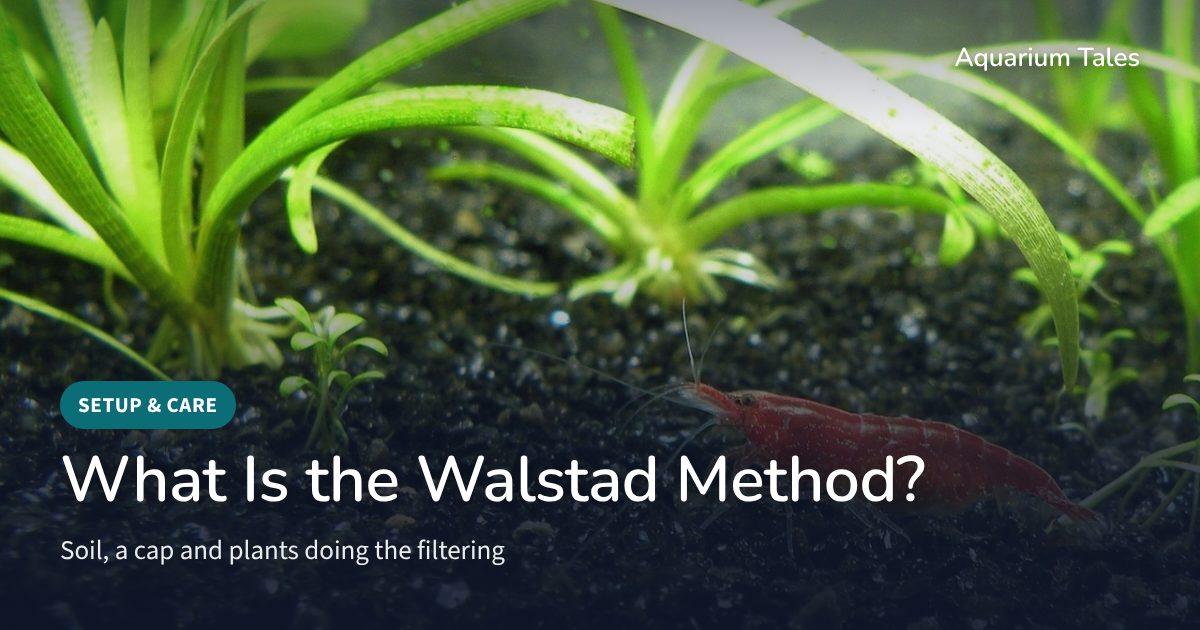
The Walstad method is Diana Walstad’s way of keeping a planted aquarium: ordinary soil under a cap of sand or gravel (how thick varies by source), many plants, no CO2 injection, and far more reliance on plants than on filters to clean the water. Fish food and soil feed the plants. Sources differ on the details.
Walstad set the method out in her book Ecology of the Planted Aquarium, first published in 1999 and now in its fourth edition (2023). More setup guides are in our Tank Setup & Care section.
This page covers freshwater planted tanks. If fish look unwell, test the water and contact an aquatic veterinarian.
What the method is made of
The book’s first chapter (pages 5-6) defines it. “My ‘Low-tech’ aquariums have no artificial CO2 injection,” Walstad writes. “One essential component is a substrate containing ordinary soil. There is a much greater reliance on plants for purifying the water than filters.” She then names who does each job in her tanks:
| Job | In Walstad’s tank | Instead of |
|---|---|---|
| CO2 for plants | Bacteria and fish | CO2 injection |
| Removing ammonia | Plants and soil bacteria | Biofilters, water changes |
| Trace elements | Fish food and soil | Micronutrient fertilizers |
How it works, in her words
Plants take up ammonia. Walstad writes that “aquatic plants have a decided and overriding preference for ammonia” (page 7). The book’s Chapter VI, she says (page 3), presents evidence “that most aquatic plants vastly prefer ammonium over nitrates as their nitrogen source”.
Soil feeds the roots. “Plants need a fertile substrate to grow well and compete with algae” (page 9). Writing about two dry-start shrimp tanks, she adds: “The decomposition of soil organic matter releases copious CO2 into the water.”
How Walstad sets one up
Her free article Small Planted Tanks for Pet Shrimp (updated May 2023) shows each step for a 1-gallon (3.8-liter) glass bowl:
Clean the soil
She takes sticks and larger wood pieces out of bagged houseplant potting mix. She warns that soil with “excessive chemical fertilizers like nitrates and sulfates” will generate toxins such as nitrite and hydrogen sulfide once submerged.
Add a shallow layer and soak it
Two cups of soil go in, to a depth of “no more than 1 inch”, then about 2/3 cup of water. She leaves it overnight so the particles are less likely to float.
Plant, then cap thinly
She covers soil and roots with about a cup of pool-filter or play sand, using only “enough sand to hold down the soil particles”. A thin covering, she explains, is less likely to block oxygen from reaching the soil, “For if the soil becomes too anaerobic, it will kill plant roots.”
Fill gently
She blocks the incoming water with her hand, uses water treated with a conditioner that neutralizes heavy metals, and changes it once or twice until it is reasonably clear.
Wait before adding animals
“Sometimes, I add shrimp right away, but I advise waiting a couple weeks.” Anyone who adds shrimp at once, she says, needs “to closely monitor ammonia levels, prepare for water changes and possibly add aeration for the first couple weeks.”
Her gear for those bowls: an Anchor Hocking 1-gallon bowl, window light plus a 10.5-inch clamp light with a 14-watt compact fluorescent bulb.
Soil depth and cap: the sources differ
| Source | Soil | Cap |
|---|---|---|
| Walstad, 1-gallon bowl | No more than 1 inch | Just enough sand to hold it |
| Buce Plant (retailer) | About 1-2 inches | 1 inch; 1.5 if gravel |
| Aquarium Co-Op (retailer) | 1/8 to 1/4 inch | At least 2 inches of gravel |
Buce Plant warns that sand that is too fine “can prevent some plant roots from reaching the soil or create anaerobic conditions”. Aquarium Co-Op prefers gravel “because gases will form as the dirt breaks down and gravel allows the gases to escape more easily.”
Light, filters and water changes: where sources split
Light. In her shrimp-bowl article (updated May 2023), the bowls had a 14-hour day with a 2-4 hour afternoon “Siesta” of lower light, which she says “regenerates CO2 levels”; a footnote there says: “Plants need a day length of at least 12 hr to mimic summer growing conditions.” Buce Plant: “You should give your plants about 8 hours of moderate light everyday.”
Filters. Of two display tanks she set up for a May 2026 expo, one month after setup, Walstad wrote: “Readers please note that there are no filters or aerators. Do not need them in these tanks with their shallow depth, lots of good-growing plants, and a soil underlayer.” A 20-gallon tank of juvenile cichlids pictured in her book ran with a small hang-on-the-back filter. Buce Plant says “circulation is important” and, in a nano tank, “a must”. Owners in a 2022 r/PlantedTank thread split too: one wrote “Walstad tanks are supposed to be filterless”, and another answered: “They are not meant to be completely filterless, that is completely wrong.”
Water changes. Walstad’s book (page 6) says “my own aquariums often go for six months or more without water changes”. Buce Plant says “you may only have to do a 25-50% water change twice a year”. Tannin Aquatics, a retailer of botanicals, says on its blog that the technique is not meant to “reduce or eliminate water exchanges”. Of her 2023 shrimp bowls, Walstad wrote: “For first 1-2 weeks I have had to change 80% of water almost every day to remove ammonia and nitrites.” She blamed the soil, which “was probably too fertile”.
The first weeks
Walstad warns that “the submergence of any terrestrial soil induces chemical and biological chaos within the soil”, with “a temporary but explosive release of nutrients—including NH3 (ammonia)”, while soil bacteria “pull oxygen out of the water”. In 2026 she wrote: “The first month is always a race against time.”
Waits before adding animals differ:
- Walstad (shrimp bowls): “a couple weeks”.
- Buce Plant: snails within the first week; fish and shrimp once the tank is “fully cycled (~4 weeks)”.
- Tannin Aquatics: “you need to really wait a couple of months or so before adding fishes”.
Test ammonia and nitrite through the first weeks (our test kit roundup compares kits). If either shows up, see how to lower ammonia and why nitrite runs high.
What owners report, good and bad
In the 2022 r/PlantedTank thread, the keeper of a filterless 5-gallon tank with snails and shrimp, running for over two years with monthly water changes, wrote: “I had a lot of algae starting but now it is completely clear. It is a hit and miss and the tank should be very lightly stocked.”
Aquarium Co-Op, a retailer, lists dirt’s advantages as “Great plant growth”, “Very cheap”, “Takes years to run out nutrients in the ground” and “Good option if you won’t ever change the design”. Its disadvantages: “Not as easy or beginner-friendly as planted substrate”, “Makes a huge cloudy mess if you move plants or have bottom dwellers that dig” and “Can lead to toxic ammonia spikes or unsightly algae growth”. On its forum in 2021, the owner of a 55-gallon reported soil seeping through a regular-gravel cap, digging yo-yo loaches throwing soil up, and stem plants dying while swords and anubias did fine; the owner then added a potassium fertilizer.
Commenters in the 2022 r/PlantedTank thread split on how long the soil lasts: one, who runs a planted tank without potting soil, wrote that “they usually don’t run forever” and “can cause toxic Hydrogen Sulfide buildup” after years; another said tanks following her method “run indefinitely without fertilizer or root tabs.” Buce Plant says “The soil will last long”. The 55-gallon owner reported that eventually the “soil nutrients got used up” and switched to an all-in-one fertilizer.
In April 2026, when plants in one of Walstad’s tanks with a potting-soil substrate were “not growing as enthusiastically as plants in the other tank, which were in garden soil”, she inserted frozen cubes of garden soil and pieces of fertilizer sticks into the underlayer: “Good rooted plant growth is key, and fertilizing the water just encourages algae.”
Plants Walstad chooses
In her bowls she used Sagittaria subulata, S. graminea, Echinodorus tenellus, dwarf E. radicans, Bacopa monnieri and Rotala rotundifolia, and “nixed Cryptocoryne species, which can melt down during adjustment to a new environment.” She writes: “I do not recommend carpet plants for beginning hobbyists.” If plants fade, our guide to why aquarium plants die lists what to check.
Frequently Asked Questions
Q. Is the Walstad method the same as a dirted tank?
Buce Plant says the Walstad tank is “more generally known as” the dirted tank. Some owners separate the two: a 2020 Aquarium Co-Op forum member, a fan of dirted tanks, tries to fully mineralize the soil first and does not really follow the Walstad method.
Q. Can I add driftwood or rocks?
In her shrimp bowls Walstad left out driftwood, which she says “would smother the soil layer, decrease the planted area, and possibly leach nutrients into the water.” Buce Plant suggests adding driftwood or rocks for looks.
Q. Do you have to cycle a Walstad tank?
Buce Plant says the method “recommends adding fish once the tank is set up”, but advises testing the water first. On the Aquarium Co-Op forum in 2021, one forum member, replying to a claim that a heavily planted tank needs no cycle, wrote that the cycle works as in any setup, just faster.
Q. Is there a Walstad method PDF?
Her site offers a free PDF sample of the book, “first 23 pages with title page, table of contents, and first chapter”.
Sources (12)
- Diana Walstad (author), Ecology of the Planted Aquarium, 4th ed., 2023: free sample, chapter I, pp. 1-10
- Diana Walstad (author), Fish and Planted Aquariums
- Diana Walstad (author), Small Planted Tanks for Pet Shrimp, updated May 2023
- Diana Walstad (author), 2023 Shrimp Bowls
- Diana Walstad (author), Fertilizing Substrates, 2026
- Diana Walstad (author), One Month after Tank Setups, 2026
- Buce Plant (plant retailer blog), The Walstad Method Tank Guide
- Aquarium Co-Op (retailer), Should I use dirt as my substrate in a planted aquarium?
- Tannin Aquatics (retailer blog), The “Walstad Method” rides again
- r/PlantedTank (forum), Is walstad basically: Put as much plants = Bad elements get sucked up, eternal cycle?
- Aquarium Co-Op Forum (forum), Questions about the Walstad Method
- Aquarium Co-Op Forum (forum), Walstad Method?