The short answer
Unplug all appliances in the tank. Clean the inside glass with a pad, scraper or magnet made for your tank’s material, glass or acrylic, with no sand caught under it. Siphon the loosened algae out in a partial water change, after your heater’s wait, then plug all appliances back in. Wipe the outside with an aquarium-safe glass cleaner.
Aqueon, an aquarium equipment maker, lists glass cleaning as one maintenance task in its cleaning checklist. These steps are for freshwater tanks with fish in them.
Glass or acrylic: match the cleaning tools first
| Tool | Glass | Acrylic |
|---|---|---|
| API glass scraper | Yes | “Do not use” |
| API acrylic scraper | Not stated | Yes |
| Aqueon algae magnet | Glass pad | Acrylic pad |
| Continuum plastic blade | Not stated | Yes, with a test |
| Tunze Care Magnet strong | 15-20 mm glass | “NOT recommend” |
What you need
- A pad, scraper or magnet from the table, kept for the tank. Aqueon: “Don’t use buckets, scrub pads or any other equipment on your aquarium that have been used with soap or other chemicals.”
- A gravel vacuum, a bucket and a tap water conditioner.
- A cloth and an aquarium-safe glass cleaner for the outside.
Three picks from our algae scraper roundup, with its caveats:
- Aqueon magnet (step 4): “Sinks rather than floats if it comes apart”.
- API glass scraper (step 5): “Glass only; Glass Box Diaries is “not a fan” and found the pad pressure hard to judge”.
- Continuum AquaBlade P (step 6): “The soft blade can pick up sand, and soft acrylic can still scratch, per Continuum”.
| # | Preview | Product | Price | Link |
|---|---|---|---|---|
| 1 | 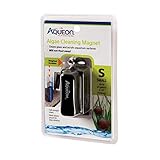 | Aqueon Aquarium Algae Scraper, Fish Tank Magnetic Glass…Weighted magnet, glass or acrylic pad | Check on Amazon | |
| 2 |  | API Algae Scraper for Glass Aquariums 1-Count ContainerPad on a handle, glass only | $8.99 Prime | Check on Amazon |
| 3 |  | Continuum Aquatics AquaBlade P – Acrylic Safe Aquarium…Plastic blade for acrylic | $33.96 Prime | Check on Amazon |
Frequency and water change percentage, by source
| Source | Glass | Water change |
|---|---|---|
| Aqueon checklist | No frequency given | “at least 25%” |
| Aqueon do’s and don’ts | No frequency given | 10% weekly or 25% every two weeks; “Avoid” over 25% |
| API FAQ | “as needed” | 25%, every two weeks |
| hygger | Every two weeks, “a suitable option” | “recommended” 10-15% weekly; “feasible” 20-25% every two weeks |
Aqueon’s two pages differ on the amount. hygger, an aquarium equipment brand (this page is its blog), says “how often you clean is determined by your aquariums, such as the size of your aquarium, fish species, other creatures, and the real-time water condition”, and warns: “But you should avoid cleaning the inside glass frequently, or it will impede the thriving of beneficial bacteria in aquariums and even pose threats to fish.”
How to clean the inside glass, step by step
Unplug before your hands go in
Fluval’s AquaClear filter manual: “Always unplug or disconnect all appliances in the aquarium from electricity supply before placing hands in water, before putting on or taking off parts and while the equipment is being installed, maintained or handled.” Stay unplugged until step 9, then plug every appliance you unplugged back in.
Clear grit off the tool and the glass
Tunze, on its Care Magnet, says “scratches can occur due to adhering particles such as sand or dust” and: “Please ensure before each use that both the contact surfaces of the cleaner and the glass are completely free of contaminant objects.” Stay unplugged until step 9.
Clean the glass, keeping a sharp blade out of the corners
Stay unplugged until step 9. Green Aqua, an aquascaping retailer, writes of an algae scraper with a “sharp stainless-steel blade”: “The algae scraper should not be used in the aquarium corners, as the silicone bonding could be damaged. Therefore, the best practice is to keep a small safety distance of about 0.5cm from the corners.” (About 0.2 inch; our conversion.) And: “When handling the algae Scraper, be careful not to get into contact with the sharp blade. Therefore, it is also highly advisable to keep the algae scraper out of the reach of children.”
Magnet: match it to the glass
Aqueon rates its Small magnet for “glass or acrylic aquariums up to 20 gallons or 1/4″ thickness”; its “bowed bottom design allows the scrub pad to rest above the gravel for easy retrieval while reducing the risk of scratching the aquarium walls.” Its scrubber “will fall straight down if separated”. Titan Aquatic Exhibits, an acrylic aquarium builder: “It’s important to use a magnetic algae scraper appropriate for the thickness of the glass of your aquarium. Using a magnet that may be too strong could damage the acrylic surface.” Tunze, on its Care Magnet strong: “We expressly do NOT recommend using the Care Magnet on ACRYLIC!” Our glass cleaner roundup quotes two magnet makers’ manuals (linked in Sources). AQQA, an equipment brand, opens its AQ208 manual with “WARNING: Do not use stainless steel blades in acrylic aquariums.” and adds: “Please use caution when using this powerful magnetic cleaner, and do not pinch your fingers between the two parts.” “Please keep the magnetic cleaner away from children.” “The magnetic cleaner is unsuitable if you wear a pacemaker or have a defibrillator implanted.” hygger’s 953 manual warns: “Do not use stainless steel blade for acrylic aquarium. Do not put your fingers between the grip and the black scrubber pad, be careful of your fingers being pinched by the cleaner” and: “Please keep the magnet cleaner away from children, due to strong magnetism.” “Please don’t wear pacemakers and implanted heart defibrillators devices when you use the magnet cleaner.” “Please more caution with this very strong magnet, do not put your fingers between the two pads, simply rotate 1/4 turn to separate cleaner.” Reach in for a dropped scrubber only while everything is unplugged. Stay unplugged until step 9.
Pad on a handle: glass only
API: “For glass aquariums only. Do not use on acrylic, Plexiglas, or any surface other than glass. Do not use on dry surfaces. Rinse pad with tap water before and after each use. Caution: If aquarium gravel is picked up on pad, wash off before using since gravel will scratch glass surfaces. Do not use pressure so extreme that scratching or breaking of aquarium glass occurs.” Stay unplugged until step 9.
Acrylic: test the tool first
API, for its acrylic scraper, repeats the dry-surface and rinse lines, then: “Caution: if aquarium gravel is picked up on pad, wash off before using since gravel will scratch acrylic surfaces. Do not use pressure so extreme that acrylic scratches or breaks.” Continuum: “Acrylic safe blade is necessarily soft and can therefore pick up sand or small bits of gravel if shoved too hard down into the substrate.” It says to check the plastic blade “periodically by running a finger or thumbnail across the surface”, and: “Some aquariums are made from low grade imported acrylic that is extremely soft and of very poor quality that can be easily scratched. User must exercise proper judgement in use and should test blade in an inconspicuous area prior to use to insure compatibility.” Stay unplugged until step 9.
Let the algae settle, then siphon it out
Aqueon follows the glass with a gravel-vacuum water change (our water change guide covers it): “The siphon will now be able to suck up the loose algae that has settled to the bottom.” Give the heater its maker’s wait, counted from when you unplugged it, before you drain. Hydor’s support page: “When undertaking water changes Hydor recommend that the heater is turned off and unplugged from the power socket at least 30 minutes before any waterchange.” Its Theo manual: “To avoid possible breakages due to thermal shock, the heater should be disconnected from the power supply at least 5 minutes before taking it out of the water or before adding or changing the water.” Where a maker’s pages differ, as Hydor’s do, or you have no manual, our reading is the longer wait: 30 minutes, Hydor’s longer figure. Stay unplugged until step 9.
Refill with treated water
Aqueon: “add water conditioner to new water and then refill the aquarium. Be sure to match temperatures of the new water with the aquarium.” Stay unplugged until step 9.
Plug every appliance you unplugged back in, once the tank is full and your hands are out
Aqueon: “Plug the filter and heater back in.” Fluval’s AquaClear manual, for its own filters: “Do not allow filter pump to run dry.” After you clean an AquaClear, it adds: “Follow operating instructions to restart and prime power filter.” Hydor: “The Heater can ONLY then be turned back on when the Aquarium is full and the heater is completely submerged.”
If fish look unwell after cleaning, test the water and contact an aquatic veterinarian.
Cleaning the outside glass
Aqueon: “Clean the outside of the aquarium with an aquarium safe glass cleaner.” Fritz Aquatics, a water-care maker that sells its own ammonia-free glass cleaner, says on that product’s page: “Most household glass cleaners contain ammonia or other harsh chemicals that are toxic to fish, reptiles and invertebrates.”
For acrylic, Titan: “It’s recommended not to use vinegar, bleach, ammonia, or alcohol-based cleaners because they could damage the acrylic or harm the aquatic life.”
White lime lines from hard water
Aqueon’s checklist uses vinegar only on parts out of the tank. For the filter’s impeller: “If there is a lot of calcium scale on the magnet, soak it in vinegar for an hour or two before rinsing and replacing.” For the heater: “If there is any calcium scale over the heating element, soak in vinegar to dissolve it away.” Titan rules vinegar out for acrylic (above). None of the makers cited here gives steps for vinegar on tank glass. For the inside of a glass tank, Green Aqua says of its scraper: “Its sharp stainless-steel blade can even make firmly attached lime deposits disappear.” Its corner and blade cautions in step 3 apply, and the magnet makers in step 4 rule out stainless steel blades on acrylic.
For mineral lines on the outside glass, our glass cleaner roundup lists API Safe & Easy, which API says “cuts through white, crusty mineral deposits”, and to “Use according to directions on product label.” The roundup quotes the label’s note on the inside: “When cleaning the inside of empty aquariums, use as directed and rinse aquarium thoroughly before using.” It gives no direction for spraying a tank that holds fish, so the roundup says “we list it for outside panes”, with the caveat “An eye irritant, per API’s safety data sheet”. That sheet: “Causes eye irritation.” “Wash all exposed external body areas thoroughly after handling.” “IF IN EYES: Rinse cautiously with water for several minutes. Remove contact lenses, if present and easy to do. Continue rinsing.” “If eye irritation persists: Get medical advice/attention.”
What not to do
Each of these is quoted above:
- No hands in the water with anything plugged in (Fluval).
- No soap or other chemicals on tank tools (Aqueon); on acrylic, no vinegar, bleach, ammonia or alcohol cleaners (Titan).
- No glass-only tool on acrylic (API, Tunze).
- No grit under a pad, blade or magnet (Tunze, API, Continuum).
- No sharp-blade scraper in the corners (Green Aqua).
Your tool’s label comes first
Where your magnet, scraper or cleaner’s own label differs from these steps, follow it. The rest of the routine: how to clean a fish tank, cleaning gravel, cleaning sand and our Tank Setup & Care section. For algae that keeps returning: how to get rid of algae and why an aquarium grows algae.
Ready to buy?
Our aquarium glass cleaner roundup compares magnets, pads, a pole kit and a spray; our Cleaning & Maintenance section has more tools.
Frequently Asked Questions
Q. Can you use Dawn dish soap to clean a fish tank?
No maker cited here says soap is safe to use on a tank. Titan, on acrylic tanks, says “soaps shouldn’t be used as well because they could create an unhealthy environment.”
Q. Can you clean the glass without taking the fish out?
hygger says “you can clean a fish tank with the fish inside”, since catching them “will bring more stress to them and shock them”.
Q. How do you clean fish tank glass without chemicals?
The inside steps use only a pad, scraper or magnet. The outside cleaner is the only cleaning product, besides the water conditioner for the refill.
Q. What is the best glass cleaner for a fish tank?
Choose by material first, by API’s and Tunze’s cautions. Our glass cleaner roundup gives each pick’s glass and acrylic rating.
Sources (17)
- Aqueon (maker), Aquarium Cleaning Checklist
- Aqueon (maker), Do’s and Don’ts
- Aqueon (maker), Algae Cleaning Magnets
- API (maker), FAQs
- API (maker), Algae Scraper for Glass
- API (maker), Algae Scraper for Acrylic
- API (maker), Safe & Easy and safety data sheet
- Continuum Aquatics (maker), AquaBlade
- Tunze (maker), Care Magnet strong
- hygger (equipment brand blog), How to Clean the Inside Glass
- AQQA (equipment brand), AQ208 user manual
- hygger (equipment brand), HG-953 user manual
- Fluval (maker), AquaClear manual
- Hydor (maker), Theo manual (linked from hydor.com/products/theo) and support page
- Fritz Aquatics (maker), Glass & Acrylic Cleaner
- Titan Aquatic Exhibits (acrylic aquarium builder), How to Clean Acrylic Aquarium
- Green Aqua (retailer blog), Aquarium Glass Cleaning
Product prices and availability are accurate as of the date/time indicated and are subject to change. Any price and availability information displayed on Amazon.com at the time of purchase will apply to the purchase of this product.
