The short answer
Start with your filter’s manual and the direction its water flows. Eheim, Seachem, Aquatop and Fluval’s AquaClear put foam or prefilter media where the water enters. After that, makers differ: Seachem and Aquatop put chemical media before biological media, Eheim’s 2213 manual ends with a fine pad and carbon, and Aqueon starts with bio rings.
Many guides give one order for every filter; the manuals do not agree.
The three jobs filter media do
Each media type does one job, or two. Mechanical media (foam, pads, floss, and Eheim’s ceramic MECH rings) trap particles. Biological media (ceramic rings, porous media such as Seachem Matrix, and foam) give bacteria surface area to live on; Seachem says a liter of Matrix offers as much surface “as 170 liters of plastic balls”. Chemical media (carbon, and resins such as Seachem Purigen) take dissolved compounds out of the water.
Foam can do two of those jobs. Lifegard Aquatics, a filter and media maker, says of sponge media: “The pores capture debris while the surfaces provide space for beneficial microorganisms.” On grades: “Coarser sponges generally have a more open structure that favors flow and captures larger debris. Finer sponges can collect smaller particles but may load up more quickly.”
First, find which way the water flows
Aquarium Co-Op, an aquarium retailer, starts there: “The first step is to look in the manual and find out which direction the water flows through the filter.” Eheim’s classic 2213 manual connects the “suction side on bottom intake nozzle, pressure side on pump head”, so water enters at the bottom. Aquatop’s CF MKII manual sends water down through cutouts in the trays, then up through them, bottom tray first. Seachem says its Tidal pump pushes water “entering through the bottom of the basket and being pushed out the top.” Fluval says water in its FX canisters first moves to the bottom, rises through the foam pads, then passes down through the media trays in the middle.
What filter makers publish, model by model
| Filter (type) | Water enters | Order the water meets |
|---|---|---|
| Eheim classic 2213 (canister) | Bottom | MECH rings, coarse pad, Substrat, fine pad, carbon pad |
| Aquatop CF MKII (canister) | Bottom tray | Coarse sponge and fine pad, carbon, bio balls or ceramic rings |
| Aqueon QuietFlow 200G (canister) | Bottom | Bio rings and balls, carbon, foam pad, then a polishing cartridge |
| Fluval 07 series (canister) | Vertical pre-filter | The factory basket levels |
| Fluval FX (canister) | Bottom, then up through the foam pads | Foam pads, then media trays |
| Seachem Tidal (hang-on-back) | Basket bottom | Sponge, chemical media, Matrix |
| AquaClear 20-70 (hang-on-back) | Basket bottom | Bio-Foam, then carbon and BIOMAX side by side |
Fluval’s 07 manual (107 to 407) says the media “have been deliberately placed in Upper, Mid, and Lower level baskets to indicate their recommended placement for optimal basic filtration”, and “When replacing the media, it is recommended to follow the same order”, unless you are “deliberately choosing a different filtration plan than the recommended basic setup”. It asks you to note the levels as you unpack, and warns: “Never overfill baskets. If baskets or cover are out of position, cover may not close properly.” Fluval’s product page says the vertical pre-filter keeps the media after it from clogging early.
The split is chemical media. Seachem’s Tidal FAQ lists a chemical filter in the middle, under the Matrix, and Aquatop’s manual puts carbon in the middle tray, below the bio balls. Eheim’s 2213 and Aqueon’s QuietFlow run carbon after the biological stage. The guides favor the end. The Spruce Pets, a pet publication, argues that “placing chemical media before the biological media means that what usually feeds the bacterial colonies will be removed prematurely, before reaching them.” Practical Fishkeeping, a UK fishkeeping magazine, says “The carbon should always be a polishing agent at the end of the filtration process, never at the start.” Our guide to what carbon does in a filter covers when to run it at all.
The three filters below, compared in our fish tank filter roundup, come with three different maker layouts.
| # | Preview | Product | Price | Link |
|---|---|---|---|---|
| 1 |  | Fluval 307 Performance Canister Filter for Aquariums Up to…Canister: keep factory levels | $217.99 Prime | Check on Amazon |
| 2 |  | SeaChem Large Aquarium Fish Tank Filter, Tidal 55 Gallon…Hang-on-back: foam at the bottom | Check on Amazon | |
| 3 | 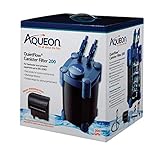 | Aqueon QuietFlow Canister Aquarium Filter up to 55 Gallons…Canister: bio media at the bottom | Check on Amazon |
Fine pad first or last?
Aqueon’s manual describes both camps. Its own layout “places the coarsest media at the bottom (upstream) of the canister with the media becoming finer and finer as you move from upstream to downstream”, and it says: “This is the most ideal way to reduce maintenance on the canister and will function efficiently biologically and chemically as any other method.” The other: “Another popular method is to put the finest mechanical media upstream (bottom) with the biological and chemical media downstream.” Aqueon says that keeps the later media cleaner in theory but traps all debris on one layer and “will require more frequent cleaning of the canister”. Its summary: “None of these are wrong and often are entirely up to the personal preference of the hobbyist.”
The 2Hr Aquarist, a planted-tank retailer, says that with fine foam first, “this layer will clog quickly and requires regular maintenance (every 2 to 4 weeks)”. Eheim’s media page advises ending with fine wadding: “As the final filter layer EHEIM SYNTH should be used in a thin layer up to maximum 10 mm.” A reply in a 2017 Fishlore thread about a Fluval 406 said: “I personally no longer use polishing wool as it clogs too fast but that’s personal preference.”
Hang-on-back filters
Fluval’s AquaClear manual says to “Rinse Bio-Foam thoroughly and place in bottom section of media basket”, with carbon and BIOMAX in the top rear and top front sections. Seachem’s Tidal FAQ starts with “Bottom: Sponge filter for mechanical filtration (included)”.
In a 2018 Fishlore thread, an AquaClear 50 owner who had removed the carbon and added a second mechanical layer found the basket rising: “My bio media (Ceramic balls it came with) is being pushed out of the water.” Replies blamed a dirty sponge; after rinsing it, the owner wrote “I think it was the sponge because it was pretty gunky”, with no later update.
Cleaning and replacing media without losing the bacteria
| Filter or media (maker) | Medium | What the maker says |
|---|---|---|
| AquaClear 20-70 (Fluval) | Bio-Foam | Check and clean monthly; replace every 2 months |
| Fluval 07 series | Bio-Foam | Check and clean monthly; replace every 6 months |
| AquaClear 20-70 (Fluval) | BIOMAX | Rinse monthly; replace every 3 months |
| Fluval 07 series | BIOMAX | Rinse with aquarium water monthly; replace half every 6 months |
| AquaClear 20-70 and Fluval 07 | Carbon | Replace monthly |
| Fluval 07 series | Biological media | Never replace it all at once |
| Eheim classic 2213, pad model | Carbon pad | For start-up; remove after about two weeks |
| Aqueon QuietFlow polisher | Cartridge | Replace if it won’t clean or is over 3 weeks old |
| Seachem Matrix | Biological media | Need not be replaced |
| Lifegard sponge media | Sponge | No universal schedule |
Each replacement interval here is written for its own product. Fluval’s two charts differ for the same media: Bio-Foam every 2 months in the AquaClear, every 6 months in the 07; BIOMAX every 3 months in the AquaClear, half of it every 6 months in the 07. The chart for your model is the one to follow. Seachem says Matrix “need not be replaced” and “may be rinsed when needed without damaging the filter.” Fluval’s 07 manual: “Never replace all biological media at one time, as valuable colonies of beneficial bacteria would be lost.” Lifegard agrees: “Avoid replacing all mature biological media at the same time.”
For media already running, the makers differ on rinse water. Fluval’s 07 maintenance steps say “Rinse biological media with aquarium water, never tap water, or replace as required.” Foams go in “aquarium or de-chlorinated tap water”. Aquatop’s manual says to rinse debris-laden bio balls or rings in clean aquarium water and does not recommend tap water. Lifegard: “To preserve established biological filtration, gently rinse the sponge in water removed from the aquarium during maintenance.” Aqueon’s manual says “Cleaning the media with chlorinated tap water will kill off some of the beneficial bacteria in the biological filter,” then adds: “However, the surfaces within an established aquarium are so heavily colonized with beneficial bacteria, that even a completely sterilized canister filter will recolonize with beneficial bacteria within hours and any effect on water quality will be negligible if at all.” New media is a set-up step: Fluval says to “Rinse baskets and media materials under running tap water to remove any dust”, and Aqueon says media is “rinsed under cold water”.
API, a test-kit maker, says: “In new aquariums, ammonia should be tested every other day until the ammonia level measures 0 parts per million (ppm) or mg/L. In established aquariums, ammonia should be tested weekly to make sure it is at a safe level.” Use the line for your tank, new or established; API’s page does not cover testing after a media change. For a reading above zero, see our guide to what causes ammonia in a fish tank. If fish look unwell, test the water and contact an aquatic veterinarian.
Ready to buy?
Our fish tank filter roundup compares hang-on-back, canister and sponge filters, our canister filter guide goes deeper on canisters, and the Filters & Media section gathers the rest.
Frequently Asked Questions
Q. What is the correct order of filtration?
The guides cited here (Aquarium Co-Op, The Spruce Pets, Practical Fishkeeping) give mechanical, then biological, then chemical. Makers vary, so the order in your filter’s manual is the one to follow.
Q. Can these filters and media be used in a saltwater tank?
Three makers cited here say their products suit either water type. Fluval says its 07 canisters “may be used with fresh or salt water”, Eheim labels its mechanical media “Suitable for fresh and marine water”, and Seachem says Purigen is “designed for both marine and freshwater use”. Our marine canister filter roundup covers saltwater models.
Sources (20)
- Aqueon (maker), QuietFlow Canister Filters instructions
- Fluval (maker), 07 Series user manual
- Fluval (maker), 07 Series product page
- Fluval (maker), FX4 canister filter page
- Fluval (maker), AquaClear 20/30/50/70 instruction manual
- Eheim (maker), classic 2213 manual
- Eheim (maker), mechanical filter media
- Aquatop (maker), CF MKII canister filter manual
- Seachem (maker), correct order of media in the Tidal filter
- Seachem (maker), Tidal filters
- Seachem (maker), Matrix
- Seachem (maker), Purigen
- Lifegard Aquatics (maker), sponge filters and sponge media
- API (test-kit maker), Ammonia Test Strips
- Aquarium Co-Op (retailer blog), What order should I put the aquarium filter media?
- The 2Hr Aquarist (retailer blog), Filter media layout and sequence
- The Spruce Pets (publication), How to Pack the Media in Your Canister Filter
- Practical Fishkeeping (magazine), Be clear about carbon
- Fishlore (forum), Does it matter what order your filter media goes in?
- Fishlore (forum), Media Order Fluval 406
Product prices and availability are accurate as of the date/time indicated and are subject to change. Any price and availability information displayed on Amazon.com at the time of purchase will apply to the purchase of this product.
