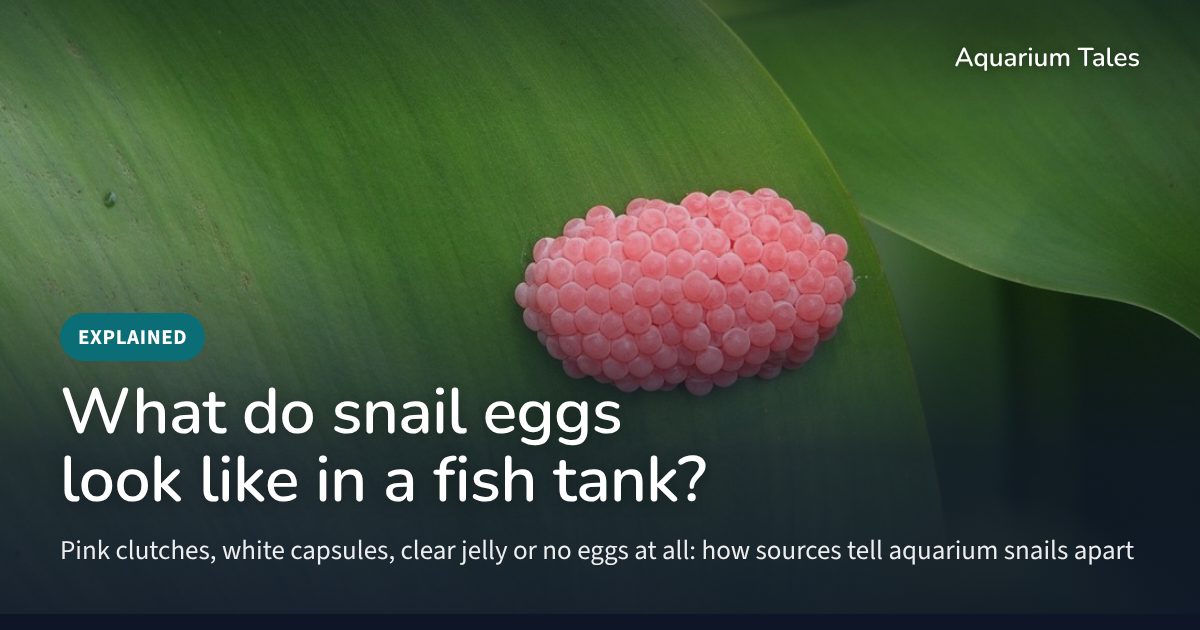
The short answer
It depends on the snail. Aquarium Co-Op, an aquarium retailer, describes mystery snail eggs as a pink cluster laid above the water, nerite eggs as white, sesame seed-like capsules unlikely to hatch in fresh water, and bladder and ramshorn eggs as small dots in clear jelly. Malaysian trumpet snails give birth to live young instead.
Color, shape and where the eggs sit are the clues, and the table below sorts the common aquarium snails by them. Aqueon, an aquarium products maker, notes that “Many snail eggs are transparent and are often attached to the undersides of plant leaves, making them difficult to see.”
This guide covers freshwater snails.
Which Snail Laid These Eggs?
| Snail | What the eggs look like | Where they turn up |
|---|---|---|
| Mystery (apple) snail | Pink cluster like “a giant, elongated blackberry” (Co-Op); “honeycomb-like” (Aqueon) | Above the water line: tank wall or underside of the lid (Aqueon) |
| Nerite | Hard, white “sesame seeds”: capsules holding dozens of eggs each (Co-Op) | Tank walls or decorations (Co-Op) |
| Bladder | “tiny, white dots encased in a blob of clear jelly” (Co-Op) | Tank walls, plants and other surfaces (Co-Op) |
| Ramshorn | Small dots in “a mound of transparent gelatin” (Co-Op) | Plants and other objects (Buce Plant, on pest snail eggs) |
| Malaysian trumpet | No clutch: the young are born live (Co-Op, Buce Plant) | Young look like tiny adults (Co-Op) |
| Assassin | “translucent, square-shaped egg capsules”, one egg each (Co-Op) | Not stated; Aqueon calls them “difficult to see” |
| Rabbit | “a milky white egg pod” holding live young (Aqueon) | Not stated |
Our snail lifespan chart by species covers how long each of these snails lives.
Pink Clusters Above the Water: Mystery and Other Apple Snails
Aqueon says “Mystery snails (Pomacea spp.) are a type of apple snail,” and Aquarium Co-Op names the two sold in stores as Pomacea diffusa and P. bridgesii. Co-Op explains: “They actually lay their eggs above water to prevent predators from eating them.” Aqueon adds that “the female must be able to leave the water to deposit her eggs, which appear as a honeycomb-like cluster on the tank wall above the water line or attached to the underside of the lid.”
Co-Op describes the clutch this way: “The clutch looks like a giant, elongated blackberry that is pink in coloration.” Its size varies with the snail: “Younger females may lay 50–100 eggs, while bigger, mature females can lay hundreds of eggs.”
Writing about clutches kept in a container to hatch, Co-Op says the color can change: “When the eggs are ready to hatch, the clutch changes from pink to a moldy, whitish-gray color.” It calls this “completely normal.”
Other apple snails lay other colors. The University of Florida’s IFAS Extension, writing about the wild apple snails found in Florida, says: “Applesnails lay grape-like clusters of white, green, or pink to red eggs on solid objects above the water line, and this is the quickest way to determine if applesnails are present.”
Note
Apple snails (genus Pomacea, which includes mystery snails) are regulated in some places, and the rules differ. UF/IFAS Extension, citing Florida’s wildlife commission, reports a 2006 rule that may have changed since: “Effective 5 April 2006, USDA-APHIS requires permits for importation or interstate shipment of all marine and freshwater snails.” It adds: “Permits are not being issued for members of the genus Pomacea, with the exception of the spike-topped applesnail, Pomacea diffusa.” Texas Parks and Wildlife, the state’s wildlife agency, lists “All species of the genus Pomacea, except Pomacea bridgesii (spiketop applesnail)” as prohibited, and says of the species on that list: “No person may possess or place them into water of this state except as authorized by the department.” The two exemptions name different species under almost the same common name, and Co-Op calls both mystery snails, so a store’s “mystery snail” label will not tell you which rule applies; check the scientific name. Check current rules with USDA APHIS and your state’s wildlife agency before you buy, ship or give away apple snails or their eggs. UF/IFAS adds: “Never release applesnails from aquaria into the wild.”
Hard White Dots: Nerite Egg Capsules
Aquarium Co-Op’s snail guide says: “While you may see them leave white, sesame seed-like egg capsules on the tank walls or decorations, they won’t hatch in fresh water, so there is no need to worry about them breeding out of control.”
Each dot holds more than one egg. Co-Op’s nerite care guide says the hard, white “sesame seeds” are “actually egg capsules that each contain dozens of eggs inside,” and that the larvae “require brackish or salt water to reliably hatch.” Aqueon: “the larvae require brackish or saltwater to develop, so there is little risk of them overrunning an aquarium.” The sources differ in strength, from Co-Op’s flat “won’t” to its “reliably” and Aqueon’s “little risk,” so hatching in fresh water is unlikely, not impossible.
Clear Jelly With Dots: Bladder and Ramshorn Snails
Co-Op says bladder, ramshorn and Malaysian trumpet snails “are often called pest snails in the aquarium hobby because they reproduce very quickly.” It describes bladder snail eggs: “The eggs look like tiny, white dots encased in a blob of clear jelly and can be found on the tank walls, plants, and other surfaces.” Of ramshorns it says: “Their eggs are similar to bladder snail eggs and look like small dots coated in a mound of transparent gelatin.”
Buce Plant, an aquarium plant retailer, says of pest snails in general: “The eggs are held in clear, jelly-like sacs that stick to surfaces like plants and other objects.”
One snail can be enough to start a colony. Co-Op calls the bladder snail “a hermaphrodite that can reproduce asexually and lay viable eggs, even if there are no other snails in the aquarium,” and says ramshorns are also “simultaneous hermaphrodites.”
Aqueon explains how unwanted snails usually arrive: “The most common ways unwanted snails enter our aquariums accidentally are via eggs or juveniles hitchhiking on plants or decorations, or in gravel cultures transferred from one tank to another.” Our guide to why snails appear in an aquarium covers how they get in and why they multiply.
No Clutch at All: Malaysian Trumpet Snails
Aqueon describes Malaysian trumpet snails as “small, cone-shaped snails,” and you will not find their clutches. Co-Op’s snail guide explains: “The eggs are incubated in the mother’s brood pouch, and once hatched, the mother releases live young that look like miniature versions of the adults.” Aqueon calls them parthenogenetic, “meaning females can give birth to more females without requiring contact with a male.”
The U.S. Geological Survey’s Nonindigenous Aquatic Species database, which lists “Malaysian trumpet snail” as another name for the species, says it can “brood young internally” and that “Juvenile snails are 1.2-2.2 mm in size at birth” (about 0.05 to 0.09 inch; the inch figures are our conversion).
Aqueon says rabbit snails “give birth to live, fully developed young, that are enclosed in a milky white egg pod.” Assassin snails do lay eggs, but Aqueon says they “are transparent and difficult to see.”
What to Do With Snail Eggs You Find
Leaving them is a fair choice: Co-Op says pest snails “are actually quite useful in aquariums” because they eat algae, uneaten food and fish waste. If you want fewer, the sources describe these options.
- Mystery snail clutches. Co-Op says: “If they are clever enough to lay their eggs on the aquarium lid or hood, make sure to remove the egg clusters before they hatch.” To stop new clutches, it suggests keeping one snail, buying a snail under 1 inch (2.5 cm) across because “Females can store sperm for long periods of time,” and keeping “the water level in the fish tank within 1.5 inches (4 cm) or less from the top so that they do not have room to lay their eggs out of the water.” Read the apple snail note above before you give clutches or snails away.
- Nerite capsules. Aqueon sees “little risk of them overrunning an aquarium”; Co-Op gives no step for removing them.
- Bladder and ramshorn clutches. Co-Op says “If you experience a population explosion in bladder snails, you may be feeding the aquarium too much,” and advises: “only feed enough food that can be completely consumed by your fish within a few minutes.” Aqueon adds: “Vacuum gravel regularly and siphon out dead plant material and detritus to eliminate their food supply.” For the adults, Co-Op suggests you “use your hands or a pair of planting tweezers and pick them out one by one,” and Aqueon suggests baiting with lettuce leaves or its own foods: “leave them overnight and remove them with the attached snails in the morning.” Our guide to what aquarium snails eat covers what they eat and how to feed them.
- Malaysian trumpet snails. Co-Op says “Manual removal may not work as well for this species”; because they are nocturnal and burrow, it suggests a trap baited with vegetables or fish food. Aqueon says “cutting back on feeding and vacuuming the substrate regularly will deprive these snails of their food source and keep their numbers down.”
Our guide to getting rid of pest snails without chemicals puts these methods in order.
To keep eggs out, check new plants first. Co-Op says: “Carefully inspect any new plants, and manually remove all snails and snail eggs.” It warns that “Snail eggs can take 1-4 weeks to hatch, depending on the species and water temperature,” so a plant quarantine takes patience. The quarantine periods differ: Aqueon says to quarantine plants “for at least 15 days in a separate aquarium,” and Buce Plant says “a minimum of 2 weeks.” By our comparison, the top of Co-Op’s hatch range, 4 weeks, is longer than both.
Warning
On chemical snail killers, Aqueon says: “While chemicals should always be your last resort and should be used with extreme caution, they can and do work. The problem with chemical treatments is that some are harmful, if not lethal, to plants, shrimp, other invertebrates and certain sensitive fish, so they will have to be removed if you choose this method. In addition, a mass die-off of snails can over-burden your filter and cause ammonia and nitrite levels to rise.” It also says: “Always read package instructions and ingredient lists before using any treatment in your aquarium.” Co-Op recommends “a slow and steady approach rather than using chemical treatments like bleach or aquarium salt,” because “It can be difficult to find an exact dosing concentration that is strong enough to kill snails and snail eggs but won’t harm more sensitive plants like vallisneria or cryptocoryne plants.” After any die-off, test ammonia and nitrite; our guide to what causes ammonia in tank water covers what a reading above zero means.
Whatever you remove, keep it out of the wild. Illinois-Indiana Sea Grant, a university research and outreach program, says: “Never release aquatic plants or animals into waterways!” Its aquarium brochure suggests that you “Find new homes for unwanted pets, such as schools, retailers or other hobbyists,” and that you ask a veterinarian or pet retailer for guidance on humane disposal of animals.
Ready to buy?
If a snail die-off leaves you testing ammonia and nitrite, our freshwater aquarium test kit roundup compares nine test kits, and our Tank Setup & Care section gathers more snail and tank care guides.
Frequently Asked Questions
Q. How long do snail eggs take to hatch in an aquarium?
Co-Op gives 1–4 weeks for mystery snails, “Depending on the temperature,” and Aqueon gives 2 to 3 weeks. Aqueon says assassin snail eggs take 8 to 9 weeks, “depending on temperature.” Nerite eggs are unlikely to hatch in fresh water (see the nerite section).
Q. How often do aquarium snails lay eggs?
For rabbit snails, Aqueon and Co-Op agree on 4 to 6 weeks: Aqueon says “Egg pods are produced once every 4 to 6 weeks,” and Co-Op says “We may see one baby appear about every 4–6 weeks.” For pest snails, Co-Op says they “can only create new babies if they have enough sustenance.”
Q. Are snail eggs harmful to fish?
Co-Op says of pest snails: “These snails will not harm your live fish or plants.” In large numbers, Aqueon says, snails “can place a burden on biological filtration as well as clog filter intake tubes.” If your fish look unwell, test the water and contact an aquatic veterinarian.
Q. What do baby snails look like, and can the filter catch them?
Co-Op says baby mystery snails “come out looking like miniature adult snails.” It advises: “Make sure the aquarium has a sponge filter or pre-filter sponge over the filter’s intake tube, or else the tiny babies may inadvertently get sucked up,” and notes that “They can eat most of the same foods as the adults”; our snail food roundup compares those foods.
Q. Why didn’t my mystery snail eggs hatch?
Co-Op names two needs: “you must have at least one male and one female mystery snail in order to breed them,” and the clutch must stay “warm and humid. Otherwise, the egg casing will harden and dry out, preventing the babies from hatching.”
Sources (10)
- Aquarium Co-Op (retailer blog), Mystery Snails
- Aquarium Co-Op (retailer blog), Nerite Snails
- Aquarium Co-Op (retailer blog), Top 7 Freshwater Snails
- Aquarium Co-Op (retailer blog), Pest Snails
- Aqueon (maker), Types of Aquarium Snails
- Buce Plant (plant retailer blog), All About Pest Snails
- UF/IFAS Extension (university extension), Applesnails of Florida
- U.S. Geological Survey (federal agency), Nonindigenous Aquatic Species: Melanoides tuberculata
- Texas Parks and Wildlife (state agency), Prohibited Exotic Species
- Illinois-Indiana Sea Grant (university program), Aquarium Mollusk Brochure