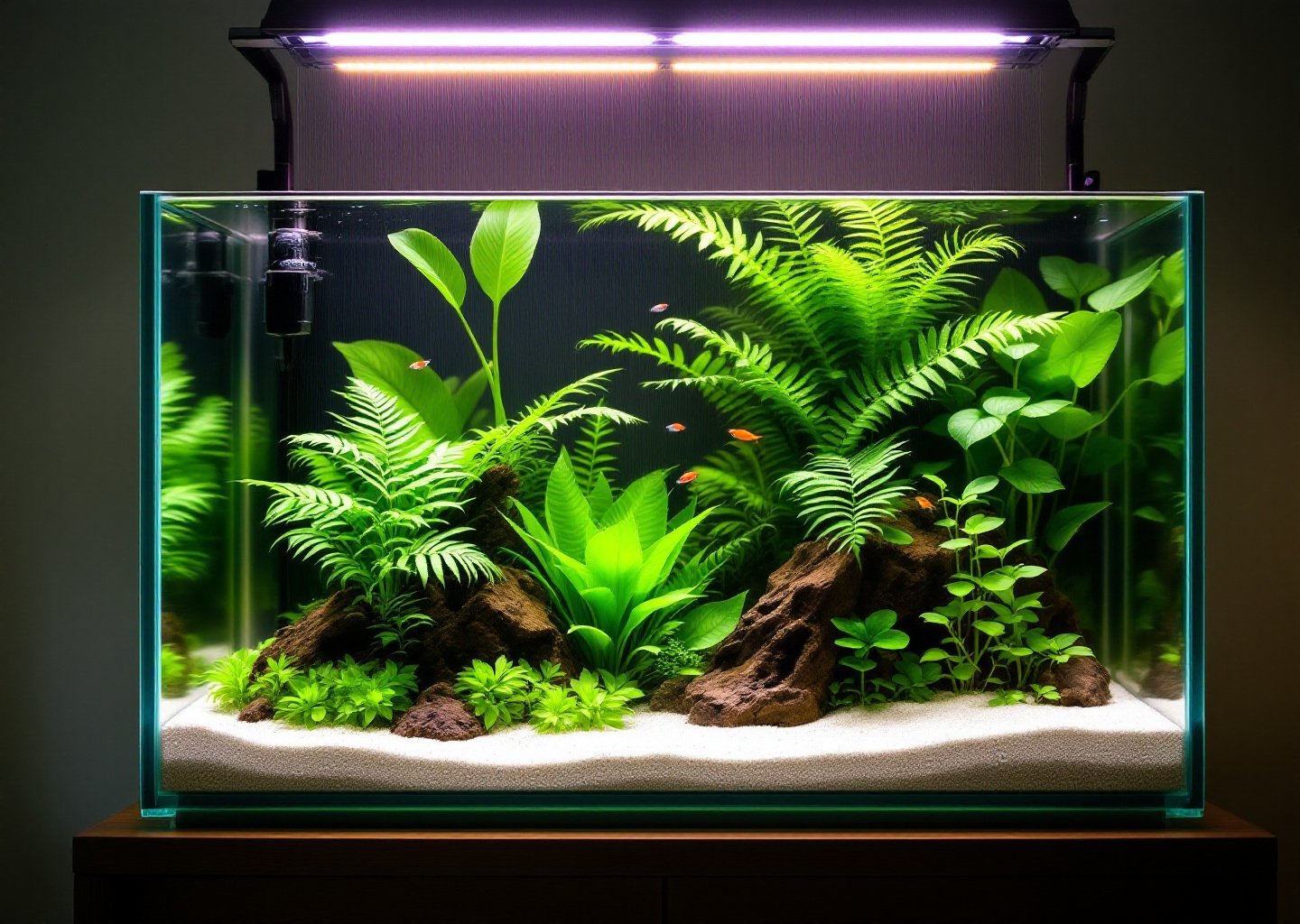
Let me tell you about the moment everything clicked. I was standing in my local fish store, staring at a wall of aquarium lights, completely overwhelmed by wattage claims and marketing buzzwords. The box promised “super bright” and “plant growing power,” but my Amazon sword was slowly melting in my 10-gallon tank, and I couldn’t figure out why. Then a fellow hobbyist asked me a simple question: “What’s your PAR at substrate level?” I had no idea what she was talking about.
That conversation changed how I approach lighting entirely. And honestly? It’s why I’m writing this guide today.
If you’re searching for the best LED aquarium lights for beginners in 2024, you’ve probably noticed something frustrating. Every product claims to be perfect for planted tanks. Every box shows lush, green aquascapes. But here’s what manufacturers don’t want you to know: wattage tells you almost nothing about whether a light will actually grow plants.
I learned this the hard way across my seven nano tanks. What wattage LED light for a fish tank actually matters? Spoiler: it’s the wrong question entirely.
In this guide, I’m going to teach you the one metric that actually predicts plant growth, show you how to match lighting to your specific tank goals, and give you real-world comparisons of the most popular budget LEDs on the market. By the end, you’ll know exactly which light to buy without second-guessing yourself.
What Is PAR and Why It’s the Only Spec Beginners Need to Understand
So what is PAR in aquarium lighting for beginners? PAR stands for Photosynthetically Active Radiation. In plain English, it measures the light energy that plants can actually use for photosynthesis.
Think of it this way: wattage tells you how much electricity a light consumes. Lumens tell you how bright it looks to human eyes. But plants don’t care about either of those things. They care about PAR.
Here’s a comparison that helped me understand it. Imagine you’re trying to feed someone. Wattage is like knowing how much the grocery bag weighs. Lumens is like knowing how colorful the food packaging is. PAR is actually knowing the nutritional content. Only one of those tells you if someone will be well-fed.
LED aquarium light PAR requirements for plants vary dramatically depending on what you’re growing. A low-tech Anubias needs maybe 30 PAR at the leaf surface. A carpet of dwarf baby tears? You’re looking at 100+ PAR, plus CO2 injection.
The good news: you don’t need expensive equipment to make informed decisions. Many manufacturers now publish PAR data, and community members regularly test and share results. I keep a spreadsheet of PAR readings from various Reddit threads and aquascaping forums. It’s been more valuable than any marketing material.
The 3-Tier System: Matching PAR Requirements to Low-, Medium-, and High-Tech Planted Tanks
Understanding recommended PAR levels for low-tech planted tank setups versus high-tech ones will save you money and frustration. Here’s how I think about it:
Low-Tech (20–40 PAR at substrate)
– No CO2 injection required
– Weekly water changes, minimal fuss
– Perfect for: Anubias, Java fern, Cryptocoryne, most mosses
– Budget lights work beautifully here
Medium-Tech (40–80 PAR at substrate)
– CO2 helpful but not mandatory
– More demanding stem plants become possible
– Perfect for: Rotala, Ludwigia, Amazon swords, most foreground plants except carpets
– Mid-range lights or budget lights positioned closer to water surface
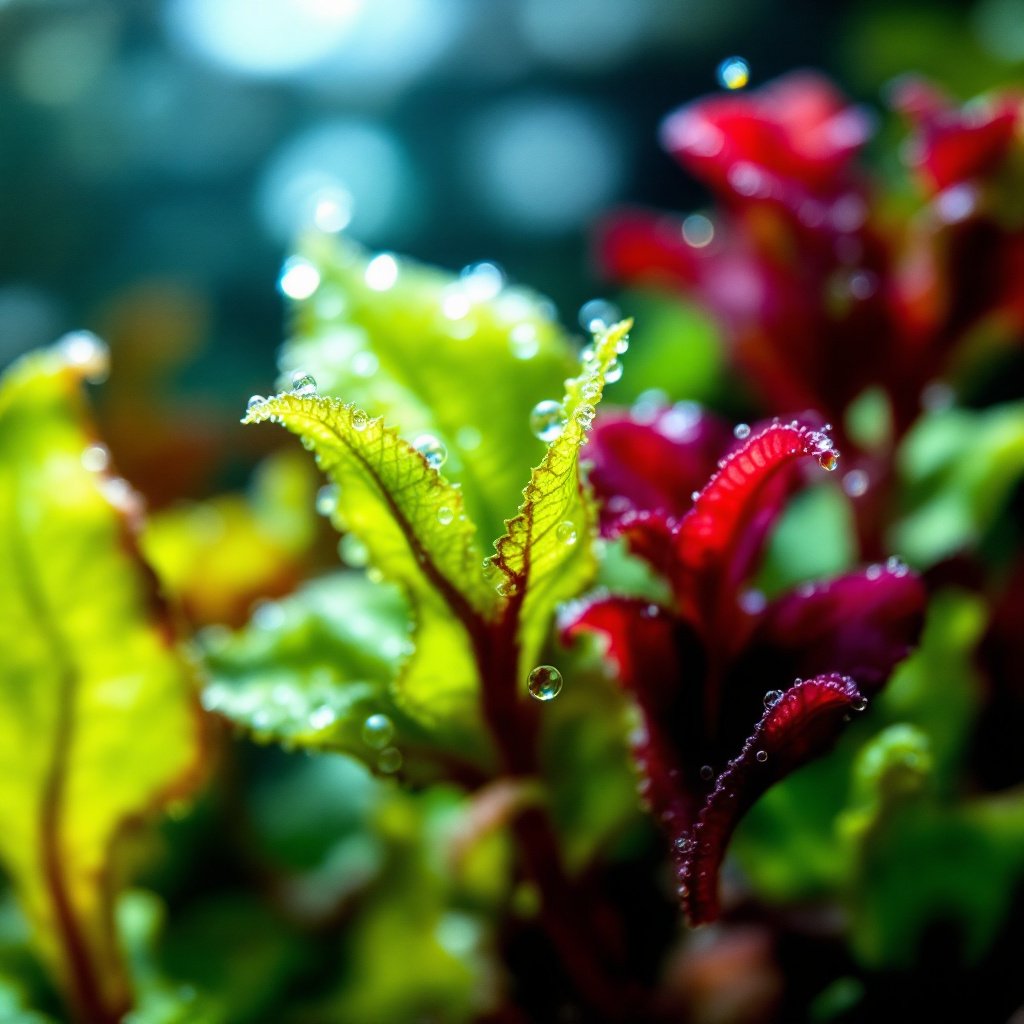
High-Tech (80–150+ PAR at substrate)
– CO2 injection basically required
– Fast growth, more maintenance, stunning results
– Perfect for: Carpeting plants, red plants at their most vibrant, Dutch-style scapes
– Premium lights, often with adjustable intensity
Here’s the thing most beginners get wrong: they buy high-PAR lights for low-tech tanks. What happens? Algae explosion. I’ve been there. My first “upgrade” to a supposedly better light turned my peaceful shrimp tank into a green hair algae nightmare within two weeks.
Start lower than you think you need. You can always raise light intensity, add a longer photoperiod, or position the fixture closer to the water. Reducing excess light while fighting algae is much harder.
LED vs. Fluorescent in 2024: Why This Debate Is Finally Settled for Beginners
Let’s talk about the LED vs. fluorescent aquarium lights comparison. Five years ago, this was a legitimate debate. Today? It’s not even close for most beginners.
LED wins for:
– Energy efficiency (typically 30–50% more efficient than fluorescent T5s, though exact savings vary by specific products)
– Lifespan (50,000+ hours vs. 6,000–10,000 for fluorescent)
– Heat output (significantly cooler, no need for a chiller in nano tanks)
– Customization (many offer adjustable spectrum and intensity)
– Initial cost (affordable aquarium LED lights under $50 are genuinely good now)
– Slimmer profiles that look better on rimless tanks
Fluorescent still makes sense for:
– Specific vintage setups
– Bulk purchases for fish rooms where you already have fixtures
– Certain specialty applications
When I’m helping friends understand how to choose aquarium lighting for planted tanks, I tell them to ignore fluorescent entirely unless they have a specific reason. The technology gap has widened too much. My design-brain also appreciates that LEDs come in sleeker form factors. They don’t visually dominate a clean aquascape the way bulky fluorescent fixtures do.
Head-to-Head: Nicrew vs. Hygger vs. Finnex Budget LEDs (Real PAR Measurements on 20-Gallon Tanks)
Time for the Nicrew vs. Hygger LED aquarium lights comparison everyone asks about. I’m including Finnex because it bridges the budget-to-midrange gap and offers useful context.
All measurements below are community-reported averages for standard 20-gallon high tanks (roughly 16 inches depth) at substrate level. Keep in mind that PAR measurements vary significantly based on testing methodology, and your results may differ.
Nicrew ClassicLED Plus (~$25–35)
– PAR at substrate: Generally reported in the low-light range suitable for undemanding plants, though specific values vary by testing method
– Spectrum: Full spectrum, slightly blue-heavy
– Best for: Low-tech tanks, fish-only setups
– My take: Excellent starter light. I ran these on my first three tanks. Plants grew slowly but steadily. Zero bells and whistles, but reliable.
Hygger Auto On/Off (~$30–40)
– PAR at substrate: Reportedly around 40–55 based on community testing, though results vary
– Spectrum: Full spectrum with sunrise/sunset simulation
– Best for: Low- to medium-tech tanks
– My take: The built-in timer is genuinely convenient. The spectrum feels warmer and more natural to my eye. I noticed slightly better plant growth than with the Nicrew.
Finnex Stingray (~$50–70)
– PAR at substrate: Commonly reported in the 50–70 range by hobbyists, though individual setups may vary
– Spectrum: Optimized for plant growth, slightly pink hue
– Best for: Medium-tech tanks, serious plant growers on a budget
– My take: This is where “best budget LED lights for 20-gallon planted aquarium” actually delivers. I noticed a step up in plant health and coloring. It’s worth the extra $20 if you’re committed to a planted tank.
The full spectrum vs. RGB aquarium lighting question comes up here too. All three above are full spectrum, which I recommend for beginners. RGB lights offer more color customization but can make achieving proper PAR trickier if you’re just starting out.
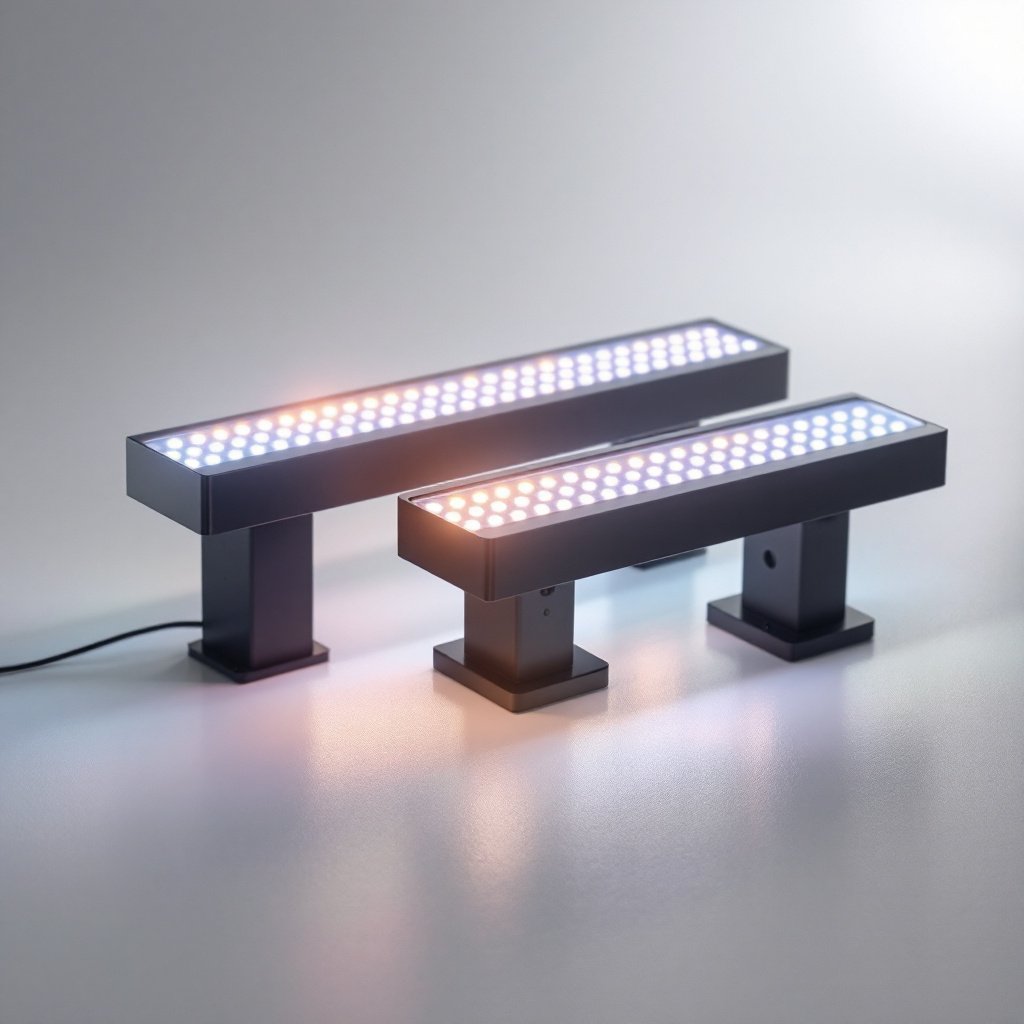
Quick note: How many hours of light for a planted fish tank setup? Start with 6–8 hours daily regardless of which fixture you choose. I use 7 hours on my low-tech tanks and 8 on my medium-tech setups. Increase only if plants show signs of deficiency without algae appearing.
5 Signs Your Current Lighting Is Failing Your Fish and Plants
Not sure if your light is the problem? Here’s what I look for:
1. New plant leaves are smaller and paler than older growth
This suggests insufficient PAR. Plants stretch toward light and produce smaller leaves when they’re starving for it.
2. Brown or transparent patches on leaves (not holes, patches)
This could be lighting, or it could be nutrient deficiency. But if you’re dosing fertilizers and still seeing this, suspect your light.
3. Algae on leaves but not on hardscape
This often indicates light hitting slow-growing plants too long. The plants can’t use it, so algae moves in.
4. Fish seem stressed during “daylight” hours, hiding constantly
Some budget lights flicker imperceptibly. Fish can detect it even when we can’t. Stressed fish often indicate poor-quality LEDs.
5. Red plants turn green or brown
Red coloration requires higher PAR and often CO2. If your “red” plants keep going green, your light likely isn’t delivering what the packaging claims.
I learned sign number five the hard way with a gorgeous Alternanthera reineckii that turned olive drab within a month. After I upgraded my light and added CO2, it became that stunning crimson I originally fell in love with.
You now understand more about aquarium lighting than I did after my first year in this hobby. Let’s put it into action.
Step 1: Identify Your Tank Type
Be honest about your commitment level. Low-tech isn’t a consolation prize. It’s a legitimate, beautiful approach to planted tanks that fits busy lives. low-tech planted tank guide If you’re new, start here.
Step 2: Match PAR to Your Goals
– Low-tech (easy plants, minimal fuss): 20–40 PAR. Look at Nicrew or Hygger.
– Medium-tech (more plant variety, moderate effort): 40–80 PAR. Finnex Stingray territory.
– High-tech (carpets, demanding plants, CO2): 80+ PAR. Save up for Fluval Plant 3.0 or similar.
Step 3: Set a Timer and Resist Overcomplicating
Start with 7 hours of light. Set it and forget it for a month. Observe your plants. Adjust from there.
The best LED aquarium lights for beginners in 2024 aren’t necessarily the most expensive or feature-packed. They’re the ones that match your PAR needs without emptying your wallet or overwhelming you with settings you don’t understand yet.
My final recommendation? If you’re setting up your first planted tank on a budget, grab a Hygger for low-tech or a Finnex Stingray for medium-tech and put the money you saved toward quality plants. The light is just the tool. The real magic happens when you start understanding what your plants need and learning to read their feedback.
Now go forth and photosynthesize. And maybe convince your partner there’s room for just one more tank. I believe in you.