I Killed My First Betta Because of a Test Strip. Here’s What I Learned.
Let me tell you about Gerald. He was a gorgeous halfmoon betta with fins like stained glass, and I killed him within three weeks of bringing him home. Not through malice, obviously, but through ignorance. I trusted a single test strip that told me my water was “fine.” It wasn’t fine. Gerald paid the price, and I’ve been a water testing evangelist ever since.
That mistake, not investing in proper testing equipment, cost me a fish I genuinely loved. So when I finally bought the API Freshwater Master Test Kit, I decided to do what most reviewers don’t: actually use it obsessively for six months, compare it against professional lab results, and document everything. This API Freshwater Master Test Kit review is the result of over 200 tests across my seven nano tanks, and I’m going to tell you things the product page won’t.
Here’s what you’ll get from this article: real accuracy data, not manufacturer claims. Side-by-side comparisons with professional lab testing. Honest talk about the daily usability issues that’ll drive you nuts if nobody warns you first. And finally, a straight answer about whether you should actually buy this thing or save your money.
My testing covered varying tank conditions: a heavily planted 10-gallon, a cycling 5-gallon, my shrimp-only nano, and several others. Different bioloads, different substrates, different challenges. Because one tank doesn’t tell you much.
What’s Actually Inside the API Freshwater Master Test Kit (And What’s Missing)
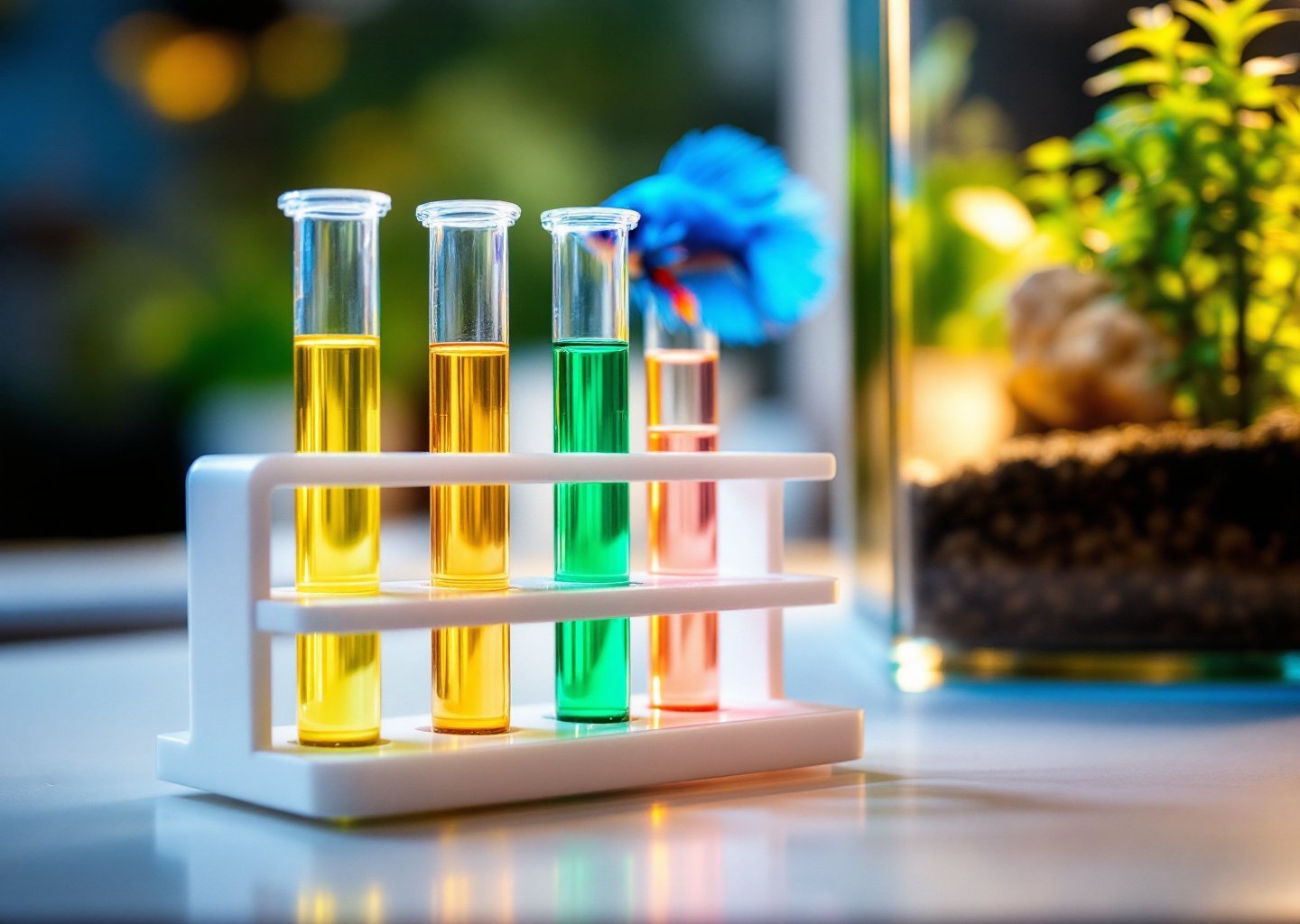
Pop open that yellow box and you’ll find seven bottles of liquid reagent, four glass test tubes with caps, a holding tray, a color card, and an instruction booklet that assumes you’ve never held a test tube before.
Tests included:
– pH (standard range and high range)
– Ammonia
– Nitrite
– Nitrate
That covers your nitrogen cycle basics. understanding the nitrogen cycle You can test for the things that’ll actually kill your fish quickly.
What’s missing, though? No GH test, no KH test, no copper test. For most tropical community tanks, that’s probably fine. For shrimp keepers like me, the absence of GH and KH testing is a legitimate problem. I had to buy a separate kit for those parameters, which added another $15 to my total investment.
Test tubes feel sturdy enough, though I’ve definitely gotten paranoid about dropping them on my tile floor. Color cards are laminated and have held up well after six months of getting splashed with tank water. Small win there.
API Master Test Kit Accuracy: My Results vs. Professional Lab Testing
Okay, this is the part you’re actually here for. Is the API Master Test Kit accuracy good enough to trust with your livestock’s lives?
I sent water samples to a professional aquarium testing lab three times during my six-month experiment. Here’s what I found.
Ammonia Testing:
My API kit consistently read about 0.25 ppm when the lab showed 0.15–0.2 ppm. Close enough. At dangerous levels (1.0 ppm and above), readings aligned almost perfectly. For practical purposes, the ammonia test works.
Nitrite Testing:
Surprisingly accurate. Kit readings matched lab results within acceptable margins across all three tests. No complaints here.
Nitrate Testing:
This one’s complicated. Fresh reagent bottles gave me readings within 5–10 ppm of lab results. After four months, though, I noticed my nitrate readings seemed consistently lower than expected. Shake that second bottle like your life depends on it. I’m talking 30 seconds minimum, bang it on your palm, shake more. Nitrate crystals settle and clump, and if you don’t agitate them properly, you’ll get false low readings.

pH Testing:
Accurate enough for freshwater purposes. Low-range pH test matched lab results almost exactly. High-range showed minor variations but nothing that would affect livestock decisions.
My verdict on API Freshwater Master Test Kit accuracy: it’s reliable enough for hobby use, but it’s not laboratory-grade equipment. You’re paying $30–38 at most major retailers, not $350. Expectations matter.
How to Read API Master Test Kit Ammonia Levels Without Second-Guessing Yourself
The ammonia color card is, frankly, a nightmare for colorblind folks and a challenge for everyone else. Yellow means safe. Green means something is wrong. Those shades between 0 and 0.25 ppm, though? They’ll have you questioning your own eyes.
Here’s how to read API Master Test Kit ammonia levels without losing your mind:
Use natural daylight. Seriously. Bathroom fluorescent lighting will betray you. Take those test tubes to a window.
White background, always. Hold the tube against a blank piece of paper, not your hand, not your countertop, not the color card’s colored sections.
Look straight through the tube. Don’t angle it. Don’t squint from the side. Direct viewing only.
When in doubt, test again. If you’re seeing something between yellow and that first green, run a second test. I’ve had genuine 0 ppm readings look slightly tinted because of minerals in my water.
One trick that saved me: if you’re cycling a tank and seeing persistent 0.25 readings, test your source water too. Some tap water contains trace chloramine that shows up as ammonia on these tests. Knowing your baseline prevents unnecessary panic.
API Test Kit vs. Strips: The Honest Comparison
Look, I get it. Test strips are convenient. Dip, wait, compare, done. Meanwhile, the API Master Test Kit requires separate tests, liquid reagents, waiting periods, and cleanup.
Strips nearly killed my first fish, though. So let’s break down the API Freshwater Test Kit vs. test strips debate properly.
Accuracy:
Strips gave me “safe” readings in water that had 0.5 ppm ammonia. My liquid test showed the problem immediately. Multiple studies have shown test strips can vary by 30–50% from actual values. We’re not talking about a margin of error here. We’re talking about a margin of dead fish.
Cost per test:
API’s kit provides approximately 800 tests total. At typical retail prices of $30–38, you’re looking at roughly 4–5 cents per test. A pack of 100 test strips runs $25–30. So that’s 25–30 cents per test. Math doesn’t lie.
Shelf life:
API states their liquid reagents have approximately a 3-year shelf life from manufacture, though longevity after opening can vary by reagent and storage conditions. Test strips can degrade faster if exposed to humidity. Living in Portland means my bathroom is basically a rainforest. Strips don’t survive well here.
Convenience:
Fine, strips win this one. I’ll admit it. When I’m doing a quick check across all seven tanks, I sometimes wish I could just dip and go. Convenience isn’t worth dead fish, though.

For beginners wondering whether the API Master Test Kit is worth buying: yes, specifically because beginners make mistakes, and liquid tests catch problems before they become catastrophes.
API Master Test Kit vs. Tetra: Which Deserves Your Money
Tetra vs. API comes up constantly in aquarium forums, so let’s address it directly.
Tetra’s kit costs less, usually somewhat cheaper than API at most retailers. You’re getting fewer total tests, though, and color cards are harder to read in my experience.
API’s ammonia test uses two bottles that require mixing. Tetra uses one. Tetra’s is faster. API’s is slightly more accurate at low levels.
Reagent bottle quality: API bottles have better droppers that actually dispense consistent drop sizes. Tetra droppers sometimes glob, which drives me crazy.
Color cards: API’s are clearer, especially for nitrate readings. Tetra’s purple/pink distinctions are genuinely difficult. Like, squinting-in-good-light difficult.
Both work. Both are better than strips. For my money, though, API wins on overall accuracy and longevity. Extra cost is worth it.
Is the API Master Test Kit Worth It for Beginners? My Verdict After 200 Tests
After six months of consistent testing, tank crashes, successful cycles, and one incredible shrimp breeding project, I can tell you confidently: the API Freshwater Master Test Kit is the best freshwater aquarium water test kit for most hobbyists.
Is it perfect? No. Color matching can frustrate you. Nitrate reagent requires aggressive shaking. You’ll need additional tests for GH/KH if you keep shrimp or sensitive species.
Worth the investment? Absolutely.
For beginners specifically, I think it’s actually better than advanced alternatives. Instructions walk you through each test step by step. API Freshwater Test Kit instructions are genuinely beginner-friendly. And learning to test properly teaches you about water chemistry in ways strip results never will.
This kit paid for itself the first time it caught an ammonia spike in my cycling tank. One survival story that compensates for Gerald’s tragedy.
Buy the API Freshwater Master Test Kit if:
– You’re new to fishkeeping and want reliable baseline testing
– You have multiple tanks (cost-per-test becomes ridiculous value)
– You keep sensitive species like shrimp or delicate fish
– You’re cycling a tank and need daily accurate readings
Skip it if:
– You exclusively keep saltwater (get the saltwater kit instead)
– You already own a quality liquid test kit that hasn’t expired
– You only have one very established tank with hardy fish and would rather pay for periodic professional testing
One upgrade worth considering down the road is a digital pH meter. After six months, I bought a $20 pH pen, and it’s become my primary pH testing method. Still use the API kit for nitrogen cycle parameters, though.
This investment has prevented more fish deaths than I can count. It taught me patience, precision, and the importance of trusting data over assumption. Gerald didn’t survive my ignorance, but every fish since has benefited from what I learned after losing him.